20 years of unlocking town past
Dudley was famous for it's chains, Walsall for its leather, Stourbridge for its glass and Wolverhampton for its cars.
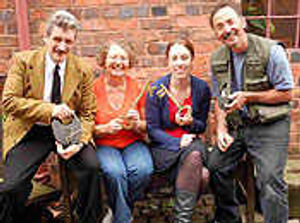
But while other industries are dying out, Willenhall's lock manufacturing is still doing well.
Assa Abloy, the owner of the Black Country's Yale, Chubb and Union brands has recently revealed a rise in sales of nine per cent to £2.3 billion.
"Lockmaking put Willenhall on the map and hundreds of small family businesses evolved as people worked from the back yards of their own houses," says Brenda Jephcott, a member of the advisory panel at the Locksmith's House museum in Willenhall.
"Lockmaking may still be doing well in the Black Country but we must not forget that its success is built on the efforts of the individual lockmakers who thrived over a century ago.
"This year celebrates the 20th anniversary of the Locksmith's House becoming a museum and we are inviting any former locksmiths to the house for the celebrations."
The Locksmith's House recreates what life was like for the Hodson family of lockmakers, who were the last inhabitants of 54 New Road, Willenhall.
The working class family home has a two-storey workshop building in the back yard and a working forge and machinery adds to the atmosphere.
"In Elizabethan times a single lock would take weeks to be finely crafted," says Brenda.
"By the 19th century, workers slaved for hours making locks and keys and often paid for it with crooked backs and deformed fingers – which led to Willenhall being known as Humpshire.
"Some public houses even had holes in the wall behind the wooden bench seats to allow their customers to sit comfortably with their hump in the hole.
"The last example of such a pub, The Bell Inn in Market Street, was demolished in the early 1950s.
"Cheap labour meant locks and keys were also inexpensive and a padlock could be sold for as little as a penny.
"But real mass production didn't arrive until the middle of the 19th century with the advent of the Yale lock."
It was Bilston man, Isaac Mason, who invented a method of pressing lock parts, which led to the decline in lock-making by hand. "The Locksmiths House is like a time capsule showing how the Hodson family lived from the start of the 1900s."
"Edgar was born in 1892 and was the last of the Hodson locksmiths so he inherited the business, Richard Hodson and Sons, when he was 19 years old.
"He took over running the business after his father John died in 1911.
"Edgar was producing a bar padlock, which is sometimes called the Spanish lock, because it was quite unusual.
"He was one of very few locksmiths who produced a bar padlock and experts have shown surprise at seeing it in the museum because it is so rare. Edgar ran the business up until his death in 1970.
"As well as working as a lock maker he also kept pigs and hens and the other passion in his life was his motorbike. Like his sisters he never got married.
"Edgar was a lonesome worker. He was a canny man who looked after his pennies so he wasn't too keen to shell out money on wages."
While Edgar Hodson worked in the factory at the back of the house his sisters Flora and Edith decided to turn the front room into a draper shop.
"The sisters sold clothes, cushions, beauty products, toiletries and the requisites for knitting, crochet and embroidery," says Emma.
"The shop ceased to trade in the 1960s, although Flora may have traded from the back door of the premises as late as the 1970s."
* Celebrations will take place at the Locksmith's House on Wednesday. For more information contact Fiona Carding on 0121 521 5692.
By Cathy Spencer.