Lecturer to unlock secret of sea
Peter Rhodes tells the story of three Black Countrymen involved in the tragedy of HMS M2.
tells the story of three Black Countrymen involved in the tragedy of HMS M2:
They were some of the unluckiest vessels the Royal Navy ever had. Four M-class submarines were planned. Three were built. Two of them sank with all hands in pre-war disasters which horrified the nation.
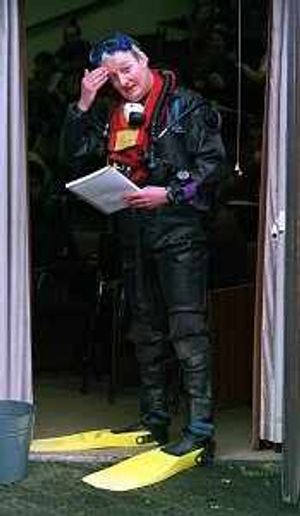
Wolverhampton University lecturer Mike Williams is preparing to unlock some of the secrets of His Majesty's Submarine M2 which went down 75 years ago.
Whether his luck will hold is anyone's guess. Over the past 30 years the 55-year-old has attempted three dives on the wreck of HMS M2 in Lyme Bay and been beaten by bad weather every time.
"I'm looking at the weather now and it's pretty bad again," he says at his holiday base in Portsmouth.
He knows the risks. Secretary of the Nautical Archeological Society, he describes his hobby as "not unreasonably dangerous but potentially dangerous."
He speaks only days after a couple of experienced divers died in the wreck of HMS Scylla off Plymouth. It is believed they ran out of air after becoming lost or trapped deep inside the sunken warship.
"We do not take unnecessary risks," insists Mr Williams, a senior lecturer in law. "If you go climbing, mountaineering or parachuting there are always risks. But this is probably less dangerous than driving to work."
His team's mission to M2 is not to enter the hull - it is a designated war grave - but to film the wreck for later examination.
The divers also hope to attach a buoy from which a flag will "fly" underwater in silent tribute to the British sailors who died on a most unusual vessel.
The loss of M2 was a huge blow to the Roy-al Navy and to Britain. It led to calls for submarines to be banned throughout the world.
Mike Williams says the tragedy was the result of the navy's ambition outstripping its technology. The M-class subs, weighing 2,000 tons and almost as long as a football pitch, were originally fitted with big guns designed to sink ships up to 20 miles away.
All went well until January 26, 1932, when M2 left her base at Portland on exercise. Her last communication was a radio message just after 10am. An hour later a passing coaster noticed a large submarine diving stern first.
HMS M2 was found on the bottom eight days later. The hangar door was open and the aircraft still in it. The accident was believed to be due to water entering the submarine through the hangar door.
Some believe the Royal Navy's crack crew, always racing to beat their previous record for launching the aircraft, opened the hangar door while the deck was still awash.
A rival theory is that the stern hydroplanes, used to hold the vessel at the surface, suddenly failed. This would account for M2 vanishing stern first.
Wolverhampton mourned the loss of one crew member, 28-year-old William Peplow of Napier Road. A sailor from the age of 16, he was part of a crew of 60. Within hours, all were "presumed drowned."
Mike Williams is not the first Black Countryman to visit M2 since the tragedy. Ernest Cox, the legendary Wolverhampton salvage expert who had raised the scuttled German fleet at Scapa Flow, was hired to salvage the huge sub.
"Some historical figures you'd just love to meet, and Ernest Cox is one of mine," says Mr Williams. "He was the best in the world with his salvage expertise."
But bad weather defeated even Cox's genius. On December 8, 1932, his team lifted M2 to within 20 feet of the surface before a gale sprang up, sending her down to her final resting place. The submarine currently lies upright on the sea bed about 90 feet below the surface.
After the terrible loss of His Majesty's Submarines M1 and M2, the crews sent to the sole surviving M-class sub M3 must have had a worrying time. In fact, against the odds, M3 had a long and successful life as a mine-layer. She was sold days after the 1932 M2 disaster and was scrapped a few weeks later.
Mr Williams's dive, a co-operative effort between the Fleet Air Arm, the Submariners' Association and the Nautical Archaeology Society, is scheduled for September 3-6.
Whatever happens, his priority is that HMS M2, having claimed 60 lives, will not claim any more.
"The weather outlook is pretty awful and I'm beginning to have nightmares," he says. "We're prepared to put up with any discomfort but we're not going to push things."