Mystery of canal's wood faces
This is how it must be if you're cruising up the Amazon.
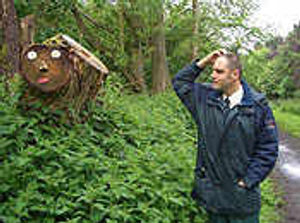
All along the water's edge strange faces stare out from the undergrowth, some friendly, some curious, some shy - and one a terrifying vision standing in a fire-ravaged spot with many limbs and tendrils, and an evil grin.
But there are no unearthly howls, apart from the occasional one from a teenage mobile phoner.
And the insects buzz drowsily rather than chirrup and scrape, for this is no rarely-visited jungle waterway but the Staffordshire-Worcester canal, between the posh neighbourhoods of Newbridge and Compton, in Wolverhampton.
However, there is a mystery to it all; no-one knows where the faces come from.
The first appeared last year, two of them on one forked, fallen tree, swiftly followed by a third. They looked scared but inquisitive, peering from the undergrowth, and low to the ground. They are still there, but have been moved further back, and now resemble a violet by a mossy stone, half-hidden .
Nobody has an idea who is making them.
Mark Game, Ranger at the Valley Park Nature Reserve which runs parallel to the canal, says many people wrongly think his own department is responsible.
"We just don't know who does them," he said. "They just seem to appear. It might be someone local who is a bit of an artist. Whoever does it must come along in the dead of night. It's good fun, though."
Another set of suspects also ruled themselves out. The staff of Groundforce, of Tipton, in their all-metal workboat, who are busy lining the edge of the canal to prevent erosion of its banks.
No, they said, it wasn't them, but they knew who it was; the staff of British Waterways who cut down the trees and lop off the branches in the first place, to stop them endangering or obstructing people on the towpath.
But British Waterways staff were also as puzzled as everyone else. "It's a real mystery," said spokeswoman Sally-Anne Partoon, "The guys on the bank have no idea who's doing it. They say that sometimes the faces appear almost as soon as the branch is chopped off. Perhaps it's a local version of crop circles or something."