Early risers catch dawn chorus
Forget looks or brains – it is accent which separates a Dudley bird from a Wolverhampton one. Forget looks or brains – it is accent which separates a Dudley bird from a Wolverhampton one. "Birds can sing straight out of the egg," says David Hill, a warden at the Wrens Nest Nature Reserve in Dudley. "They learn what to sing depending on where they live and it is like an accent or a local dialect. "A female will want to choose a male with a local 'accent' because she knows he has the best knowledge when it comes to good nesting areas." During a Dawn Chorus Walk at the nature reserve yesterday eight people turned out of their beds for the trek, which started at 4.30am. Standing in the dark ears pricked up, the silence is broken by the chirrup of a Robin. Read the full story in the Express & Star.
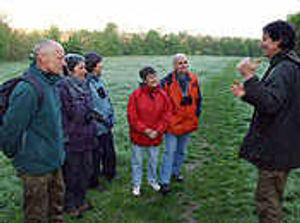
"Birds can sing straight out of the egg," says David Hill, a warden at the Wrens Nest Nature Reserve in Dudley.
"They learn what to sing depending on where they live and it is like an accent or a local dialect.
"A female will want to choose a male with a local 'accent' because she knows he has the best knowledge when it comes to good nesting areas."
During a Dawn Chorus Walk at the nature reserve yesterday eight people turned out of their beds for the trek, which started at 4.30am.
Standing in the dark ears pricked up, the silence is broken by the chirrup of a Robin.
"There is always a great urgency for a bird to announce himself because he is telling a female that he has great breeding potential," says David in a hushed David Attenborough-style voice.
"He is also letting other males know that this is his territory.
"When people hear the dawn chorus they think it is sweet, but actually it is more like War and Peace.
"Birds patrol their own area in the morning singing at 'song posts'. You can get conflict when a rogue bird comes into the area and I have seen birds fall to the ground fighting.
"This happens particularly with robins, who are quite often the first to start the dawn chorus."
David says some birds just sing until it is light while others go on all day and can find it quite exhausting. "The blackbird can sometimes be the first singer and despite being one of our most common birds he makes a lovely sound," he says.
"There are so many birds that it can sound confusing to humans.
"The birds do the same sort of singing at dusk but it is not as intense because the sound carries further at dawn."
David says a 'chew-it chew-it' sound is likely to be a song thrush, the great tit makes a 'teacher-teacher' sound like a rusty wheelbarrow and the cole tit has a 'see-oo see-oo' song.
The Blackbird usually goes 'tic-tic-tic', the chiff chaff says its own name and the green pecker makes a ha-ha noise, called a yaffle.
David says: "The birds don't just sing constantly, they stop to have a listen to everyone else. The wren's song is like machine gunfire and for a small bird it produces a lot of sound.
"However, not all birds are good singers. Woodpeckers are good at thumping pieces of wood and they treat timber like a drum while other non-song birds use their feathers to make a noise when they dive through the air."
On the walk is June Moore, 68, from Coseley, who has been doing dawn chorus walks for five years. She says: "It was something I always wanted to do because you don't always make the most of the natural areas that are close to you.
"I'm retired and I have a big interest in birds, but I feel like I don't know enough about them.
"Getting up early may be tough but it is wonderful to say that you knew which bird started the morning chorus."
Dawn Watkins, 36, and Ricky Bate, 35, from Stourbridge went on their first dawn chorus walk last year.
Ricky, who is an air-conditioning engineer in Coventry, says after the walk finishes at 6.30am he is heading off for a full day at work.
Dawn adds: "As an IT trainer I'm normally stuck in an office but it is good to know what is happening outside."
Connor Welch, aged 13, is on the walk with his mother Wendy before setting off for day at Bishop Milner School.
He says: "It was my mum's idea to go on the walk but I like to go along because when I was little I used to watch birds.
"I find that when I learn about birds in geography I can refer back to these walks."
Peter Parkes, 65, and his wife Della, 65, from Woodsetton often go out on their own for dawn chorus walks.
"This is something we have wanted to do for some time," says Peter.
"I have just retired and these walks help me to pick out the common bird sounds."
Linda Hunt, 48, Sedgley who works in a bank, says: "I have done a number of walks in the past but this was a chance to get out into the fresh air.
"I'm part of the Friends of Wrens Nest and it is nice to come out and be part of what goes on."
David says if people took more notice of birds it would enhance their lives.
"Your garden is more beautiful for having them in it," he says.
"All people have to do is open their window, sit in the garden or go for a walk.
"On a bright, fresh morning I can't think of anything better to do."