Cubs set to be just purr-fect
Cute orphaned twin Amur leopard cubs were today revealed to the public at Twycross Zoo. Cute orphaned twin Amur leopard cubs were today revealed to the public at Twycross Zoo. The cubs are set to become the big attraction at the Midlands zoo over the Easter holidays. The cubs lost their mother Izzy when they were only eight weeks old. It is the first time Twycross has bred Amur Leopards. Diesel, the cub's father, was born at Hodenhagen, Germany, in May 2002. Read the full story in the Express & Star.
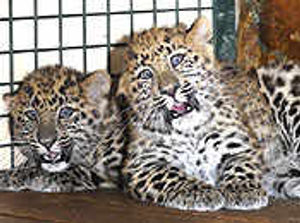
The cubs are set to become the big attraction at the Midlands zoo over the Easter holidays.
The cubs lost their mother Izzy when they were only eight weeks old.
It is the first time Twycross has bred Amur Leopards. Diesel, the cub's father, was born at Hodenhagen, Germany, in May 2002.
Zoo spokeswoman Kim Riley said: "The cubs are extremely shy but they are wonderful.
"They can sometimes be seen playing mischievously with one another and they are certain to be a big hit." The cubs, named Davidoff and Kelvin, could end up weighing 75kg.
Cubs will normally stay with their mother for up to two years before becoming fully independent, but the pair are having to be be reared by hand.
Kim said: "Amur leopards are very distinct from other leopards.
"Their long legs and long hair allow them to survive in cold, snowy climates.
"Their spots are widely spaced rosettes with thick borders. The colour of their fur changes from lighter in the winter to a more reddish-yellow in the summer which makes them very distinctive."
The cubs will also grow into among the most powerful creatures in the world, capable of running at speeds of 37 miles per hour and leaping 20 feet horizontally and 10 feet vertically.
Amur leopards are found in the remote areas of the China-Russia border and also share their habitat with the Siberian Tiger. In the wild, leopards live between 10-15 years but may live up to 20 years at zoos like Twycross.
The Amur Leopards are considered critically endangered with only 30-40 in the wild and 130 in captivity. Their main decline is due to poachers and habitat loss.