Beheading plot foiled
Crime Correspondent Mike Woods examines the background to today's police operation to smash an apparent terrorist kidnap plot.
Crime Correspondent
examines the background to today's police operation to smash an apparent terrorist kidnap plot.
Click here to watch our exclusive video
See also: Terror raid pictures
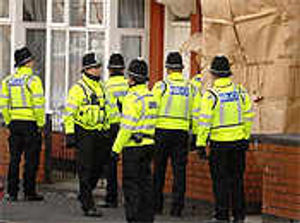
The spectre of terrorism loomed large over the West Midlands today as the region awoke to news of the dramatic police strike.Dozens of uniformed police officers stood guard outside addresses raided in the early morning operation. This afternoon, it emerged that 12 addresses in the second city had been "secured and sealed off".
Police said they were still searching the properties in Sparkhill, Washwood Heath/Alum Rock, Kingstanding and Edgbaston areas of Birmingham .
Today police said the details of the case were "broad ranging". A statement on the force's website said: "West Midlands Police is investigating a number of issues about which we are unable to go into further detail at this stage."
But in a grim twist, security sources said the alleged plot would not have involved mass casualties.
It would, they claimed, have marked "a different approach to terrorism in the UK" - the kidnapping, torturing and execution by beheading of a victim, possibly a Muslim soldier who had served in Afghanistan.
The plan, which was in its late stages, was said to have been a departure from recent al Qaeda-style bombings. High profile alleged plots have targeted transport hubs such as the London Underground and Heathrow jets.
But those arrested today are believed by police to have been involved in a plan to target an individual, a man in his 20s who is now believed to be under police guard at a secret address.
Sources said the would-be kidnappers may have seen the failure of other, more complex, terror plots and opted for a more "straightforward" method.
Those involved would have replicated the tactics used by the killers of Kenneth Bigley and Margaret Hassan in Iraq - playing on the world's fears using the internet as their main tool.
The intelligence community has long believed terrorist "hit lists" of high profile targets are in existence. It is unclear whether the person identified was high profile but he would certainly have been tortured then paraded in front of the world's media with the threat of execution hanging over them.
One source said: "People will find the details rather chilling."
Today's operation was said to have been six months in the planning and involved MI5 as well as West Midlands police officers.
Baswant Kant, who lives in Stratford Road, near the junction with Poplar Road, in Sparkhill, where one of the police raids took place, said he saw a lot of police activity in the early hours of today.
"There were about 55 police officers who turned up in white vans," he said. "They went into shops and restaurants along the road.
"A lot of people got arrested."
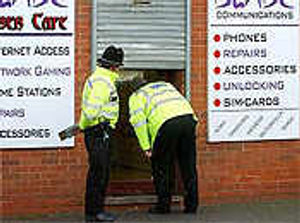
The street is made up of largely residential terraced homes. Mr Jakkula said the majority of houses are ex-council, having been bought by the tenants. Two other areas of police activity were Jackson Road and Foxton Road, both in Alum Rock in east Birmingham.
Shaheda Nazmeen Nessa lives in Jackson Road and her house is within the police cordon. Her street, which leads on to Alum Rock Road, has been closed.
The 20-year-old university student woke up today to find police officers out in force.
"The police were outside the house," she said. "They seem to have blocked off one house in particular on the road.
"There are about 20 police officers and two large vans outside the house, which are blocking the road off."
Jackson Road is a residential area made up of terraced houses.
"I was quite alarmed when I woke up," Miss Nessa said. "My family were all here as well and they are worried and a bit curious about what is going on."
The student, who has lived in the area all her life, said: "It is really quiet, I haven't seen anything like this before."
A resident of Foxton Road said he had stayed awake to watch India play the West Indies at cricket. Then suddenly, at about 4.20am, "lots and lots of police" raided the house next door, he said.
The man said he did not know his neighbour well but was surprised to hear he had been detained in an anti-terror swoop. "I never heard him say anything like that to me," he said. "I can't say that he's that kind of person, but there again, who knows? You can't tell."
The man said his road was in a "very quiet area" where most people were in work.
"I've been here for 15-16 years at this address," he said. "I've never heard anything like this. There are no problems or anything like that."
In a further sign of how seriously the plot was being taken, the skies above the properties involved were declared off-limits to aircraft.
Civil Aviation Authority spokesowoman Janine Aldridge confirmed that the body had received a notice effective from 4am excluding planes and helicopters from the Alum Rock and Sparkhill areas.
There is an airspace exclusion zone in that area," she said. "It covers airspace below 3,000ft over a two-mile radius."
She added that local airmen would have been informed of the restrictions. "We don't know how long they will be in place but the police requested its imposition and it's a reactive thing."
Today's dramatic raids mark the second time this month that the Midlands' links to terror have been thrust into the public spotlight.
Birmingham's radical Muslims were exposed in a TV documentary filmed undercover at the Jamia mosque in Sparkbrook.
More than 20,000 people were evacuated from Birmingham city centre on a Saturday night after police received information about a threat. West Midlands Chief Constable Paul Scott-Lee later said at the time that the bomb disposal experts had failed to find any devices in Birmingham, but he was still 100 per cent certain that information received by officers had been significant enough to warrant the mass evacuation.
"I can tell you that the information we received posed a real threat to the lives of people in the city centre," he said.
"At the end of the day the safety of the 20,000 people in the city was the very top priority to the police." Mr Scott-Lee had revealed that the discovery of two packages - one on a bus in Corporation Street and the other on Broad Street - had been entirely incidental to the threat received by detectives.
The real reason behind the evacuation has never been made public, although reports at the time claimed anti-terror officers had "lost" suspects as they tracked them through the area.
Much of the police's response to terror is shrowded in secrecy.
But two years ago, it was revealed that all officers in the West Midlands were being given a checklist of suspicious activities to help the fight against terror.
Officers from Operation Contest, the force's anti-terror drive, drew up a list of four Ps which cover their role - prevent, pursue, protect and prepare. And West Midlands Police announced that all officers would soon get an "aide memoire" with a checklist of examples of activities which might be regarded as suspicious.
Assistant Chief Constable Anil Patani, in charge of the force's counter-terrorist group, said at the time: "While enforcement activity is a crucial element of any counter-terrorist strategy, the force's approach needs to be comprehensive. Members of the public and other agencies can also play a crucial role, so we are all working together to provide a credible and effective response."
One officer told the Express & Star: "If we get a sniff of anything terrorist related, we pass it on to HQ. That's often the last we hear of it until it's concluded."