Welsh National Opera heading to Birmingham again
[gallery] The Welsh National Opera has been coming to the Midlands for 41 years. Cathy Spencer visits them to find out what it takes to put an opera on tour.
The Welsh National Opera has been coming to the Midlands for 41 years.
visits them to find out what it takes to put an opera on tour.
Over the last four decades, thousands of people have spotted the convoy of Welsh National Opera trailers as they have made their way from Cardiff to Birmingham.
More behind the scenes pictures to the right
Onlookers can only guess at the treasures that hide inside the trailers, which include lavish costumes, intricate sets and delicate musical instruments.
However, what people don't realise is that the company also has to take its own washing machines, tumble dryers, ironing boards, tins of paint and wig ovens with it.
This huge operation may take months of planning, but it doesn't stop the opera company from touring three times a year with its productions, which this spring includes La Traviata, The Marriage of Figaro and Beatrice and Benedict.
Usually the Welsh National Opera is based at the Wales Millennium Centre in Cardiff Bay but says they always look forward to visiting Birmingham.
"Birmingham is like our second home and is very important to us," he says.
"The response we get from people in the Midlands is fantastic and it is the only other place that we head to in the summer, so audiences in Birmingham can see as many of our shows as possible.
"Our touring commitments are an important part of what we do and the work that goes into it is incredible."
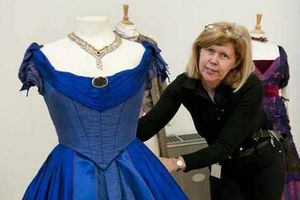
One of the people to go on tour is wardrobe manager Judith Russell who has to make sure all the costumes are in perfect condition for each show.
Items have to be washed, ironed and mended regularly by the wardrobe department and Judith says it can mean a lot of hard work.
"People don't realise that we can have 24 women on stage at the same time and each one has to be laced into a corset and is wearing petticoats, bustles and heavy dresses," says Judith, who has worked with the opera company for 30 years.
"So, we hire 12 dressers who help get the cast into their costumes and they have to get a balance between making the corsets tight enough to fit the fashion of that time, and loose enough for the women to sing in."
Judith says that because they transport their own washing machines the team has had to pick up a few plumbing tips.
"All of us can plumb in a washing machine – it is something you need to get the hang of when you are moving so frequently," she says.
"We have a vast stock of costumes from previous operas that we can use. We have also loaned them to the National Trust and movies such as the recent Sherlock Holmes 2."
The 10-metre-high corridors at the Millennium Centre are filled with racks of colourful costumes and props such as a thunder sheet, which creates a loud rumble when it is moved.
Doors lead off to make-up studios, sewing rooms, rehearsal areas filled with props and pianos and massive scenery storage rooms. Carefully knotting individual hairs on to some netting is Rhiannon Llewellyn who says the wigs department has its own team to ensure they are looked after while on tour.
"Wigs have to be made for each individual, and from measuring a person's head to having their wig finished usually takes seven days," says Rhiannon, 31, who is assistant wig and make-up artist.
"Because artists regularly work with the WNO we are able to use wigs that are years old, but they are still in great condition because they have been so well looked after."
Also on tour are a stage crew involving 19 people which is headed up by a master carpenter. They also employ another 12 casual staff during the tours and they are assisted at each venue by a local team of six technicians.
In the Welsh National Opera carpentry and metal assembly areas is Zena Chandler-Burnell, who was a student at the Birmingham Institute of Art and Design.
"At Birmingham I decided to focus on theatre design and now I'm involved in doing research on the sets and helping to paint them as well," she says.
"When you look at your work on stage it does make you feel proud and we have also done pieces for other shows – we did a lot of the London street scenes for Oliver, which is touring at the moment."
Zena says that set designers create a 1/25 scale model of how they want the set to look and the crew have to get as close to it as possible.
"Some sets will come together easily whereas with others it can take a while to find out what the designer is after," says Zena, 34.
"We take a lot of care of the sets and a team travel with it to ensure it looks as good on the closing night as it did when it opened."
* The WNO will be at the Birmingham Hippodrome from March 6. For tickets call 0844 338 5000 or visit www.birminghamhippodrome.com
Facts behind the touring company:
WNO has a fleet of 14 trailers to transport costumes, lighting and music stands.
Every corset is made in-house to match each individual womans shape.
The sets are built on wheels to make them easy to transport.
Some instruments, such as cellos and percussion instruments, are transported in a special climate-controlled trailer.
The heaviest load is the electrics trailer, which weighs 10 tonnes.
WNO tours three times a year spring, summer and autumn.
The bar area at the Cardiff Millennium Centre was used for a space station scene in Dr Who.
Due to the number of rehearsal and storage rooms at the Millennium Centre the WNO can have three shows running at the same time.