Birmingham SEALIFE turtle surfs over the green veg crises
The recent national lettuce and broccoli shortage signalled dark times for vegetable fans.
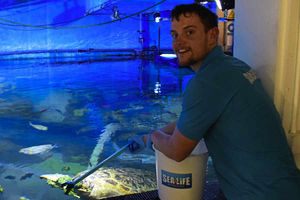
It even meant that one leafy lover at Birmingham's National Sea Life Centre has been missing out on his favourite food.
Now giant green sea turtle Molokai is having to make do with curly kale instead.
The centre's James Cant said: "Mo is one of our biggest creatures and his appetite definitely reflects that.
"It's important he enjoys a varied diet and with the current shortage of his favourite foods we took the opportunity to encourage him to try something new.
"At 40 years old, our veteran sea turtle is very set in his ways and will be the first to make it known if he's not happy. So we were delighted that he really seems to enjoy kale. That is breakfast, lunch and dinner sorted during the lettuce and broccoli shortage."
The green sea turtle has a range which extends throughout tropical and subtropical seas. There are two distinct populations in the Atlantic and Pacific oceans, but it is also found in the Indian Ocean.
The diet of green turtles changes with age.
The young eat fish eggs, mollusks, jellyfish, small invertebrates, worms, sponges, algae and crustaceans. They have a relatively slow growth rate because of the low nutritional value of their diet.
It was announced last week that supermarkets were going to be limiting the number of lettuces each customer could purchase in stores. Iceberg, sweet gem and romaine varieties were not available at all at some online supermarkets.
The shortage was caused by an extreme mix of drought followed by flooding and freezing conditions which had severely affected growers in southern Spain.
Elsewhere in Europe, the poor conditions have also hit farmers in Italy, Greece and Turkey.
But environment minister Lord Gardiner of Kimble insisted that there was 'certainly no crisis' while speaking in the House of Lords on Wednesday.
He pointed out that the shortage only affected iceberg lettuce and not the cos variety, which he said was even better this year.
He also encouraged consumers to 'reflect on using our own wonderfully nutritious British vegetables', pointing out that cauliflowers from Cornwall were coming on to the market.
Visitors to the National Sea Life Centre Birmingham can see Mo for themselves in the attraction's 360 degree ocean tunnel.
For further information, or to pre-book tickets online before your visit, go to SEALIFE.co.uk/birmingham