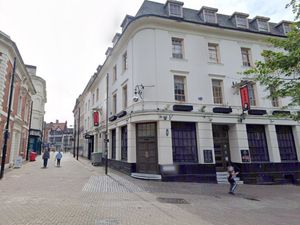
A Tale of Two Cities, Wolverhampton Grand Theatre - review and pictures
The collaboration of The Royal & Derngate Theatres, Northampton and the Touring Consortium Theatre Company has produced some outstanding productions of late and so it was with high hopes that I set out to the Wolverhampton Grand Theatre last night to see their latest offering, Charles Dickens' classic novel, A Tale of Two Cities.
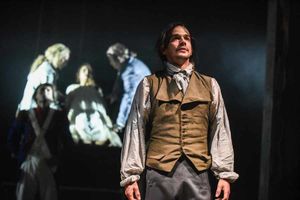
Having read this epic book at school, I was fully aware of the complex plot, though time had erased the finer details. I was therefore hoping that Mike Poulton's stage adaptation would be simplified and would focus on the main storyline, without compromising any of the significant moments of the tale. I could not have been more satisfied.
Depicting the plight of the French people who lived for years under the constraints of the aristocracy in the years leading up to the French Revolution, which resulted in unspeakable cruelty and deaths of the former upper classes, the tale mirrors life in London during the same period of time, hence the title of the piece.
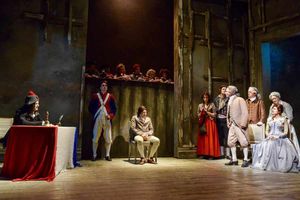
Charles Darnay is saved from the gallows by Sydney Carton, who sets a seed of doubt in the minds of both judge and jury when he points out the similarity in appearance between himself and the prisoner and therefore asks them if they could be absolutely sure if their verdict should be guilty. Darnay and Carton's lives then interweave until Carton pays the ultimate sacrifice for Darnay, but why would he risk life and limb for a man he barely knows?
From the opening scene, you are gripped by the unusual style of this production. The attention to detail in each and every scene to ensure Dickens' perception of this era remains intact is fastidious. The delivery of the script is fast, but coherent and the characterisations extremely powerful and expressive.
The stage appeared very full at times, courtesy of community casting by twelve or so local people who jumped at the chance to appear in this timeless tale, but this certainly created the mob mentality, appearance and mood of the crowds mercilessly surrounding the court room and ultimately the guillotine.
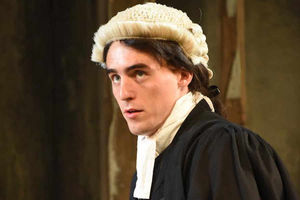
The whole cast is outstanding and extremely hard working as they double and triple up to portray the vast cast of characters required in this play. It therefore seems almost an affront to reference individuals, but Joseph Timms stands head and shoulders above the rest, with a commanding stage presence and dominant performance as Carton.
He is nearly matched by Jacob Ian as Darnay, whose expressive portrayal of the clandestine aristocrat is superb, despite having much fewer lines than Tams.
There is a wonderfully natural performance by Shania Raft as Lucia Nanette and a warm, seasoned portrayal of her servant, Miss Pross by Sue Wallace.
Experience showed in the excellent performances by Patrick Roomer as Dr. Manette, Sean Murray as Barsad and Michael Garner as Lorry, while Rebecca Birch is amusing, ringing every drop of comedy out of her tiny role as Jenny Herring in the opening scene.
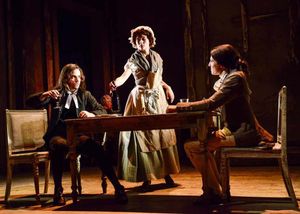
The clever use of regional accents, although completely unconnected to either London or Paris, somehow enhances the characters that portray them, giving certain scenes a modern, contemporary feel which in turn adds to the ambiance of the play.
Ruth Hall's costumes are perfectly contrasting in sumptuous and colourful fabrics and textures for the wealthy and dark, dreary textiles for the poor, further widening the gap between their two worlds, while the authentic scenery which moves from scene to scene with swift ease, transports the audience back in time and stimulates the imagination.
Atmospheric lighting effects establish the mood and feel of each vista, often setting the scene before a word is spoken and the score by Oscar winning composer, Rachel Portman, moves the piece a long seamlessly.
The final scenes are chilling, uncomfortable and thought provoking. What exactly does go through a man's mind as he approaches the guillotine? Let's hope we never find out.
Another triumph for director James Dacre whose exceptional staging, multi-layered but meaningful characterisations and ability to recreate the past to perfection will not only delight devoted Dickens' aficionados, but also ensure that those expected to study the piece for academic reasons will grow to enjoy, understand and definitely learn from, in Dickens' own words "the best play I have ever written."
A Tale of Two Cities is exceptional, powerful drama and completely unmissable.
Runs until Saturday. Call 01902 429212 or visit www.grandtheatre.co.uk for tickets.
By Alison Norton