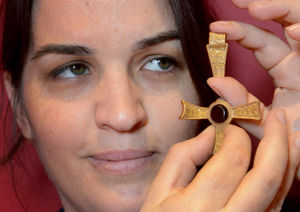
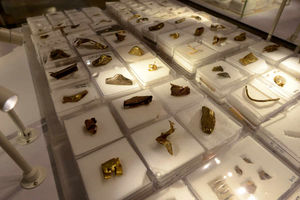
Staffordshire Hoard clean and restored
Conservation has now been completed on the historic Staffordshire Hoard but archaeologists have declared its true secrets may never be revealed.
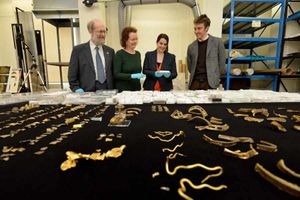
Out of around 4,000 fragments excavated from the ground from a field in Hammerwich in 2009, work to clean and restore the pieces has finished in recent weeks making up 900 or so 'catalogue' items.
Now experts are writing up their findings with a view to publishing a full report in 2018 addressing some of the major questions about the hoard, with why it was buried in the ground being the biggest mystery.
But Pieta Greaves, Hoard Conservation Coordinator at Birmingham Museum, said that may never be answered conclusively.
She told the Express & Star: "The hoard has undergone a major research project being supported by Historic England answering some of those big questions, 'Why is it there?', 'Who put it there?'
"Some questions research won't be able to answer. There will always be a bit of mystery about it which is nice in a way.
"But we are also talking about what the hoard means, how it was made and what it means for the Mercia Kingdom."
The hoard was the largest collection of Anglo-Saxon gold and silverwork found anywhere in the world and was even more remarkable for the fact the vast majority of pieces were military orientated.
Ms Grieves said: "It is all from elite warriors of the Anglo-Saxons. The original theory is still sound. It was probably given to the soldiers by the king who would have expected something back.
"It was all for men. We always assume these beautiful items are for women but they were not. They were objects of power and a real show of strength. It has changed what we thought we knew."
She added: "But it is very interesting to think about the technology of these pieces. How were they making these objects so tiny and so detailed and why? Why would they need to make something so small. The items are very beautiful."
The conservationist said that because the hoard dated back to the late 6th and early 7th century they were delving back into a time of no written record which has proved problematic in researching the origins of the find.
But Ms Grieves also stated while the initial conservation work and research project was moving towards completion, wider research into the Staffordshire Hoard was ongoing with other historians likely to pose different questions about the find.