Firm uses key skills to lock in excellence
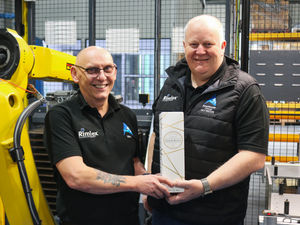
Professor Carl Chinn presents Keith Carrier and Son in Willenhall with a special Express & Star Excellence in Manufacturing Award
Professor Carl Chinn presents Keith Carrier and Son in Willenhall with a special Express & Star Excellence in Manufacturing Award
There are few descriptions of Black Country towns in novels by 19th century authors, but among them is Benjamin Disraeli's an insightful description of Willenhall in his book 'Sybil or the Two Nations' (1845).
Better known as a politician, the younger Disraeli was deeply concerned about the Condition of England problem. Like others he feared for a society increasingly split between rich and poor, north and the south, the old and the new, and the industrial and agricultural.
One of the chief characters in the book is Stephen Morley, who goes to Willenhall, or Wodgate as Disraeli termed it.
The town began as a place where "adventurers" in coal and iron mining had settled because they had freedom there, freedom from landowners and the established order.
Occupations changed as skills were acquired and their reputation for skill and the economy of labour increased so "they have been unmatched throughout the country".
Willenhall was a democratic town where small gaffers dominated the increasingly important lock trade and by 1855 there were 340 workshops in the town.
A generation later a correspondent declared that "more locks of all kinds are made in Willenhall than in any other town of the same size in Europe". However, by the end of the 19th century production was beginning to move into larger units.
As late as 1962 it was stated that 90 per cent of the locks in the land were made in Willenhall. Thereafter that figure dropped sharply in the face of foreign competition in low-wage economies, mergers, and closures.
Yet lock-making continues in Willenhall, with Keith Carrier and Son continuing the craftmanship of small gaffers highlighted by Disraeli more than 150 years ago.
Keith has been involved in lock-making for most of his working life having left school at 15 in 1962 to work at James Gibbons Ltd, Snow Hill, Wolverhampton. At first he was in the lock shop, finishing locks made by the locksmiths.
He was later taught how to make locks from scratch by Bill Oliver, one of Gibbons' most experienced locksmiths. After the firm was taken on by Tube Investment Group, Keith moved to Chubb on the Wednesfield Road as a trainee chargehand, and then to Herbotson's Construction, Heath Town, and Goodyear's tyre factory.
He still aspired to work as a locksmith and finally was able to follow his chosen career at Speedcraft, Bloxwich. Three years later he became a locksmith at Wolverhampton Council and then, after ten years, took the chance to beself-employed in a small workshop in Regent Street, Willenhall.
Main products were hand-crafted toilet locks which were fitted nationwide. Bridgeward cast iron keys, used in churches and the like, were also hand-crafted .
This went hand-in-hand with machine cutting of modern keys, lock opening and general lock and key smithing tasks.
Eventually based in Ward Street, Willenhall, Keith was joined by son Neil. From an early age Neil was fascinated to learn how things worked. Taking anything mechanical apart and putting it back together again, he made bicycles, model cars and aeroplanes.
After school he visited his father's works, drawing on traditions of lock-making, and at weekends made and cut keys and learned how to repair locks. Together Keith and Neil tackled challenges that have thwarted others, investigated ways of making the job easier, and created their own tools.
They designed their own locks, picks, opening and repairing combination locks and high security locks — and are ever keen to increase skills and learn new methods. Together they have a reputation for craftsmanship, innovation and niche products.
Keith and Neil successfully worked with large firms such as Yale and Chubb in developing locking mechanisms forsecurity systems; they design and make locks and keys and can supply a huge range of replacement keys for the plant and construction industry.
They are specialists in lock and key restoration and reproduction as well as architectural ironmongery - skills invaluable for the custodians of older buildings.
Keith and Neil have a high status portfolio of work for places such as Buckingham Palace, Westminster Abbey, the House of Lords, castles, churches and stately homes.
They repaired brasses on the 17ft main staircase at Longleat; made bronze locks and keys for Eric Clapton; refurbished an antique bureau for Randy Lerner of Aston Villa; and reconditioned locks and keys for the Royal Yacht Britannia.
Recently Keith and Neil have repaired and overhauled 250-year-old lock and furniture on the 8ft oak door of the main entrance to Aston Hall, Birmingham.
Another challenge they overcame involved taking a pattern from a 150-year-old safe manufactured by E Cotterill & Co and producing a key to fit the mechanism.
In making locks and keys by hand to the best of their ability, Keith and Neil Carrier highlight the ongoing importance of skill, originality, design, adaptability, dedication and quality in their craft.
In doing so they play a crucial role in maintaining Willenhall's lockmaking fame.