Traditional ironworking company Kirkpatrick targets sales in its 160th year
A historic Walsall ironworking firm is marking its 160th anniversary year with a major push to win more sales at home and abroad.
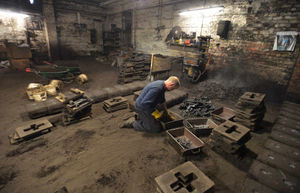
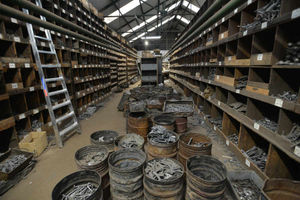
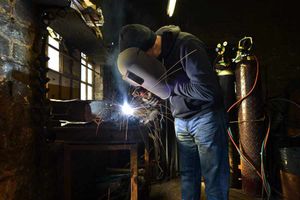
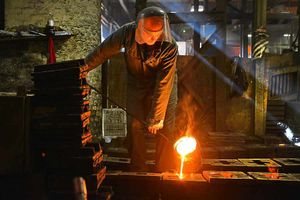
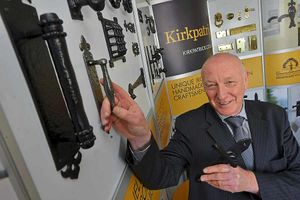
Kirkpatrick has been making high-quality malleable iron castings at its Town Wharf Business Park site since 1855.
It is now the last remaining British company pursuing the traditional methods of making iron door handles and hinges, window locks, letter box slots and drawer handles as well more unusual items.
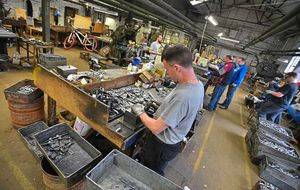
That includes T-shaped manhole cover keys, produced by the thousand. The customer has considered rival manufacturers but none are able to produce keys with the strength and reliability of Kirkpatrick's.
The company's ironwork is sold through scores of stockists around the UK and overseas, but the company is now also aiming to directly appeal to consumers, particularly those looking to carry out some home improvements
"We are hoping that as people see the quality of our products, they will increasingly specify them with their builders when they get work carried out," explained managing director Stephen Preston.
"We are already making components for upvc double glazed window and door manufacturers and, again, we are hoping that as people become aware of our products they will choose them."
As part of its new sales campaign the company is relaunching its website next month and has also produced several new lines of products. It is also experimenting with new finishes, such as glossy black, pewter and its 'Argent' silver in addition to its traditional look.
Mr Preston is hoping it will play a part in Kirkpatrick's efforts to boost exports, particularly to the US market. "We used to sell very well in America, but that was several years ago. We think it is the right time to launch there again."
Meanwhile the company has been working hard to cut its costs after a tough time since the recession, and has invested in several energy-saving projects with the aid of grant support.
The ovens have undergone an £80,000 conversion from oil to gas. "It was a big expenditure but it paid back the investment in two years in the money we have saved on fuel," said Mr Preston.
The company has also invested in a new hi-tech powder coating line and has further plans ahead for reducing its energy bills. It has also embraced the computerisation of its stock control system at the hands of Jim Till, manager of Kirkpatrick's packing department.
The focus on costs is part of Kirkpatrick's response to difficult times for the industry. From a peak of more than 100 staff, the workforce at Kirkpatrick has been cut to around 70 as the company adapted to a drop in sales.
"Our oldest director, who was 93 at the time but has since passed away, said to me he hadn't seen anything like it in his time, even during the war," said Mr Preston.
"The big problem was the building industry. It is our biggest customer so we are quite closely aligned to how it performs. It wasn't so much the lack of new building work but people weren't carrying out refurbishment work on their homes, which is a big part of our sales. And we haven't seen much of a recovery."
Despite that, the company managed a small profit last year and is hoping to build on that this year as it aims at driving up its sales figures.
Kirkpatrick could well be the last remaining traditional ironworking factory in the UK, and it is currently fighting back after the toughest time in its history.
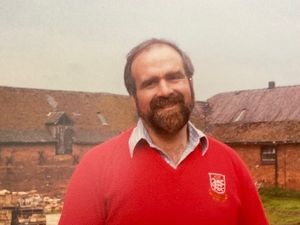
Managing director Stephen Preston has worked at the Walsall firm since joining as an accountant 1982.
The quality of Kirkpatrick's hand-crafted ironwork is key to its appeal and to its ability to combat cheaper imports from India and the Far East, he said. But it is an uphill struggle.
"The stuff our competition is making looks similar, but you only have to pick it up to feel how much lighter and less substantial it is. It is just not as well made."
On a shelf in one corner of the factory is a cardboard box full of rusting doorhandles. "They were sent to us by a customer who was complaining, but if you look at them it's quite apparent they are not ours, they are made by another firm that gives the impression of being made in Britain, but in fact they are made in India or China."
It would be funny if it wasn't so frustrating. "We're going to keep them and have a good look, see how they are made and what from," says Mr Preston.
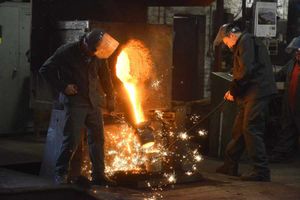
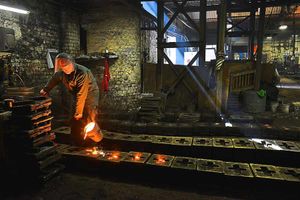
Kirkpatrick makes its products out of malleable iron, which is both stronger and more flexible than cast iron. But the whole process starts melted iron being poured in moulds using the sand casting method – "It dates back to the Ancient Egyptians," says Mr Preston.
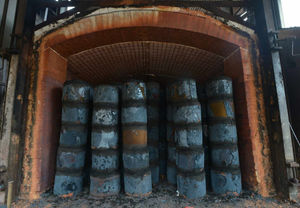
The excess sand is removed from the cooled cast iron parts, which are then placed in special buckets in one of the factory's 'annealing' ovens. They are brought up to heat in the annealing process which changes the structure of the cast iron into malleable iron. This enables it to be hammered and worked in a way that would shatter ordinary cast iron.
"It takes about a week to fill one of the ovens, then it comes up to 975 Centigrade for a week, and then it takes another week for it to cool down so the oven can be emptied," explained Mr Preston.
"We heat three to four tons at a time, and we are using two ovens at a time at the moment."
The heat and fumes from the oven go up the factory's distinctive box-shaped chimney, but all that comes out the top is heat and water vapour. Environmental equipment ensures that no particles or fumes are released into the open air.
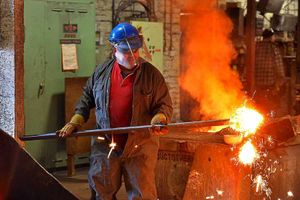
While embracing 21st Century technology, Kirkpatrick is still a firm that relies on traditional skills and methods in making its products, with the finished product relying on the skill and eye of the men and women of its workforce, whether it is the team on the factory floor or blacksmith Tony Evans, in his small workshop in the site's original Victorian buildings.
Kirkpatrick has been based on the same site since it was formed in 1855 by William Kirkpatrick, and the company motto "I mak siccar" – I'll make certain – in the dialect of the Lowland Scots emphasised William's pride in his ancestry.
It dates back to the defeat of Scottish hero William Wallace – made famous by the Mel Gibson movie Braveheart – by English King Edward I at Falkirk in 1298.
It led to John Comyn, Earl of Badenoch, and Robert the Bruce becoming joint Guardians of Scotland. But the two became rivals for the throne. In 1306, at a meeting of Scottish notables at a monastery in Dumfries, Comyn quarrelled with Robert the Bruce, who had supported Wallace. Robert stabbed his enemy and then ran outside shouting: "I doubt (think) I have slain Comyn".
Calling out "I mak siccar" Sir Roger Kirkpatrick, a cousin of Robert the Bruce,ran into the building. Finding Comyn wounded and not dead, Kirkpatrick stabbed him in the heart and killed him. Robert the Bruce went on to be crowned King of Scotland. Much later, in 1685, a descendant of Sir Roger became the Baronet Kirkpatrick of Closeburn in the County of Dumfries.
William Kirkpatrick was descended from a junior branch of the third baronet's line and he became not only a leading manufacturer in Walsall but also a prominent citizen. A JP, he was mayor in 1887, Queen Victoria's Golden Jubilee year.