
I went on a climbing holiday in Russia and faced the KGB and a drone strike scare
Sarah Derry describes how she left her Staffordshire home for an adventure of a lifetime - in war-torn Russia.
When I announced that I was travelling to Russia, in the middle of the war in Ukraine, to climb Mount Elbrus (5,642m), I received a mixture of enthusiasm, concern and the occasional look that suggested people were quietly wondering whether I had finally lost the plot.
Elbrus is the highest mountain in Europe, due to Russia's position as a transcontinental country — and as someone who loves climbing and adventure, it seemed like the perfect challenge, although admittedly, not everyone's idea of a relaxing holiday.
Following my hike to Everest Base Camp (EBC) in 2025, I continued training and, through friends, discovered Performance Hiking, a group run by Natalja Vasina, a Latvian who organises hiking trips to Russia, Turkey, Georgia and Tanzania.
I thought travelling with a Russian speaker would make life considerably easier, particularly when navigating the bureaucracy involved with visas, biometrics and generally trying to convince people that I was visiting Russia for the completely innocent purpose of walking up a very large mountain.

Three mad Brits, three crazy Russians and a slightly nervous airline
Months later, with tried-and-tested kit, plenty of training under my belt and a fistful of US dollars, three mad Brits set off with three crazy Russians for the Caucasus Mountains.
Naively, I assumed the flight would be the least eventful part of the journey.
I woke over the Black Sea to a distress signal and an emergency landing back in Istanbul, due to initial concerns that our plane might have suffered a drone strike. It turned out to be rather less dramatic than that, but at the time it certainly added a little excitement to what was supposed to be a straightforward journey.
Fortunately, we set off again a few hours later and eventually landed safely at Mineralnye Vody Airport in Russia.
Having been awake for more than 26 hours, we must have looked particularly suspicious because two of us failed passport control and spent the next two hours being interviewed by the Federal Security Service (FSB), formerly the KGB.
It is one of those situations where you suddenly feel guilty even when you have done absolutely nothing wrong. My criminal record consists of little more than the occasional parking fine, but sitting there being questioned by Russian security officials certainly made me reconsider my life choices.
With no wi-fi, thanks to the country's near blackout, I was armed with little more than a handwritten note detailing our accommodation and acclimatisation hikes, while Natalja translated. My phone was taken away and examined. This was slightly concerning, not because I had anything particularly incriminating on it, but because I had recently visited the KGB Bar in Bratislava and also had a photograph of myself holding a decommissioned AK-47 in front of an old USSR flag in Prague.
I began wondering whether explaining that these were tourist activities would actually make matters worse. Thankfully, nobody appeared interested in scrolling through the 22,000 photographs still mysteriously languishing in my deleted folder, and eventually I was waved through.
Freedom!
Welcome to Russia
The FSS checked our story with our trusty guide Igor Abdurakhmanov, who had been waiting patiently, and we finally set off on the three-hour journey to the Kabardino-Balkaria, Elbrus region.
The scenery was spectacular, although the effects of the war were apparent, with fuel shortages, no Wi-Fi except in the mountains, and our credit cards and US dollars were of little use because transactions were only in roubles.
Our apartment for the next few days was close to Elbrus, in Neytrino Settlement a Muslim community where the calls to prayer echoed across the beautiful landscape in the early hours. It was a fascinating introduction to a part of Russia that felt a world away from anything I had experienced before.
The following morning we began our acclimatisation hikes.
Our first hike started from a ski resort and took us along Peshiy Marshrut k Ozeru, a relatively empty trail leading to the stunning Donguz-Orun-Kel Lake. It was beautiful, peaceful and — most importantly — involved no passport control.
The following day we hiked through an alpine meadow and nature reserve in the spectacular Adyl-Su Valley to Kurmychi Lake.
We jumped across streams, walked through wildflower forests beside waterfalls and climbed steadily upwards before stopping for a picnic in the sunshine.
Naturally, this was when the weather decided to remind us who was actually in charge. The weather turned, and we had to abandon the hike. The afternoon was therefore spent trying to dry our kit — one of the less glamorous but essential skills of most hiking holidays.
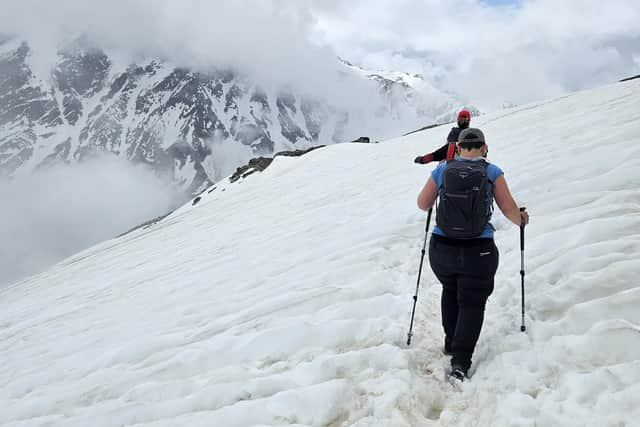
The following day we headed to Cheget ski resort and climbed towards its snow-covered summit, which had been teasing us all day poking through the cloud and rain.
Igor had planned a series of varied and increasingly steep climbs to prepare us for Elbrus. The next day we walked through a dense pine forest, crossed a river in the Kogutay Valley and finally reached a summit where we got our first glimpse of Elbrus, which looked imposing; enormous.
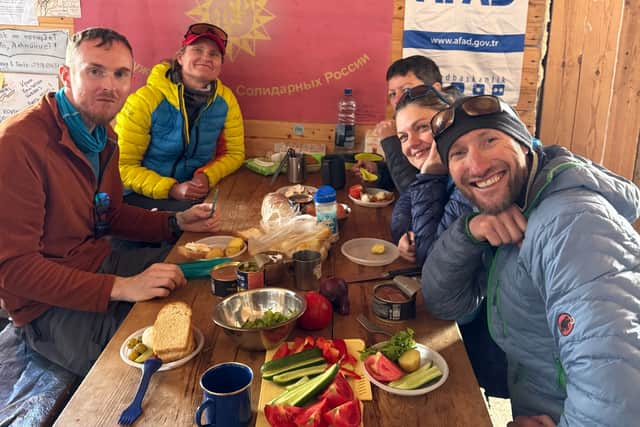
Each evening we ate in a local restaurant, where the homemade food arrived in hearty portions with trout, rabbit, venison and whatever else had apparently been caught that day on the menu. After several days of hiking, eating and trying to convince ourselves that this was all part of a sensible training programme, it was time for the main event.
The Eagle's Nest
Before transferring to the Elbrus area, we hired our climbing equipment from well-equipped local shops. Then came the rather complicated journey transferred ourselves and all our equipment to our refuge by car, coach, gondola and finally snowcat. It was less transfer to accommodation and more The Crystal Maze.
Our home for the next few days was the "Eagle's Nest" refuge.
Anyone who has climbed will know that mountain refuges tend to be basic. This one certainly lived up to expectations. The six of us shared a room, electricity was available for just two hours a day and the toilets were long drop.
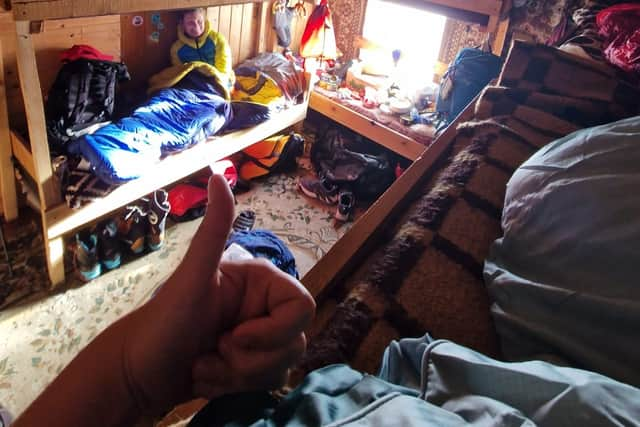
Food wasn't provided, but we were lucky to have a chef; Marc in our group who we helped with the prep, whether he wanted us to or not. Snow had to be collected and melted whenever we wanted hot drinks.
The owner was friendly and welcoming and was quite literally a self-made man. He had built much of the refuge by repurposing whatever materials were available. The bunk above me had been made from a recycled door. Another was constructed from a metal ladder. At this point, I decided not to ask too many questions about structural integrity.
The refuge's greatest advantage was its location. It was the closest accommodation to Elbrus and had uninterrupted views of the mountain.
And what a view.
Learning to fall
The following morning we brushed up on our crampon skills and aimed to reach a rocky base at the foot of Elbrus in under four hours.
This was our test to see whether we were capable of tackling the full climb.
Despite the steep terrain, we all made it in under three hours.
We celebrated by watching the wind swirl around Elbrus like a miniature tornado — a useful reminder that the mountain was still in charge and wasn't particularly interested in our schedule.
Elbrus is notorious for harsh and rapidly changing weather. Its twin-coned dormant volcanic peaks can attract sudden storms, and we had already been made aware that two climbers had died during the week of our ascent.
The forecast for our summit day, however, was looking promising.
The following day was supposed to be our rest day. Naturally, we woke to thunder and lightning, but the weather cleared by midday, giving us the opportunity to refresh our skills: climbing knots, using ropes and carabiners correctly and, perhaps most importantly, learning how to slow a fall using an ice axe.
Igor shouted "GOOD" or "DEAD" depending on our performance as we practised while roped together. Given the recent deaths on the mountain, the exercise was sobering, and it certainly concentrated the mind. You really don't want your guide shouting "DEAD" at you when you're attached to an ice axe.
After an afternoon meal and some rest, we prepared for the summit attempt and just after midnight, Igor meticulously checked us and our equipment and we set off.
Summit night
There is something strangely exciting about starting a major climb in the middle of the night.
You are tired before you start, slightly nervous, wearing far too many layers and wondering why you voluntarily paid to take on this adventure.
All our acclimatisation hikes had been steep, but the section from Pastukhov Rocks at 4,800m to the Slanting Shelf at 5,000m seemed particularly relentless.
We climbed at around a 20-degree angle for 1.5km, guided only by the beams of our headtorches. It seemed to go on forever, but we eventually reached the Traverse Path.
It is difficult to decide whether it is better to see the enormous drop beside you or remain blissfully unaware of it because your headtorch only illuminates the few metres in front of you. Either way, we eventually reached slightly flatter ground. Unfortunately then one of our group began showing signs of altitude sickness.
At altitude, things can change very quickly, and safety always comes first. We decided the safest option was for everyone to head towards the eastern summit, where there was an emergency shelter, rather than continue towards our original objective of the western summit.
This was a good reminder that mountains don't care about your plans. You can have the perfect training programme, the best equipment, the most detailed weather forecast and a beautifully organised itinerary. Mother Nature simply looks at all of that and says, "That's nice."
Four go up
Four of us, including our guide Igor, continued towards the summit, while staying in regular radio contact with the two members of our group in the emergency refuge. The wind was blowing hard and buffeting us around, but we continued upwards. The summit seemed to involve a remarkable number of "just another five minutes", which incidentally, appear to last considerably longer at 5,000 metres.
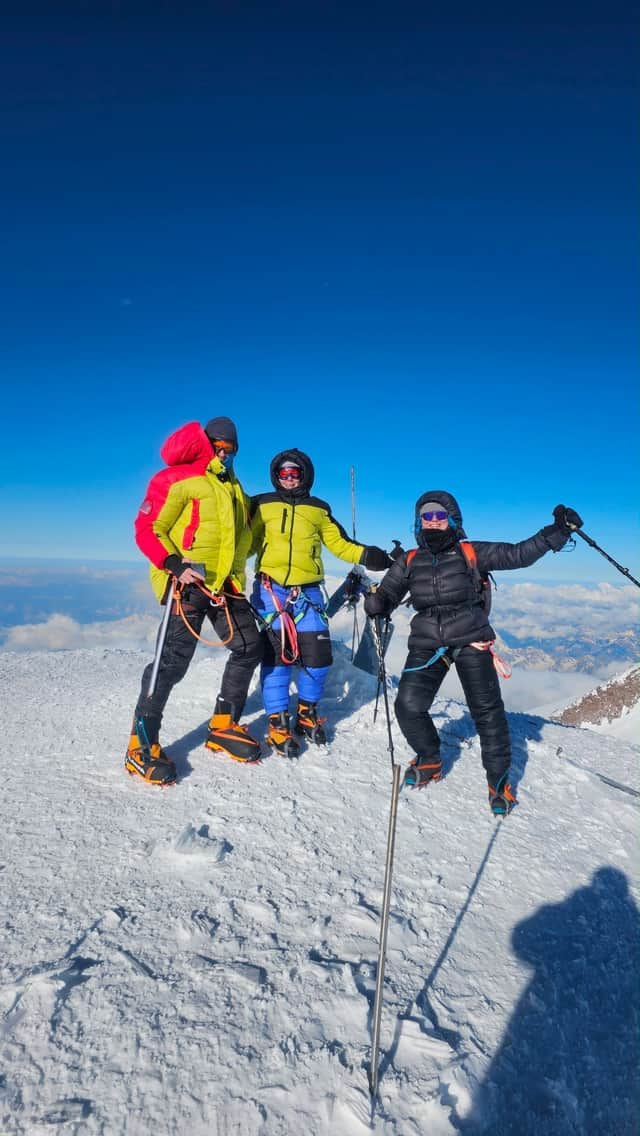
Eventually, we reached the top and it was spectacular. We were treated to a sun-soaked view across the hugely underrated Caucasus Mountains — a breathtaking panorama that we had entirely to ourselves.
After all the training, preparation, bureaucracy, cancelled flights, FSS questioning, bad weather, crampons and the occasional moment of wondering whether this had been a sensible idea, we had made it. It was an unforgettable moment.
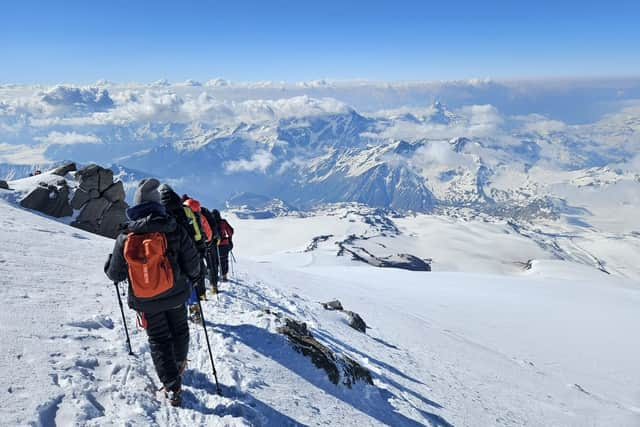
After savouring the moment we descended to the emergency refuge and were delighted to discover that our friend had recovered sufficiently to hike down the mountain with us.
Tired but elated, we finally had the chance to appreciate some of the spectacular scenery as dawn broke.
There is something particularly satisfying about watching the sunrise from a mountain after spending most of the night wondering whether your legs will continue to function.
Back to Civilisation
After arriving back at the Eagle's Nest, we packed our bags, had a quick drink and began the journey down via gondola. Civilisation was getting closer. We had a celebratory lunch before the long drive back to Mineralnye Vody, a beautiful spa town which we explored the following day "taking the waters" and walking around the lake, which after several days of climbing with only the basics felt positively decadent.
Our final day included one last "small" hike — although, at just a little higher than Ben Nevis, the Russian definition of small is clearly very different to the English one. Then it was time to say goodbye to our hiking buddies, with hugs, photographs and, inevitably, discussions about our next adventure.
The current plan? Mount Kazbek in Georgia, because apparently climbing one of Europe's highest mountains wasn't enough to satisfy us.
Looking back
Looking back, this was certainly not a conventional holiday, with moments of genuine concern, particularly during the flight, the FSS questioning and the summit attempt. Mountains demand respect, and the altitude and weather made it essential to be prepared to change our plans.
However there was also incredible scenery, wonderful food, fascinating culture, the warmth of the Russian people, great companionship and the satisfaction of achieving something that, at times, seemed considerably easier on paper than it did at 5,000 plus metres.
Travelling to Russia during such a difficult period was inevitably going to attract questions, and I completely understand why.
For me, the trip was about adventure, mountaineering and experiencing a part of the world I had never previously visited. It certainly fulfilled all three — along with a few experiences I hadn't ordered.
Would I do it again? Absolutely.
Although next time I will remember to delete those 22,000 photographs first.
Sarah Derry
Insta Sarahsmadadventures
Insta Performance_hikinguk