
Black Country voices brought to life through poetry - review
Black Country women in Waterstones - Midlands Fringe
Poems of Black Country life and history
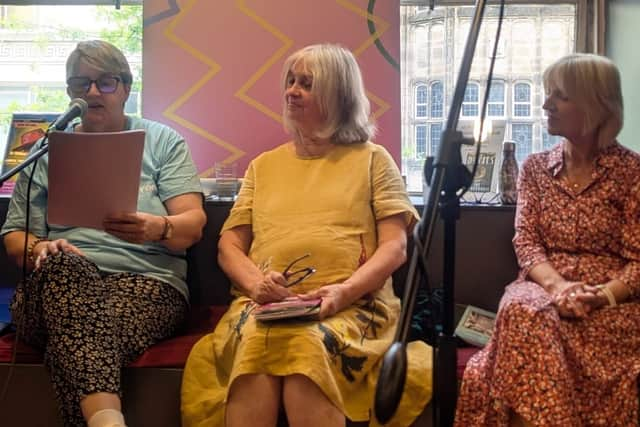

Marion Cockin, Anne Babbs and Jane Salmons marked Black Country Day with poems celebrating Black Country life and history.
From Mary Macarthur and the chain-makers of Cradley Heath, via the ‘Wednesbury Mangle Theory’, to the more intimate realities of life today, this was poetry filled with fun, warmth and connection.
Marion, Anne and Jane all have strong Black Country roots and a great love for the area, both past and present.
Fight for your birthright of Black Country pride
It was Anne Babbs who referenced pride in the Black Country, taking listeners back to memories of family homes and teenage experiences many could relate to:
‘I was the 529, he was the 310. We’d have a Wimpey then walk to the Arbo’.
The line could almost have been sung by Jarvis Cocker. Or perhaps Jonny Cole.
Stourbridge lass Jane Salmons spoke about the lauded trade unionist Mary Macarthur, who travelled from Scotland in 1910 to witness the dreadful conditions endured by the women chain-makers of Cradley Heath.
She led the women in a strike that resulted in victory in their fight for a minimum wage. The poem Jane went on to read was sobering, referencing babies being kept in crates, with sparks flying around them as their mothers toiled.
The protections and rights enjoyed by workers, and by women, were hard-won and must be guarded fiercely.
Jane’s grandmother was called Mercy Fisher – a wonderfully exotic name for late nineteenth-century Lye. She lost her 25-year-old husband to Spanish flu and had to work to provide for their three daughters.
She worked in a brickyard and, by all accounts, ‘had shoulders like an oss and er’d walk barefoot’.
With the World Cup closing, Marion Cockin was strident about Jude Bellingham being from Stourbridge and so, yes, Stourbridge is very definitely in the Black Country.
Her recollection of moving from the second-worst council estate in Wednesbury to the ‘posh estate’, only to later discover a neighbour was a ‘lady of the night’, was a memorable highlight.
Marion’s talk and readings of her poems were highly evocative. Where have all the pigeon fanciers gone? The memories of sharing a boiled sweet, sticky from a mate’s spit, captured the simple connections and shared experiences of the past.
It was difficult to remember what came from a poem and what was simply shared during the event, but that underlined how accessible poetry like this can be.
One particularly memorable line was ‘consonants you could lick the coal from’ – taken from Liz Berry’s poem Homing, which was also read as part of the event.
By Kate Goodall