
Canadian poet and essayist Anne Carson wins Nobel Prize in literature

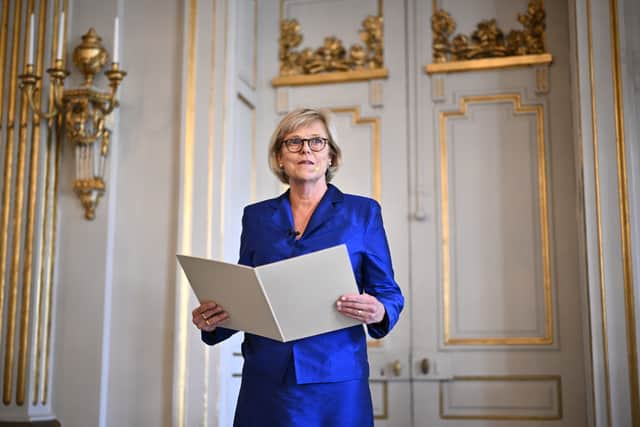
The prize was announced by the Swedish Academy in Stockholm.
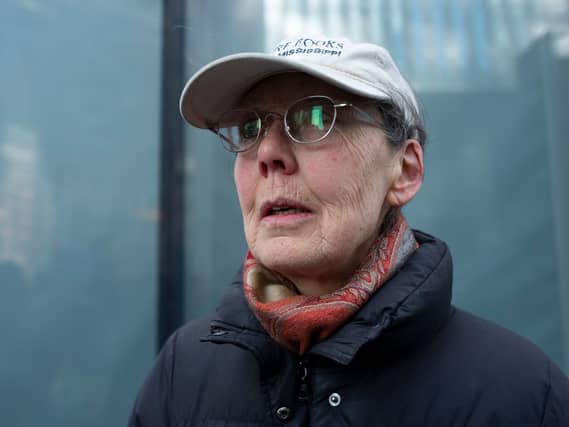
Canadian author Anne Carson has won the Nobel Prize in literature “for her bold and inventive oeuvre that, in playful dialogue with the classical tradition, has created new forms for contemporary literature”.
Ingrid Carlberg, permanent secretary of the Swedish Academy, said the author was in Iceland “listening to the wind” when the academy reached her to notify her of the win.
“She was very taken by surprise,” Ms Carlberg said.
Asked how she felt about the award, Carson told the Icelandic public broadcaster RUV: “I think they’re all crazy.” She described the conversation with the academy as “rather halting”.
“They have the usual questions, and I have no answers,” she said.
She said poetry is “probably more useful than prose right now because it’s faster, and everybody is in a hurry. So basically I think it’s good because it’s brief. Except Homer. Homer’s not brief”.
Toronto-born Carson draws on themes and stories from ancient Greek and Roman literature for works that often blend elements of poetry, essay and fiction.
Her books include Eros The Bittersweet, a look at the pleasure and pain of desire in ancient Greek literature, verse novel Autobiography Of Red, Men In The Off Hours, a collection of poetry and prose that won Canada’s Griffin Prize for poetry in 2001 and Norma Jeane Baker Of Troy, which compares Marilyn Monroe and Helen of Troy.
Carson also has translated works of classical Greek literature that, the Swedish Academy said, “may be regarded as independent works in their own right”.
They include If Not, Winter, based on poem fragments by Sappho, Sophocles’ tragic plays Electra and Antigone and Euripides’s Bakkhai.
“Almost all her literary production has centred upon the intersection between the philologist’s obsession with words and the poet’s desire for new meaning,” said Anders Olsson, chair of the literature committee.
Mr Olsson added that Carson’s juxtaposition of influences ranging from the ancient Greeks to John Keats, Virginia Woolf and Emily Bronte “leads to playful and ironic works that move not only between classical and modern poetry but also between different genres and artforms”.
Carson has taught classics at several North American universities and has lived in Iceland, where she and her husband, Robert Currie, were granted citizenship in 2022.
The prize was announced by the Swedish Academy in Stockholm.
Last year, Hungarian writer Laszlo Krasznahorkai, whose surreal and anarchic novels combine a bleak world view with mordant humour, won the Nobel Prize in literature for work the judges said upholds the power of art in the midst of “apocalyptic terror”.
This week ends with Friday’s peace prize. The Nobel Memorial Prize in Economic Sciences will be announced Monday.
The prize money this year is 12 million Swedish kronor (about £900,000), whether for an individual, small group of laureates or organisation.