
American economists win Nobel for overturning assumptions about economic shocks
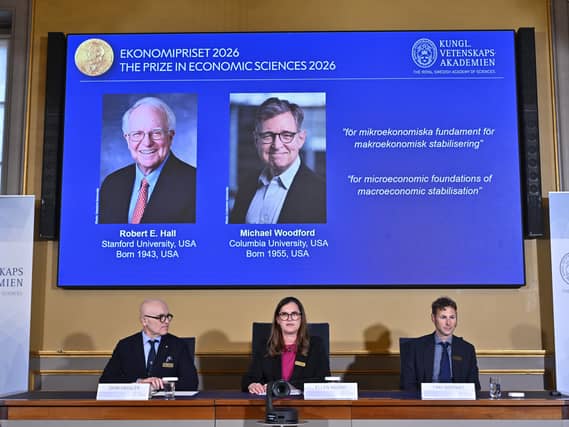

The memorial prize in economics is the final award in this year’s Nobel cycle.
US-born economists Robert E Hall and Michael Woodford won the Nobel memorial prize in economics on Monday for their work on models that have helped governments and central banks manage economic shocks.
The Royal Swedish Academy of Sciences announced the winners in Stockholm, saying the pair were being honoured “for microeconomic foundations of macroeconomic stabilisation”.
“The laureates have helped us smooth out the economy’s peaks and troughs,” the academy said in a statement.
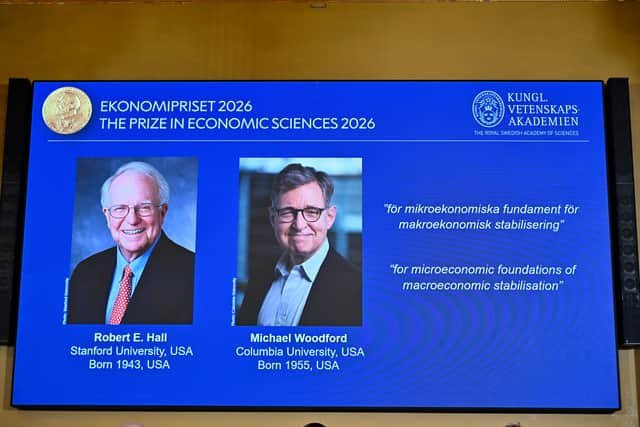
Professor Hall, 83, is affiliated with Stanford University in California, and Professor Woodford, who was born in 1955, with Columbia University in New York.
Prof Woodford spoke to the committee by phone on Monday from New York, saying: “It’s a tremendous honour, it’s a surprise.”
“The laureates’ work has provided us with a stable theoretical foundation for the models that are now used by central banks and governments around the world,” John Hassler, chair of the Committee for the Prize in Economic Sciences, said in a news release.
“With them, we are better equipped to deal with shocks in the economy, such as energy crises or sudden changes in how much households consume.”
For decades, governments responded to economic shocks by following the US depression-era prescriptions of the British economist John Maynard Keynes: intervene in the economy by lowering taxes and hiking government spending, thereby encouraging consumers and businesses to spend and invest themselves and help growth get restarted.
“This is the Keynesian recipe and it worked well – until it didn’t,” Timo Boppart, of the Nobel economics prize committee, said.
Policymakers had thought economic management involved simple tradeoffs – unemployment, for instance, would stay low at a time of high inflation and rise when inflation fell.
But the “stagflation” of the 1970s – when the world economy experienced simultaneous high inflation and high unemployment – proved the formula was simplistic.
Prof Hall and Prof Woodford set about coming up with an improved model that took into account how consumers and businesses actually made decisions about whether to invest and spend.
“Economic outcomes are the result of millions of decisions made at the microlevel by households and businesses,” the Nobel committee wrote.
“Using models based upon this approach, rather than simply studying the economy from a macro perspective, like a bird’s eye view, Hall’s and Woodford’s research has generated a paradigm shift in the theory of stabilisation policy.”
Prof Hall studied the way that consumers’ decisions about whether and how much to spend depend on what they expect their future income to be.
“If they are optimistic, they will consume more than if they are pessimistic,” the committee wrote.
But consumer expectations could change unexpectedly as new information about the economy came in. And some households were so poor they could not borrow or tap savings in response to economic changes.
Prof Hall found that forecasting future consumer spending is virtually impossible.
The idea that consumption is mostly unpredictable “is not good news for forecasters, or policymakers”, Olivier Blanchard, who was chief economist at the International Monetary Fund during the 2008 financial crisis, said by email.
“But it is news they must take into account in thinking about the effects of policy.”
In a 1982 paper with the economist Fredric Mishkin, Prof Hall found that around 80% of households made spending decisions based on their expectations for the future “while the rest lived hand-to-mouth”, the committee wrote.
“The prize is for research that pushes our understanding of macroeconomics from the bottom up, from families and firms making decisions over time, while looking ahead,” Ivan Werning, an economist at the Massachusetts Institute of Technology, said in an email.
Prof Woodford’s research established that businesses make decisions about prices based on where they think interest rates will go in the future.
“If the business believes that its competitors’ prices and its own costs will increase, it is best to set a higher price than it would with the opposite expectation,” the Nobel committee wrote.
“Businesses’ decisions are thus also governed by their expectations.”
To this end, central banks such as the US federal reserve, which set short-term interest rates, should provide “clear and credible communication about how they reason and what they plan to do”.
Central banks had responded to this insight by working harder to explain what they were doing.
During the phone call broadcast at the news conference, Prof Woodford said his work had stressed “the understanding of the people who are in the markets and making decisions about spending”.
Last year, three researchers who study business innovation won for explaining how new products and inventions promote economic growth and human welfare, even as they leave older companies in the dust.
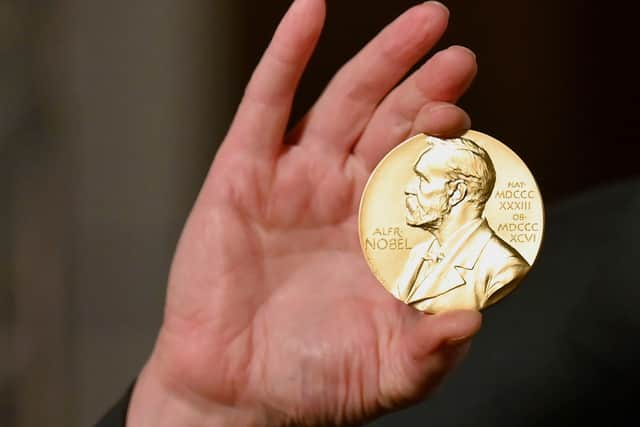
The economics prize is formally known as the Bank of Sweden Prize in Economic Sciences in Memory of Alfred Nobel. The central bank established it in 1968 as a memorial to Nobel, the 19th-century Swedish businessman and chemist who invented dynamite and established the five Nobel Prizes.
Nobel purists stress that the economics prize is technically not a Nobel Prize, but it is always presented together with the others on December 10, the anniversary of Mr Nobel’s death in 1896.
Nobel honours were announced last week in medicine, physics, chemistry, literature and peace.
The prize money this year is 12 million Swedish kronor (about £906,000), whether for an individual, small group of laureates or organisation.