
It's news, but not as we know it says Dead Donkey creator Andy Hamilton amid stage adaptation
If you were a conspiracy theorist, you might be forgiven for thinking the television news industry has evolved purely to give Andy Hamilton and his co-writer Guy Jenkin some new material to work with.
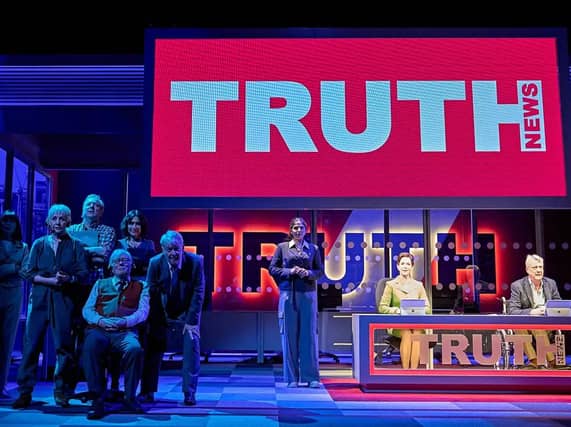


More than a quarter of a century since Channel 4 screened its last episode of Drop the Dead Donkey, the cast is back together for a stage adaptation of the hit newsroom comedy, reinvented to reflect today's media landscape.
"They're the same, but older," says Hamilton, who created the series with co-writer Jenkin some 34 years ago.
"Sally is as much of an egomaniac as ever, Damian is chronically dishonest, and George is still out of his depth."
Back in the 1990s, the sitcom about a beleaguered TV newsroom struggling to maintain standards under pressure from a rapacious new proprietor became a cult hit. Hamilton always maintained that its ensemble cast, made up of little-known character actors, was crucial to its success, and for many members it proved to be the springboard to successful and varied careers.
But although the series ended in 1998 – with Globelink News being turned into a TV shopping channel – the close-knit cast kept in regular contact. And it was at Zoom get-togethers during coronavirus lockdown that the cast members began debating how the show would have evolved were it still being made today.
When Drop The Dead Donkey was first screened on Channel 4 in 1990, Britain's first 24-hour news channel was still two years away, and most people were unaware that the internet actually existed. How would the shallow, vacuous newsreader Sally and indecisive editor George have adapted to this brave new world? How would amoral field reporter Damian get away with his sensational but unethical reports in the post-Leveson climate? As the ideas took shape, Hamilton and Jenkin realised they could have the making of a theatre production.
Hamilton says: "What we have seen in the last few years is the emergence of channels like GB News and Talk TV, they are not reporting on the news in the traditional sense, they are about people sitting around talking about the news, getting information about the news and trying to prove their agenda to the audience."
He adds that social media has made journalism a much more interactive industry, with output not being dictated by traditional news values, but by big data and the whims of target markets.
The play sees a mysterious series of events conspire to bring the old Globelink crew back together for a controversial new station called Truth News, where conspiracy theories are all the rage and the running orders are set by artificial intelligence.
"Now, an algorithm is controlling what they are putting out, it is like an extra character," says Hamilton.
"They don't know who they are being paid by, but it is very good money.
"They don't know who they have sold their soul to."
In the original series, Sally, played by Victoria Wickes, was the vapid former Blue Peter presenter recruited more for her looks than her journalistic integrity. Now in her late 60s, she has reinvented herself as a Nadine Dorries-style talking head, whose wild, outspoken opinions provoke strong audience reaction. Joy, the ineptly named secretary, has now risen to the role of personnel manager – or HR in modern corporate speak – where she is able to use her misanthropic skills to bring fresh misery to the staff.
The show is now without David Swift, who played veteran news anchor Henry Davenport, following his death in 2016. Henry's role is now largely taken by Damian, played by Stephen Tompkinson, who is now confined to a wheelchair after coming a cropper on one of his hard-hitting investigations. But he isn't particularly enjoying his new roles as the silver-haired, reassuring face of Truth News.
"He is spending more time behind the desk, but he is trying to get back out into the field," says Hamilton.
The new show will also be without Haydn Gwynne, who appeared in early episodes as George's assistant editor, Alex Pate, following her untimely death last year.
Hamilton says George's legendary bad luck has seen him fired from a string of jobs since he finished at Globelink, but he has somehow managed to find himself back in charge at Truth News.
"I think we all know somebody who makes you wonder 'how on earth did he get that job', but they continue to get offers," he says.
Neil Pearson returns as Dave Charnley, the perennial under-achiever whose career was always hampered by his feckless, impulsive behaviour. Now in his 60s, he has matured somewhat. But his attempts to face up to his responsibilities are continually frustrated by his past, and he is still the put-upon office dogsbody who nobody takes seriously.
"He's trying to be a responsible person, he's trying to be a different person to the reckless individual he was as a young man, but he's not succeeding necessarily," says Hamilton. "Life didn't turn out the way he would have liked, he's made lots of bad choices."
The television series was famously edited hours before transmission to keep it fresh with topical gags, and Hamilton says the same is true of the stage show, which is constantly updated to keep up with the news cycles. Sometimes the production is tweaked to fit in geographical references.
With nostalgia all the rage at the moment, could a successful stage show pave the way to a television return for the series?
"I don't think it would work," says Hamilton.
"It works as a stage show, and you could make a sitcom about a group of people working in an office of a news organisation. But a workplace made up almost entirely of people in their 60s? It would feel strange."
Comment Guidelines
Iconic Media encourages reader discussion on our stories. User feedback, insights and back-and-forth exchanges add a rich layer of context to reporting. Please review our Community Guidelines before commenting.