
Review: To Kill a Mockingbird, Birmingham Hippodrome
Harper Lee’s classic novel makes a surprisingly sharp and humorous transformation as a stage play

Looking around the near full-house at Birmingham Hippodrome, I wondered how many of the audience knew how the story would end.
If you went to school sometime between 1970 and 2010, there’s a fair chance that you would have read Harper Lee’s Pulitzer Prize-winning novel about racial injustice in the American Deep South during the 1930s. My own memory was of a ‘progressive’ English teacher not only telling me how much I liked it, but also going into great detail about why I liked it. After a bit of teenage truculence, I dutifully complied, and reaped the rewards come exam time. A valuable lesson learned, although I suspect it was not the one Harper Lee intended.
The question is that when you are performing a story where almost everyone knows the outcome, how do you keep an audience engaged? The answer is that Aaron Sorkin’s adaptation, directed by Bartlett Sher, did surprisingly well.
For a start, Sorkin’s adaptation brought some much-needed humour to the proceedings, helped by an energetic performance by Dylan Maylin as the Tiggerish Dill, and Anna Munden’s dry-humoured portrayal of six-year-old protagonist Scout Finch. Casting adults in children’s roles is not without risk, but it enabled Sorkin to bring a bit of wit and sharp social commentary to the story that would not have been possible had the roles been played by youngsters.
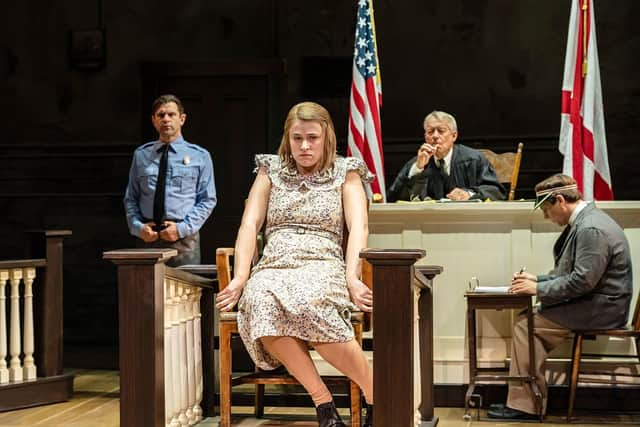

Unlike the novel, the play jumps straight in with a courtroom drama surrounding hero lawyer Atticus Finch’s defence of Tom Robinson (Aaron Shosanya), a black man falsely accused of rape. The simple scenery enables seamless flitting between the courtroom and the porch outside the Finch household, but wisely, the emphasis is on the courtroom action. Stephen Boxer puts in a strong performance as the kindly, elderly judge who treads a delicate line between his duty to uphold the constitution and the obvious unfairness of the proceedings before him. There was a touch of the Dukes of Hazzard about Oscar Pearce’s performance of red-neck Bob Ewell, but perhaps a bit of light relief doesn’t go amiss.
Sorkin’s adaptation is refreshing in the lightness of his touch in dealing with a subject which many will say is particularly pertinent to the times we live in. He could easily have turned this into a culture war between the enlightened intellectualism of the liberal Finch family and the reactionary boorishness of the Ewells, and lesser writers may have been tempted to draw unsubtle parallels with the BLM v Maga conflicts of today.
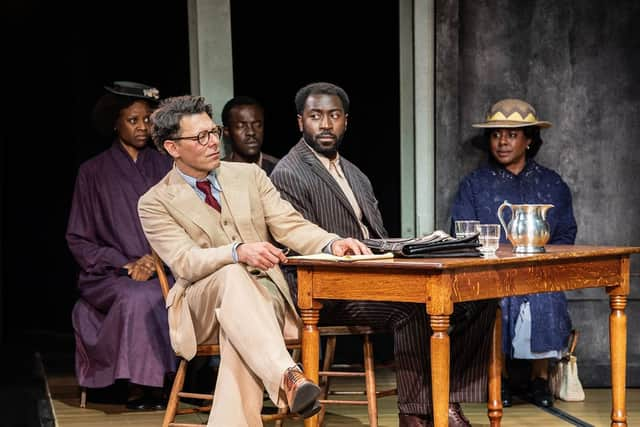
Instead, the play focuses on Atticus’s belief that most people are inherently good, and leaves the audience to form their own interpretation.
School-day nostalgia will inevitably contribute to the popularity of the play, as demonstrated by the queues outside the theatre before the show. But that would be a great disservice to what proved to be a surprisingly compelling watch, which somehow managed to keep the audience on the edge of their seats even though they surely knew what was coming next.
If only it had been as enjoyable 40 years ago.
*To Kill a Mockingbird runs at Birmingham Hippodrome until Saturday (April 18).
Comment Guidelines
Iconic Media encourages reader discussion on our stories. User feedback, insights and back-and-forth exchanges add a rich layer of context to reporting. Please review our Community Guidelines before commenting.