
Milburn demands welfare reform and job help to tackle youth unemployment crisis
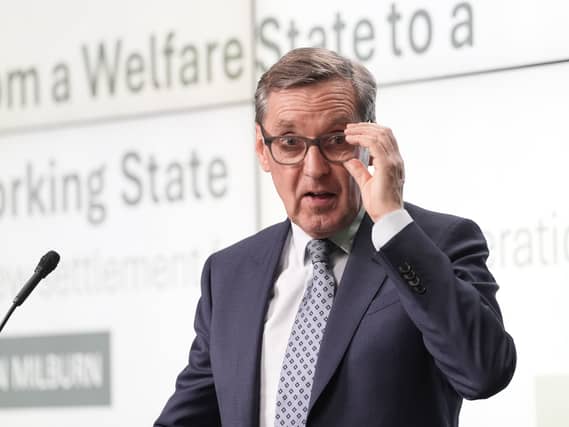

Alan Milburn’s report on youth employment called for sweeping changes across the state to help get people off benefits and into work.
Andy Burnham’s government must back sweeping changes to tackle youth unemployment or risk a “lost generation” of jobless youngsters, Alan Milburn said as he published his long-awaited report on the issue.
The former cabinet minister called on backbench Labour MPs to back his plan, even though welfare cuts could mean some youngsters having their benefits reduced.
The Government-commissioned report calls for billions of taxpayers’ money to be spent creating opportunities for those aged under 25 to get off benefits and into work, partly offsetting the cost by squeezing welfare payments.
Launching his report, Mr Milburn said: “Britain is at risk of losing a generation of young people, not because they lack talent, not because they lack ambition, not because they do not want to work.
“This is not a crisis of aspiration; it is a crisis of opportunity.”
He said “half measures will not do” because “the scale of the problem is just too big for that”.
“We have reached a profound moment of choice for the country, it calls for a new approach to back the next generation, to make young people a top priority. This is not what we have been doing.”
The report calls for the Government to spend around £5.8 billion a year by 2036-37, funding a new youth opportunity service and support, including tax breaks and bonuses for firms employing young people.
The cost would be offset by £3.6 billion of annual welfare savings and £2.4 billion of extra tax revenue from people in work.
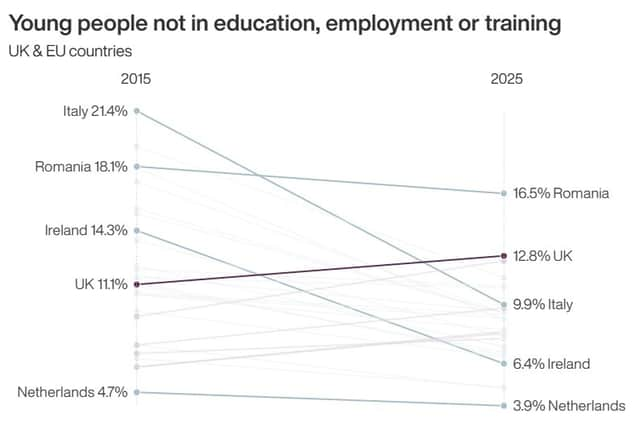
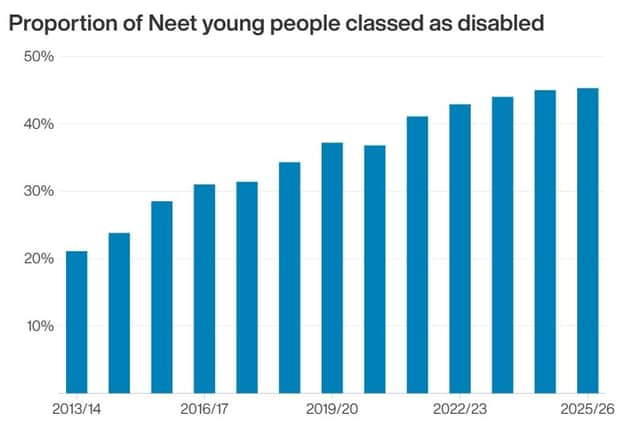
Mr Milburn said the increasing number of 16- 24-year-olds not in education, employment or training (Neet) was a “moral crisis”.
The Government will create a new youth opportunities unit reporting directly to the Prime Minister in response to the Milburn report, Work and Pensions Secretary Pat McFadden told MPs.
Mr Milburn demanded rapid action from the Government, with a “downpayment” of £500 million in the next financial year to fund the package he set out, arguing it must be a top priority in next year’s spending review.
He said if legislation was passed quickly then welfare savings could begin to be delivered by the end of the decade.
Mr Milburn said there was a “clear political imperative” for Mr Burnham and Chancellor John Healey to press ahead with the measures.
“Prime Minister Burnham is a half-term prime minister and so he needs to get on with it. And I know that he wants to. So I’m very hopeful indeed.”
Warning against the Government cherry-picking his recommendations he said: “It sort of does fit together as one package.”
Previous attempts to cut the welfare bill have been derailed by opposition within Labour but Mr Milburn said the party as a whole must get behind the reforms.
The report proposes an “entirely new benefit system for young people”, with a youth allowance replacing the health element of universal credit (UC) and the personal independence payment (Pip) for 16 to 24-year-olds.
The system would give every young person a legal entitlement to a route into education, training or work, and a guarantee of support to get the health, employment and functional and practical help they need to get into and stay in work.

He addressed the Parliamentary Labour Party on Monday night and insisted that “people buy the argument” he is making.
Mr Milburn said his plan was a change in approach to the attempt at welfare reform under Sir Keir Starmer which ended in humiliation for the then prime minister.
“The way that was approached was – to be candid about it – it was just a fiscal grab, ‘let’s cut some benefits’, and there are people who are still proposing to do that and I do not think that is the way to do it.”
Mr Milburn said his scheme aimed to get people into work, which was “a very different argument” so “I’m very hopeful that colleagues will support it”.
The Institute for Fiscal Studies said the proposals would mean “many of those with less severe disabilities would be likely to see large income losses initially”, although this could be offset if they enter work.
The forecast £3.6 billion a year savings would be equivalent to 41% of projected spending on health-related benefits for young people in 2036–37, the think tank said.
Mr Milburn acknowledged policies introduced since Labour came into office in 2024 had contributed to the Neet problem by making it more expensive to hire younger workers.
The Government has pushed up national insurance costs for employers and increased the minimum wage for younger workers at a faster rate than for older employees.
“Well, there’s no doubt that that has hit business sentiment. Absolutely, no doubt at all,” he told Sky News. “Employers have come to me and said that that has made it harder.”
At his report’s launch he said the Government should enshrine in law a new “youth opportunity test” to ensure new taxes and regulations do not hit under-25s.

“You cannot call youth employment a national priority while making young people harder or more expensive to hire,” he said.
There are around a million Neets and Mr Milbrun warned that could rise to more than 1.25 million within five years.
His recommendations for wholesale reform of the system, including early years and schools, apprenticeships and health and welfare support, would result in 600,000 more young people in education, employment or training each year – around 440,000 of whom would be in sustained work – by 2036, according to modelling for the report.
A new youth opportunity service – across all of England by 2029 – will aim to ensure employment, careers, health and practical support are available to a young person, with a personalised participation plan and a named adviser.
Conservative leader Kemi Badenoch said: “We don’t need costly government schemes to fix Labour’s own mistakes.
“We need to stop making it so expensive and risky to hire young people.”