
Fact check: Viral ‘new Covid strain’ video and smart glasses sales

Round-up of fact checks from the last few days compiled by Full Fact.
This roundup of claims has been compiled by Full Fact, the UK’s largest fact checking charity working to find, expose and counter the harms of bad information.
Viral video does not show ‘new strain of Covid’ found in Northampton
A viral video of a person on a stretcher surrounded by people wearing white protective clothing suits and medical masks has been shared with false claims that it shows a new strain of Covid found in Northampton.
The footage actually shows emergency services responding to reports of concern for a person’s welfare – and the UK Health Security Agency (UKHSA) told Full Fact that it has not had any notification of a new strain of Covid-19 being found in the town, or anywhere else in the UK.
The clip circulating on social media has been viewed more than eight million times, alongside the caption: “New strain of COVID found in Northampton UK. New lockdown imminent.”
Another clip of the incident has also been shared with similar claims about a supposed new strain.
We traced the footage to a property in Northampton. The Northamptonshire Fire and Rescue Service told us they were called to the street in Northampton on October 22 to assist the East Midlands Ambulance Service in response to reports of concern for a person’s welfare.
Northamptonshire Partnership Homes – an organisation managing social housing on behalf of the council – also told us officers attended a property in relation to the welfare of one of the occupants. It said that all people entering the property “wore protective clothing as a precautionary measure” and that the incident was not related to Covid.
The UKHSA described the claims in the video as a “hoax”. A spokesperson said: “We have not had any notification of a new strain of Covid-19 being found in Northampton or anywhere else in (the) UK; no such Covid-19 sample has been sent to our labs from the hospital in Northampton.”
We often see mis-captioned images and videos being shared widely on social media. Before reposting something you see, first consider whether it comes from a reliable and trustworthy source. Full Fact’s misinformation toolkit can help you do this.
Were more than seven million pairs of one smart glasses brand sold in the UK last year?
Shockat Adam, the independent MP for Leicester South, told a Westminster Hall debate last week: “It has been reported that more than seven million pairs of one brand (of smart glasses) alone were sold last year in this country.”
That is not correct. As far as we can tell, far fewer than seven million people in the UK own or have access to smart glasses – let alone bought a pair last year.
Mr Adam’s office has since told us he meant to say “globally”, and it appears he was referring to the eyewear company EssilorLuxottica selling more than seven million pairs of smart glasses worldwide in 2025.
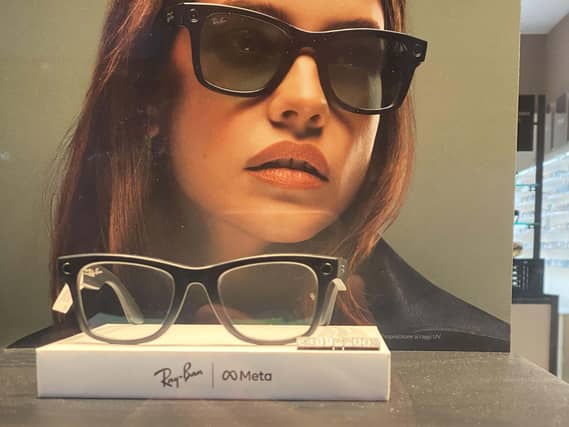
EssilorLuxottica, which makes the Ray-Ban and Oakley glasses with Meta, said in February that “AI-glasses units sold, including Ray-Ban Meta (launched in September 2023) and Oakley Meta (launched in June 2025), were above seven million in the full year” in 2025. It said “all the regions and brands” contributed, and gave no figures for individual countries. Mr Adam named EssilorLuxottica later in his speech as the company that makes Ray-Ban Meta glasses.
We couldn’t find any published UK sales figures for smart glasses, or any official statistics on how many people own them. But surveys suggest the number sold last year was far below seven million.
In May 2026, around 2% of people aged 16 to 75 in the UK owned or had “ready access” to smart glasses more generally, compared with 3% in 2025, according to Deloitte’s Digital Consumer Trends survey. Based on the Office for National Statistics’ latest population estimates, 2% of that age group would be about one million people.
A YouGov survey of UK adults in March 2025 found that 3% of respondents “used” smart glasses, which would be about 1.7 million adults, although it would not necessarily mean that they all owned a pair.
These are survey estimates, so are not precise, and the number of people who have smart glasses is not the same as the number sold in one year. But both suggest this would be nowhere near seven million.