
Europe selects negotiating team for Ukraine talks
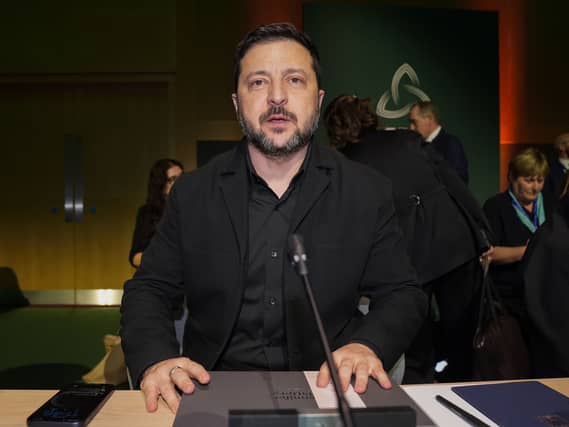

Ukrainian President Volodmyr Zelensky was in Dublin earlier this week to attend a major EU summit focused on support for Ukraine.
Europe has said four member states, the United Kingdom and representatives from the EU institutions should form the continent’s presence in peace talks involving Russia and Ukraine.
Ukrainian President Volodmyr Zelensky was in Dublin earlier this week to attend a major EU summit focused on support for Ukraine.
He left the meeting for an engagement with US envoys Jared Kushner and Steve Witkoff, who had earlier been involved in talks with Russian officials in Abu Dhabi.
European heads of state and government convened again on Friday for an informal EU Council meeting in Dublin, where the war in Ukraine was again a key talking point.
It was decided that Europe would send forward several people to participate in the negotiations, instead of one name.
Earlier, EU Foreign Affairs and Security Policy high representative Kaja Kallas had suggested that she should be the European voice at negotiations between Russia and Ukraine.
Speaking at the end of Friday’s summit, European Council President Antonio Costa welcomed “all diplomatic efforts aimed at bringing Russia to the negotiating table” as he said Europe’s security “begins with Ukraine’s security”.
He said said European leaders agreed that the bloc’s team for the negotiations on peace in Ukraine is “the European Union institutions and the E5 of the coalition of the willing”.
The E5 countries are France, Germany, Italy, Poland, and the United Kingdom.
Mr Costa told reporters: “Our principles and our positions in these negotiations remain well known, and our European team will continue to act in close coordination in full unity.”
He added: “Europe must speak with one clear and united voice in all discussions that shape the future of Ukraine and the security of our continent, and this is ultimately a team effort.
“Only Ukraine has the legitimacy to decide on matters concerning its territory and sovereignty.”
Earlier on Friday, Ms Kallas told reporters she was mandated to be the representative at those negotiations.
She said: “In 2024, in June, there was a decision by the leaders, who is representing us when it comes to security and foreign policy, and it was the discussion that in these five years there’s going to be a negotiation with Russians. So, if the leaders want to change that agreement, of course they may because it’s the leaders’ decision. But I think we should focus our energy, actually on the substance.
“Well, all the member states actually agreed that I’m the one who is representing Europe in foreign and security policy. So, I mean that was in 2024 when it was clear that this is going to be the case.”
The foreign affairs chief added that Russia does not want her at the talks because she is too strong.
“I know that the Russians don’t want me, but do we have a say who is representing Russia? No, we don’t, and really we have to have a strong team,” she said.
“They don’t want anybody strong on the other side because they want to push through their maximum demands, like they have always done.
“Their tactics are very clear. I mean, first you present threats and ultimatums, you use force, and then you will just wait because there will always be people in the West who will offer you something you didn’t have before, and every time you go further.”
Asked if selecting other representatives undermines the role of Ms Kallas, Mr Costa said there was a need to “work as a team” and pointed to the US putting for two envoys and the Ukrainians putting forward “three or four people”.
“Regarding the EU institutions, the treaties are very clear. The President of the European Council represents the European Council and represents the Union when it comes to the common foreign and security policy at the level of head of state and head of governments, and the president of the European Commission represents the Commission, and the Commission represents, externally, the Union in humanitarian issues.”
European Commission President Ursula von der Leyen also defended the decision and said: “To be very clear, we decide on who represents us, and that’s what we’ve done today.”