
The Wolves link to the tragic Bradford City fire 40 years on from the Valley Parade disaster
May 11th, 1985. Wolves were beaten 3-0 at Blackburn, rounding off a miserable Second Division season and the second of third successive relegations which took them directly from the top of the English league pyramid to the bottom.

The club was in turmoil. A year later they nearly went out of business. Again.
Fans among the crowd of 9,543 had once again travelled with very little hope and even less expectation.
But it was a final day of the season when, throughout the country, football was ultimately of very little consequence.
Because 40 miles east, across from Lancashire into Yorkshire, Bradford City were ready to welcome Lincoln for a promotion party, a Third Division title-winning party, which would see them swap places with Wolves and head into the league above for the first time in nearly half a century.
There was a carnival atmosphere around Valley Parade as fans old and young gathered for one of those special footballing days, rare and cherished days which remain forever etched in the memory bank.
And then, tragedy.
Five minutes before half time, a fire broke out in the Main Stand. A discarded cigarette end had fallen underneath the floorboards into the mass of rubbish and debris which had built up below. A combination of the wooden structure, and strong winds, saw the Stand quickly engulfed in flames. Within four minutes, and less than an hour after the fans had gleefully hailed the presentation of the Third Division trophy, the Stand had been pretty much destroyed. Devastatingly, 56 people would lose their lives.
Football would never be the same again. Footage of the fire was transmitted on World of Sport and Grandstand barely minutes after the event. And yet, in the pre-internet era of no mobile phones and no social media, many of the Wolves fans watching their team’s demise were completely unaware of the catastrophe unfolding just a short car journey away.
“In those days, unless someone had a radio at the football, you didn’t know what was going on elsewhere,” recalls Charlie Daw, a lifelong Wolves fan who was then in his mid-twenties.
“The first we heard about what had happened was on the coach on the way home, and the reaction then was just shock.
“Then you got home and saw the pictures on TV and it was just horrendous – it hadn’t been a great season for Wolves but football just didn’t matter anymore compared to that.”
By the cruellest of ironies, the Stand was scheduled to have its wooden terracing replaced by concrete less than 48 hours later. It just needed to get through one final afternoon.
The 40th anniversary of the Bradford Fire was marked recently at their last home game of the season against Fleetwood, and then again with the annual memorial service in the city’s Centenary Square on the actual date on Sunday.
There were several players at Valley Parade that day who would later go on and turn out for Wolves.
Don Goodman was then an 18-year-old striker who had enjoyed a really successful first year as a professional with Bradford, but would lose a friend in the fire. Whilst admitting the painful memories and thinking about those who passed away will never leave him, it’s understandably not a subject he has been keen to talk about over the years.
Micky Holmes, also on Bradford’s books at the time, had been watching the game from the Stand, before decamping to the players’ bar and then jumping out of the window to reconvene with other players to try and process events in a nearby pub.
For Peter Withe, who had earlier spent two years at Wolves towards the start of a career which would see him score the winner for Aston Villa in a European Cup final, he was plying his trade blissfully unaware that several members of his family were at risk.
Withe was playing for Villa, then managed by Graham Turner, who lost 2-1 against his native Liverpool at Anfield, with Paul Birch grabbing their goal after coming off the bench to replace Tony Daley.
But his brother Chris was playing for Bradford, and their parents Gerry and Kathleen had gone along to join the party at Valley Parade.
“It was difficult to find out any sort of information back then, and you would have to pick a lot of it up on the grapevine,” Peter recalled this week, from his home in Australia.
“It was a testing time, and obviously you are panicking a little bit, hoping that everyone is alright.
“I’d seen the pictures on the television, and eventually I spoke to Chris on the phone, who told me everything that had gone on.
“My Mum and Dad were in the stand, and had gone done early before half time for a cup of tea.
“If they wouldn’t have done that, then maybe they wouldn’t have gone out.
“Even though my family were ok, it was clearly such an awful tragedy with so many people killed and injured.
“I will always remember I had to attend a function in the evening, but the atmosphere was nothing like what it would normally be, everyone was just quiet and thinking about what had happened at Bradford.”
Chris had missed just one game for the Bantams in that title-winning season. On that final day, his parents – who watched both sons as much as possible during their respective careers - were also joined by his then heavily pregnant wife, and her sister. His son Matthew turns 40 this year.
“It was supposed to be a day of celebration, not just lifting the trophy but we were also due to fly out to Magaluf after,” Chris recalls.
“When the fire started, I thought it was only a little flame because that is all we could see in the stands.
“I didn’t realise the fire had actually started below the seats and it was actually 20 foot high.
“I came straight off the pitch and into the dressing rooms when it happened.
“They were concrete and never got touched but very soon people started shouting at us to get out.
“Some of the lads stayed on the pitch and saw people getting burnt which was horrific, and I think because I didn’t, I escaped some of the trauma from what went on.
“Fortunately, my parents and ex-wife had left the stand before half time and gone to the players’ lounge for a cup of tea.
“They were able to leave the stadium from there, but we were very lucky, because my wife at the time was so heavily pregnant, it would have been very difficult for her to make it out.”
It feels impossible to even dare to suggest that anything positive could emerge from such a devastating tragedy in which 56 people died, hundreds were injured, and many more traumatised.
If there was the tiniest crumb of comfort, then the Popplewell inquiry into crowd safety which followed outlawed the use of wooden stands and put restrictions on smoking in wooden areas. Those measures, which included the closure of the Waterloo Road Stand and North Bank at Molineux, would ensure that the speed and ferocity of the blaze at Bradford should never happen again.
And then came the reaction of the footballing world, and indeed the world in general.
The Withe brothers were both involved in the response to the disaster, Peter in playing a fundraising game between Villa and West Bromwich Albion organised by the Express & Star just six days later.
Both clubs fielded strong teams in what was an end-of-season fixture, Villa including not only future Wolfs in Gordon Cowans and Daley but also a guest star, George Best.
A crowd of 5,650 enjoyed an entertaining 3-3 draw which raised £11,000 for the Fire Disaster Appeal, which raised over £1million in its first week of operation.
“It was just our small way of trying to do something to help all those affected by the disaster,” Peter explains.
“I had done some media work with George and he wanted to help as well so he came along and we managed to raise a bit of money.
“It was strange, because I think in any game of football, as soon as you cross the line you become really competitive and want to win.
“But at half time and full time, it came back into our minds what we were playing the game for, and you remember the tragedy that has happened.
“I also remember there was a young lad who kept kicking George and I told him on a couple of occasions that this wasn’t a proper game and the crowd were there to watch him play, not get kicked.
“The fella wouldn’t listen, so eventually I had to give him a little nudge to remind him.”
For Chris and the Bradford players, it was a case of providing any sort of support to the community that they could, which included helping to add the donations to that appeal fund.
“Throughout the close season we were travelling all over the country to collect cheques from people who were fundraising for those affected,” he explains.
“And we would go and visit some of the supporters who had been burned.
“They were amazing to be honest, unbelievable.
“We would walk in to see them and it was them asking how we were doing – they were incredible.”
That legacy, the improvement of sporting stadia, which would later be forced to take another step forward after the Hillsborough disaster finally brought an end to the high perimeter fences which caged supporters in, also affected Molineux.
For several years, and indeed years of success, just two sides of the ground were open, until the arrival of Sir Jack Hayward’s tenure heralded the all-seater stadium which, bar the refurbishment of the Stan Cullis Stand during Steve Morgan’s chairmanship, remains very much the same now as it was then.
“I used to stand in the South Bank, and had never really thought about safety and what might happen,” adds supporter Daw.
“Although I do remember that there was always a lot of rubbish underneath the North Bank which was a wooden stand.
“At the time I was a smoker, and if I wanted a cigarette, I would need to go away from any stand which was wooden.
“It was such an awful thing that happened, but safety certainly improved as a result.”
There has always been a sense of quiet dignity to the commemorations at Bradford, always remembering the victims and those affected on every anniversary, just as they have in recent weeks.
Despite having secured promotion the week before, Bradford’s players all attended Sunday’s memorial service along with boss Graham Alexander and backroom and office staff.
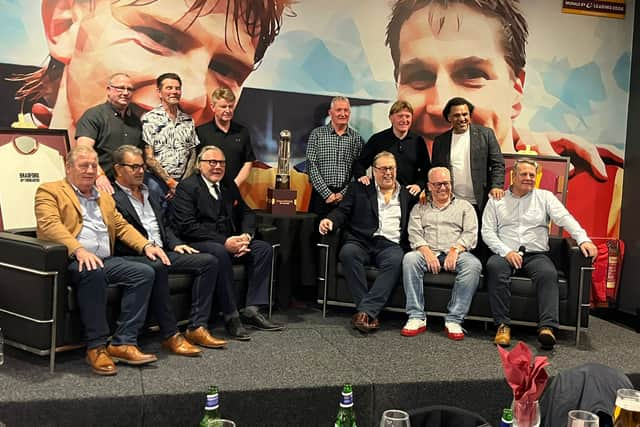
For Chris Withe, there was the opportunity to meet up with those former team-mates, in some cases for the first time in decades, and including Wolves’ alumni Goodman and Holmes, when the club staged a ‘Champions’ reunion event back in March.
“It was great to see the lads and to be able to celebrate what we achieved, but it’s also about thinking about the people that we lost,” he adds.
“I think it is always important to remember all those that were there and everyone who was affected.”
And that was very much the motivating factor for Wolves club historian Peter Crump, who made the trip to Valley Parade for Bradford’s final game of the League Two season at home to Fleetwood, at which they paid tribute to the victims of the Fire.
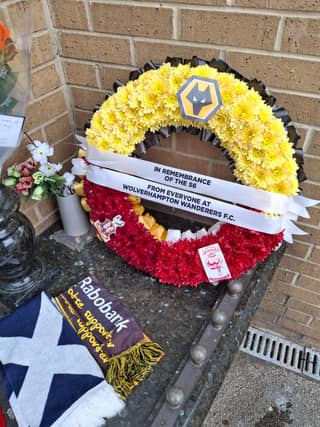
Crump visited the memorial at the stadium, laying a wreath on behalf of the club, and was approached by a supporter who offered his thanks, before revealing he had lost his father in the disaster.
“That was one of the most emotive moments I have ever had at a football match,” said Crump.
“I felt we needed to be represented there as a club – at Wolves we lost bricks and mortar but Bradford and Lincoln lost supporters.
“It was important to pay our respects to the victims. The 56 who lost their lives and all the supporters, emergency workers, club staff and everyone who was there that day.
“Those of us who weren’t there that day will never understand how it would feel and to try and find those words would be disrespectful to all those who lost their lives.
“My thoughts like everyone are just with all those who were affected – the minute’s silences at Bradford and Lincoln were impeccably observed and remembered the 56 with the utmost dignity.”
The scenes at the end of the game, Brentford scoring a 96th minute to seal League Two promotion with virtually the last kick of their season were, even if footballing success is immaterial when compared to the disaster of 40 years ago, somehow fitting to mark the anniversary.
“It was such a sad day and one which still hits home, especially because my family were there,” Peter Withe concludes.
“It always comes back into my mind, especially at the anniversaries, and I think it is important to remember those who lost their lives and everyone who was affected.”
Comment Guidelines
Iconic Media encourages reader discussion on our stories. User feedback, insights and back-and-forth exchanges add a rich layer of context to reporting. Please review our Community Guidelines before commenting.