
The man who became thorn in Wolves' side as Tottenham Hotspur picked up bogey team tag
John Richards once described Tottenham as ‘our jinx team’. Kenny Hibbitt said he hated playing against them, ‘because they were a pain in the backside against us for so many years.’
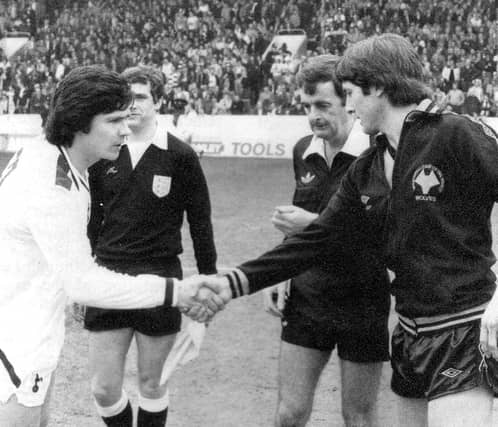

It is fair to say the Seventies and early Eighties left Spurs as uncomfortable bedfellows for Wolves given some hugely disappointing results, especially in the biggest three showpieces in which the two clubs locked horns.
Across the two legs of the UEFA Cup Final in 1972, Spurs prevailed by a one-goal margin. The same in the League Cup semi-finals later that year. And then, a 2-2 draw in an FA Cup semi-final in 1981 before clear daylight in the replay with a 3-0 victory for Tottenham.
From the 1970/71 season to 1983/84, Wolves won just four of 28 meetings. So, it’s clear to see where Richards and Hibbitt are coming from!
But what about the view from the opposition? And the often leader of the opposition?
Steve Perryman MBE captained Tottenham for many years, to many trophies. He is their record appearance maker, chalking up a staggering 866 in both defence and midfield during 17 years spent at White Hart Lane.
In November, he is coming up to Stourbridge Rugby Club, to speak to a newly formed supporters’ club, the Dudley Spurs, a night which will also support a charity, the Aortic Dissection Charitable Trust. That’s because Perryman survived an aortic dissection in 2012, and speaks regularly about his recovery journey and the importance of early diagnosis and awareness.
Perryman is what you would call a true ‘football man’. At 73, his powers of recollection, and thoughts on the game, remain razor sharp. Whether it’s memories of Spurs, of being managed by Bill Nicholson and Keith Burkinshaw, of games, of modern football terminology, he has a forthright approach which underpins - and offers plenty of evidence - as to why his career was so successful.
“I was lucky enough to work under Bill and Keith, two of the most successful managers of the club,” Perryman explains.
“They were both straight-talking Yorkshiremen, and I think I linked well with them because I was homegrown.
“Also, neither of them were managers who were great at saying ‘well done, you played well today’. There wasn’t a lot of praise going about.
“If you were one of those players who needed that, then you had it all to do, but I didn’t need that, I was happy in my own skin.
“Sometimes, when you stay at a club for such a long time, people think you must be a crawler or similar, but I think I had more rows with managers and chairmen during my time than any other player I remember.
“That’s simply because I am a football man, and I stand up for football, so if something was working against football, I would let it be known.”
A football man for sure. It’s not very often that these pages would feature the thoughts of an opposition former player. But in this case, it most definitely feels worthy. Both because Perryman is very much a footballing legend, and also with his impending visit to the patch to Dudley Spurs.
And also, his memories of Wolves. Which are extremely positive. Probably because of those stats mentioned above.
“What I do remember about all those games with Wolves is that they were never nasty games,” Perryman recalls.
“We were two footballing teams as such, and whoever beat anyone on the day, it was down to the football.
“I have read in recent years about ‘Bill Nic’ going into the Wolves dressing room after the second leg of the UEFA Cup final, and saying how unlucky they were to only draw and not overturn our advantage.
“That is the sort of thing he would do, and I do remember that we struggled in the second leg.
“The first game was the Chivers game, wasn’t it? Martin Chivers scoring a header and then a fantastic strike.
“Those big occasions against Wolves, the really big occasions, they always seemed to go our way.
“I do always remember that big terrace at Molineux behind the goal, the South Bank I believe, which was particularly impressive both with the numbers and the noise.
“And then the dressing rooms, being so close to the road outside – you could hear everything the fans were saying walking past and look out and see your family and friends waiting to collect their tickets!”
The specifics then. Of those big games.
The League Cup semi-final in 1972/73 saw Wolves lost the home leg 2-1, hitting back to win the second leg by the same scoreline, only to be denied by Chivers – yes him again – scoring in extra time.
Before that came the UEFA final. Wolves players involved have all gone on record to suggest – and with no animosity towards Tottenham – that they would have preferred to have faced European opposition in the final, especially having been on a tour of the continent featuring Portugal, Holland, East Germany, Italy and Hungary.
Well, it turns out, they weren’t alone.
“Our semi-final was against AC Milan, and before the second leg, Bill (Nicholson) told us that all our wives would be treated to a trip to the final if we got there,” says Perryman.
“We got back in the dressing room after qualifying after the second leg, and it turns out it was Wolverhampton!
“I’m not sure the wives were too impressed - they were hoping to have a bit of a trip away and didn’t even have to get on a plane!”
Perryman is seemingly too modest to point out that he notched both goals in the 2-1 win against AC Milan in the first leg of that semi-final.
Spurs then prevailed across the two legs of the final against Wolves, and then nine years later, won the FA Cup semi-final replay, played not too far away at Arsenal’s Highbury stadium, after a 2-2 draw in the initial tie at Hillsborough.
There was controversy at the end of that game, as Hibbitt won a penalty awarded by Clive Thomas and converted by Willie Carr, perhaps giving added motivation to Spurs who comfortably won the replay 3-0.
“I think we felt a bit cheated in that first game, and I remember Kenny saying he was tired and fell over Glenn Hoddle’s foot,” says Perryman.
“We knew driving back on the bus that we were going to win the replay.
“When the teamsheet came into the dressing room, and Andy Gray wasn’t playing, that cemented that feeling.
“It turned into a really good night for us, that replay.
“How often do you get the chance to play on your nearest rivals’ ground, and get to a big final? Once we got into that game, we were in cruise control in the end.”
Spurs would win the final against Manchester City, Perryman insisting they got away with it in the first game – needing an own goal to secure a draw - before taking it to a replay where Ricky Villa’s incredible solo goal remains one of the best ever seen at Wembley.
Coming back to Wolves, he also recalls the day Spurs opened their new West Stand at White Hart Lane. And beat Wolves 6-1.
O-k then, maybe that’s quite enough of that!
Time to move on to some more positive Wolves recollections. And, given Perryman’s standing in the game and experience not just as player but also coach and manager, there are plenty of those.
He played in the same England Under-23 side as Richards – “a great lad” – which included a post-season tour to Poland, East Germany and Russia not long after the UEFA Cup final.
Perryman was also captain when Geoff Palmer made his England Under-23 debut in a fixture against Wales at Ashton Gate. “Another very good footballer,” he says.
“That was an era which fed off players being loyal and staying at clubs for a very long time,” Perryman continues.
“When you find the right club, as much as you fall in love with the club and the area, you know how the supporters work as well, and it fits.
“Spurs supporters can spot a cheat a mile off, but if they liked you, and you were genuine and gave what they thought you should give, they backed you even on a bad day.
“That was the way it was when it was a game of the people, and I am sure Wolves fans are exactly the same.”
When it comes to Perryman’s playing career, there are many more Wolves memories.
Hibbitt, Derek Parkin, facing Hughie Curran and Derek Dougan – all are mentioned positively in despatches.
But a trio of other Seventies Wolves heroes also particularly caught the Perryman eye.
“I used to really appreciate Mike Bailey, Danny Hegan and Dave Wagstaffe,” he explains.
“Wagstaffe was something else. He was the type of player who got supporters out of their seats.
“When he picked the ball up, you knew something was going to happen.
“He was almost like the kid in the playground, there was no fear and nothing to hold him back – the brakes weren’t on.
“To an opposition defender, that was always a danger!”
Perryman’s dances with Wolves continued after he had finished his playing career.
Having moved from Spurs to Oxford, he then became player-manager at Brentford which included crossing paths with Wolves in the Sherpa Van Trophy and old Third Division.
“The days of Bull and Mutch,” he muses. “Wolves were way too good for that level, and that’s how it turned out.”
As his managerial career continued, from Brentford, to Watford, and then later in Norway and, with much success, Japan, there were many more brushes with Wolves’ personnel.
At Brentford, he inherited a squad including a young Andy Sinton, and was told by his chairman, in no uncertain terms, that he wouldn’t amount to much.
“I said I’d make my own mind up on that, and what I found was a kid who wanted to improve every single day,” says Perryman.
“He tested you as a manager by his questions – always asking what he can do to get better and how you could help him get better.
“Eventually, he was sold to QPR for a lot more money than they would have got at first, and I was hated by the Brentford fans for that.
“But I had given my word to Andy that if he carried on working hard and improving we wouldn’t stand in his way, and I wasn’t willing to go back on my word.”
Sinton went on not just to QPR, Sheffield Wednesday and Tottenham, but also England, and spent three years at Wolves in the latter stages of his career where his consistency and professionalism were always to the fore.
In Japan, Perryman won a J-League stage Championship, and Asian Cup Winners Cup, and also came into contact with previous Wolves midfielder Mark Burke, who was playing for a separate team but forged a friendship based on being two Englishmen abroad, sharing thoughts and ideas.
And then later, as Director of Football at Exeter, a job which thankfully he was able to continue after the aortic dissection which left him undergoing emergency surgery, he gave the green light to sell George Friend to Wolves.
“George was one of the cleanest living, best looking athletes I had ever seen in the game,” Perryman says with a chuckle.
“I remember getting the call from Jez Moxey (Wolves chief executive) quite late on deadline day, and it was an offer that we couldn’t refuse.
“I think it was Mick McCarthy who said that George was too good looking to be a footballer, but he was always going to succeed because of being proper, how he trained and looked after himself, and he went on to build a great career.
It is perhaps in discussions around two Wolves managers that Perryman maintained plenty of interest when it came to links with Molineux: Glenn Hoddle and Kenny Jackett.
Hoddle is described by Perryman as ‘the best I ever played with’, and whilst his spell in the hotseat at Wolves – his most recent as a manager – didn’t have the desired success, many individuals such as Joleon Lescott, Lee Naylor and Mark Kennedy have spoken about just how much their games improved.
“Someone said to me only last week, that the times a manager has with a player talking in the office was almost as good, if not better, than a training session,” says Perryman.
“That’s one-on-one time, concentrating purely on their game, and not a player moaning about a session or a manager wondering if it is flowing enough or that everyone is getting enough out of it.
“When you are sat there with one player, you can get to the crunch of their game, and that is what Glenn would have done, I’m sure of it.
“He always liked players who worked, but not if it quelled their talent, and he would always give certain players an amount of freedom in that respect.
“Glenn would always help those players who needed that boost in terms of their confidence.”
And Jackett? His role at Molineux will never be underestimated, nor indeed forgotten.
Arriving at a club in chaotic disarray following back-to-back relegations from the Premier League to League One, he masterminded an immediate response, a record-breaking title and the foundations of the push to where the club are now, in an eighth successive season back in the topflight.
Perryman not only identified Jackett’s managerial acumen right from the very start, he also helped develop it.
And this, despite – plot twist – the fact that his only sending off in all those years at Tottenham came, when seeking retribution against Jackett as a player!
“I only got sent off once in all the games I played, and that was for kicking Kenny Jackett!
“He had left one on me during a game and, stupidly, I took my revenge too quickly and right in front of the referee.
“We did laugh about it all several years later, and I always knew Kenny was a very, very good professional football person.
“He had been a player at Watford when I went there as manager, and was involved in coaching the schoolboys at the club.
“I went to watch his team play one Sunday morning and popped into the dressing room at half time to listen to the instructions he was giving.
“Straightaway, I knew this was a fella with a really good football brain, and while that wasn’t unsurprising from someone who was such a good pro, you never quite know how people will react when they move from playing into coaching.
“When I got the chance, I made him youth coach, and, if I played just a small part in starting him off, then I’d be very proud of that one.
“I remember Joe Gallen at Watford as well, who went on to be his assistant, and both are really good people who have deservedly done well in the game.”
Perryman also couldn’t escape Wolves’ connections via his involvement in a string of sports shops not just close to home in London but also abroad in Norway.
When visiting the shop out in Bergen, he would regularly meet football fans of a certain age who followed Wolves and would quote legends such as Billy Wright and Ron Flowers.
Names from a golden era, as were those in the Seventies, even if they found it so tough to get one over on Perryman and Spurs.
Fortunately for Wolves, who head into Saturday’s tough test at Tottenham looking for a first point of the season, things have improved in recent years, having won five and drawn one of the last seven meetings.
For Perryman, the meeting he is really looking forward to, is with the Dudley Spurs, no doubt re-living the two FA Cup triumphs, two league Cups, and two UEFA Cups, several of those with Wolves among the victims!
It is a night which is open not only to those of a Tottenham persuasion but anyone interested in hearing from one of the game’s true legends.
· Steve Perryman will be speaking to Dudley Spurs at Stourbridge Rugby Club on the night of Friday, November 14th (6.45pm doors for 7.30pm start). Visit dudleyspurs.co.uk/steveperryman to purchase tickets.
Comment Guidelines
Iconic Media encourages reader discussion on our stories. User feedback, insights and back-and-forth exchanges add a rich layer of context to reporting. Please review our Community Guidelines before commenting.