
Matt Maher: Sport's big men highlight big problems with the calendar
Other than their imposing height, in a sporting sense you wouldn’t think footballer Chris Wood and cricketer Oliver Hannon-Dalby have all too much in common.


Yet in the past week, both have emerged as key spokesmen in an issue increasingly central to both of their respective sports - that of player workload.
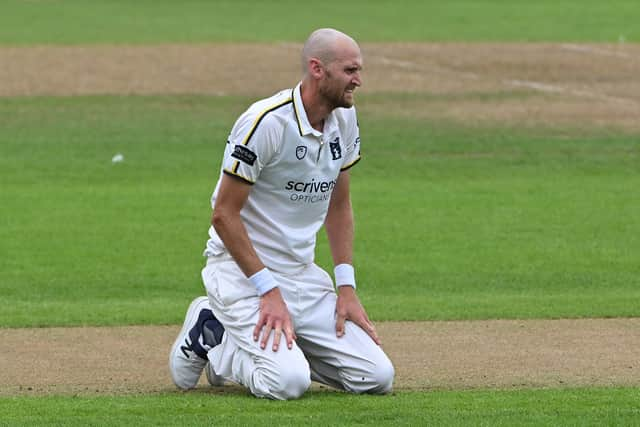
Warwickshire seamer Hannon-Dalby, chair of the Professional Cricketers’ Association (PCA) since the beginning of the year, has been outspoken in his criticism of the sport’s decision-makers, after nearly a year of negotiations over changing the domestic schedule resulted in virtually no change at all.
Nottingham Forest striker Wood, now a member of Fifpro’s global player council, refused to rule out the possibility of strike action after a report from the world players’ union concluded last season’s timetable was “no way to treat a human”.
“It (a strike) is a potential thing I’m sure, but we don’t ever want to get to that point,” said Wood, during a round of media interviews this week, words which echoed those of PCA chief executive Daryl Mitchell a few days earlier when discussing the situation in cricket.
There are doubtless many for whom the notion of professional sportspeople, particularly footballers, going on strike is preposterous. After all, aren’t these people living an existence which is a dream to millions around the world?
That’s the knee-jerk reaction, anyway. A closer examination of the facts, in both sports, suggests the players might have a point. The difficulty, as cricket has found, is finding consensus on how you reshape the calendar in an environment where self-interest typically reigns.
When discussions over a restructure of domestic men’s English cricket began this time last year, there was general agreement something needed to change. Pick out the schedule for any of the 18 counties in the 2025 season and in many cases it will look a mess, with T20 matches wedged in between County Championship fixtures and vice versa, with travel arrangements which quite literally push the boundaries, with some teams being asked to play in the afternoon having arrived back in the early hours of the same day.
A reduction in the number of games was expected and in the case of the T20 Blast there has been some compromise, with counties playing 12 group stage games instead of 14 from next summer.
Mercifully, the tournament will also see its conclusion brought forward two months, from September to July. This will help avoid the nonsensical scenario from this and previous years, which saw teams left with markedly different and in many cases weaker line-ups for knockout rounds which took place weeks after the groups stages had concluded.
The biggest issue for the players, however, is the County Championship. Despite a variety of different proposed restructures, the sport’s longest and most demanding format is staying at 14 matches for the foreseeable future. No alternative structure received the necessary 12 votes from the 18 counties.
“Ultimately the required minimum number of 12 county chairs did not see player welfare as a priority,” said Hannon-Dalby.
The PCA had pointed to a survey of men’s players which showed 83 per cent were concerned about their physical wellbeing under the existing schedule and 67 per cent were worried about their mental wellbeing.
Nearly three-quarters argued the current calendar impacted performance, while even more believe too much domestic cricket is played.
The question over whether the existing schedule produces the best possible cricket is a valid one.
On the second point, however, a cynic might wonder when some cricketers talk of too much cricket being played, they are speaking specifically of the least lucrative form.
Fitting 56 scheduled days of red-ball cricket into a congested summer is certainly no easy task, yet it would be a far sight easier if the month of August wasn't mostly taken up by The Hundred.
Supporters of the County Championship might suggest attempts to reduce it are similar to the way the Carabao Cup and FA Cup have been increasingly squeezed into the margins of the football season by the march of the Champions League.
In years to come the latter might find itself under pressure from the Club World Cup, a competition which despite all the criticism and negative publicity aimed its way, still appears to have done enough to earn at least a second edition.
Its scheduling was a key focus of the Fifpro report, which studied 12 of the teams which entered and found none had the recommended 28-day off-season rest period it recommends.
A review of last year's Euro 2024 tournament, meanwhile, revealed just 14 per cent of players were granted the 28-day break between seasons.
Such a relentless schedule, it argues, places too great a strain on players, leading to more injuries which ultimately damages the entire show.
Fifpro general secretary Alex Phillips pointed out the last two winners of the Ballon d'Or, Rodri and Ousmane Dembele, were both injured at the time they picked up the award.
Less is more? There's certainly some mileage in that argument. It's hard to claim the Euros have been improved as a spectacle since the expansion to 24 teams, while even to some fans the prospect of next summer's 48-team World Cup feels rather exhausting.
Viewing figures for the Premier League were down 10 per cent last season. Maybe it is possible to have too much of a good thing?
On the other hand, you can’t help but think players might get a bit more sympathy if they directed more ire toward the long-haul pre and post-season tours so many Premier League clubs undertake.
The clubs will argue such ventures are necessary to help boost revenues and enable them to keep paying the players wages. A reduced schedule might mean less money and it may be telling that at the moment, you don’t hear anyone arguing for that.
Comment Guidelines
Iconic Media encourages reader discussion on our stories. User feedback, insights and back-and-forth exchanges add a rich layer of context to reporting. Please review our Community Guidelines before commenting.