
Four decades on from one of the lowest Molineux crowds and the dark days at Wolves
On Saturday, Wolves will head to Manchester City for a Premier League fixture in front of an attendance in excess of 50,000. Forty years ago today, a game at Molineux was played out in front of 1, 618. How times change. Paul Berry looks back, with the help of a trio of those involved.
A few years ago, when the Grand Circle was made up of benches, you could have fitted them all in the Grand Theatre with room to spare. The Civic Hall would only have been half full. A figure which would now amount to little over five percent of Molineux’s current capacity.
On this day in 1986, or more to the point evening, Wolves took on Torquay United in the preliminary round of the Freight Rover Trophy.
Wolves, a few months off completing the final of three successive steps on descent from First Division to Fourth, sat bottom of the third tier. Torquay, in the middle of three seasons finishing 92nd, 92nd and 91st at a time when finishing bottom didn’t automatically spell relegation, occupied bottom spot in Division Four.
So it’s fair to say that no one was expecting a classic.
But on that cold January night at Molineux, with half the ground shut due to restrictions following the Bradford fire, only 1,618 trudged relatively unambitiously through the turnstiles.
It was billed at the time as the lowest first team attendance in the club’s history, the previous worst having been 2,000 for a First Division match against Accrington Stanley in 1892.
“They could have announced the crowd changes before the game rather than the players,” quips Dean Edwards, who played up front for Wolves on the night.
Geoff Palmer, twice a Wembley winner with Wolves in the League Cup, including against Manchester City in 1974 in front of a crowd of nearly 100,000, was only a few weeks into a second spell at Molineux having spent a year at Burnley.
Life at Molineux was now very different, as Palmer was quickly to discover.
And with the vast expanse of the South Bank, up there with Aston Villa’s Holte End as one of the biggest terraces in the country, even with only two Stands open, the lack of numbers was there for all to see.
“You could definitely see the gaps, and you could hear everything the fans were saying as well,” says Palmer.
“A lot of it wasn’t too complimentary!
“I hadn’t been too happy at Burnley, and I nearly went to Walsall where Dales (Steve Daley) was playing.
“But Wolves is my team, and my ties were back there – it’s the club I have always supported and the result I always looked out for
“The crowds though, like that night against Torquay, it just felt like it was empty.
“Usually before a home game, I’d have a sleep in the afternoon to be properly prepared and then the enthusiasm and build-up would start.
“Yet during my second spell you’d get to the ground, even walking down into the stadium, and there was no one there.
“It didn’t feel like a proper football match, because there was so little noise and atmosphere.
“And we were struggling as a team.
“The number of players that were coming and going, it felt like we ended up by trying to patch things together from game to game.
“We lost a lot of experience and were just trying to bring players in however we could, and it was never really going to work.”
The lack of crowds weren’t felt by everyone, however.
Also in the Wolves line-up that night was forward Jon Purdie, an 18-year-old in his first full season of competitive football.
A former England schoolboy international who scored five goals in seven games for his country, and graced both Wembley and Berlin’s Olympic Stadium, Purdie came through as a young talent at Arsenal which included playing alongside Charlie Nicholas, Tony Adams, Paul Merson, Michael Thomas and David Rocastle.
Arriving at Molineux with an excellent pedigree, playing regularly even in front of the sparse home attendances, was something he hadn’t experienced before.
“Playing reserve team football at Arsenal at 16 and 17 was pretty much in front of three men and his dog, so even the crowds at Wolves for my first season were way bigger than anything I was used to,” says Purdie, who joined the club in 1985.
“So that was never a problem for me.
“Ultimately when I came to Wolves, it was about trying to get back higher up the divisions, but it didn’t work out that way.
“I’d not really had great coaching at Arsenal before arriving at Wolves, and was put straight into the first team.
“The manager Sammy Chapman must have liked the way I played and gave me an opportunity.
“In that first year, with the small crowds, it was like a revolving door with players coming in and out and the quality and experienced players needing to be sold.
“It was probably a bit like the current Wolves situation over the last couple of seasons, where we lost good players and the ones that came in weren’t as good – and that made it a struggle.”
Meanwhile fellow forward Edwards, like Palmer, was living the dream of playing for his boyhood club having grown up watching from the South Bank with his Dad.
He had been at the club for three months ahead of the Torquay fixture, having scored a 30-yard screamer in the previous preliminary round at Exeter, and his first league goal for the club against Brentford.
“It may have been tough times but it was a dream for me to be playing for the club I supported,” says Edwards.
“We had some quality experienced players like Kingy (Andy King), Alan Ainscow and Tommy Langley but they all had to move on as the club needed to lower the wage bill.
“It all came down to budget, and it just proved that without money in football, it is very challenging to do anything.
“But Sammy Chapman was brilliant in just trying to keep it all together as much as possible.
“Having come in as scout he had those spells as manager either side of Bill McGarry, and I don’t think he had the credit or respect that he deserved.
“He could certainly spot a player - it was Sammy who spotted Neil Edwards and Andy Mutch - but it was circumstances that made it so difficult during the times he was manager.”
Obviously, there was plenty of context around the early to mid-Eighties timeframe which partly explained the drop off in quality and, as a result, attendances.
From winning the League Cup in 1980, to relegation and nearly going out of business in 1982, coming straight back to the topflight under Graham Hawkins followed by an even quicker decline through the divisions, life was never dull.
In the summer of 1986, just a few months after this Torquay game, under the ownership of the Bhatti Brothers, Wolves nearly went out of business again.
That was when Jack Harris and Dick Homden, with Gallagher Estates, and the support of Council Leader John Bird, took on the ownership and laid the foundations for Sir Jack Hayward’s arrival four years later. The rest is history.
But, early 1986 was difficult. And this fixture was as bad as it got, attendance-wise.
Express & Star reporter Eddie Griffiths, describing that Brentford game in which Edwards grabbed the consolation in a 4-1 defeat, wrote that ‘Wolves virtually kissed goodbye to the Third Division with one of the most abject performances I have seen for many a long day.’
And then, around that Torquay game itself, in which Ian Cartwright struck Wolves’ second half equaliser to salvage a 1-1 draw, the intro to the match report from Denis Sunley read: ‘In a season of disaster, Wolves were last night held to a draw by the club in 92nd position in the Football League.’
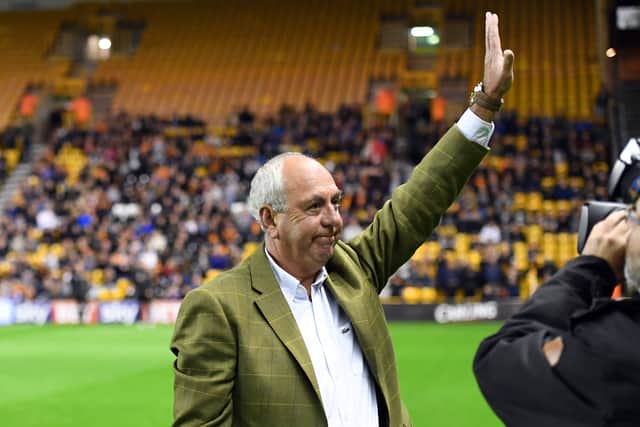

Even if Wolves were heading for that third successive relegation in a crumbling stadium and amid financial chaos, there was still a sense of togetherness among the group of players who were desperately swimming against the tide.
Around the time of the sale of the Castlecroft training ground, the week was often spent at various other venues, including the middle of Dunstall Park racecourse, and of course later, famously, the North Bank Car Park on a Friday.
Facilities at Molineux weren’t great either, with the two sides closed and dressing rooms far from luxurious, but something of a siege mentality was nurtured among the squad.
“Even if results weren’t great, for a lot of us we were young lads enjoying playing football for a living because there really isn’t anything better,” says Purdie.
“There was a fantastic core group and the camaraderie was there, so we did enjoy ourselves when the time was right.”
“The legendary historian Graham Hughes arrived at a similar time as me, and I remember talking to him later and him saying that his first two years were among his favourites,” adds Edwards.
“There was still some soul around the place, it was still Wolves, and we’d still head to the Goal Post and have a drink with the fans.
“I mean, some of the times we had to go out and have some fun because otherwise I’m not sure we’d have coped!”
For the fans too, there remains an almost macabre sense of looking back and feeling slightly proud - maybe even privileged - to have been there.
That vast expanse of the South Bank may have looked painfully threadbare when the crowds weren’t there. But it became a cauldron of noise and passion once the revival kicked into gear.
Loud and vociferous away followings remained a constant throughout, and Edwards recalls notching a winner away at Blackpool and being chaired off the pitch by jubilant Wolves supporters.
There was, as always with Wolves supporters, plenty of self-effacing humour as well.
Dave Meads, then Supporters Club travel organiser, commented on the decision to offer free transport for fans travelling to the Freight Rover tie at Exeter.
“We think they are slightly crazy to want to go to this match anyway so the least we could do was offer them free transport,” Meads told the Express & Star.
The club’s demise even prompted discussion within the chamber of Wolverhampton Council as to whether the colours of carrier bags issued from the town’s markets should be changed from yellow and black to ‘orangey red’.
Drawing this impassioned response from Committee chairman Councillor Phil Richards: “We are keeping faith with our football team even if everyone else is deserting them!”
Wolves exited the Freight Rover Trophy after their two draws as Torquay defeated Exeter to qualify for the next stage.
And yet, only two-and-a-bit years after such a small turnout at Molineux, in the same competition Wolves took 50,000 to Wembley to defeat Burnley in the final in front of over 80,000.
By then the revival was well and truly underway. But only Floyd Streete and Mick Holmes from those who featured in this game against Torquay would get some minutes under the Twin Towers in May of 1988. Although goalkeeper Tim Flowers, kept very busy during that 1985/86 campaign, was the one who would go on to greater heights including a Premier League title and playing for England.
Palmer, who would later do some coaching during Brian Little’s temporary spell in charge, had hung up his boots to become a police officer, and both Purdie and Edwards had moved on after finding opportunities limited under Graham Turner.
Purdie would enjoy a fantastic moment in the sun by scoring the winner for Kidderminster Harriers in an FA Cup giantkilling act against Birmingham, whilst Edwards, driven in part by wanting to show Turner what he was made of, broke the hearts of his hometown team by scoring home and away as Torquay defeated Wolves in the area final of the Sherpa Van Trophy final in 1989.
Effectively the same competition, and same two clubs. But this time the attendance for the second leg at Molineux was 22, 532.
And while the players and staff involved in that spectacular revival deserve all the plaudits their performances delivered, so too those who, despite so many obstacles and challenges, continued to turn out and keep things going when times got so incredibly difficult.
Including playing in front of crowds such as 1, 618.
“I’ve still got fond memories of my time at Wolves, even if it wasn’t the most successful period,” says Purdie.
“A lot of us played for very little money, for our own careers and to try and keep the club going, and I feel very proud to have played for the club.
“And now, to be on first name teams with lads from the era before, people like John Richards and Steve Daley who I had watched on Star Soccer, that is something which is a real honour.”
“I was still playing Sunday League when I first went to Wolves, and was probably getting paid as much for that,” adds Edwards, whose book – Wolves, Gulls and other footballing wildlife - featuring plenty more tales of life at Molineux, is due out at the end of the season.
“Playing for Wolves and then strolling over to Fowler’s Park – it doesn’t make sense, does it?
“But you know what? It’s still there, as part of the history of the club, and I suppose we helped to keep it going.
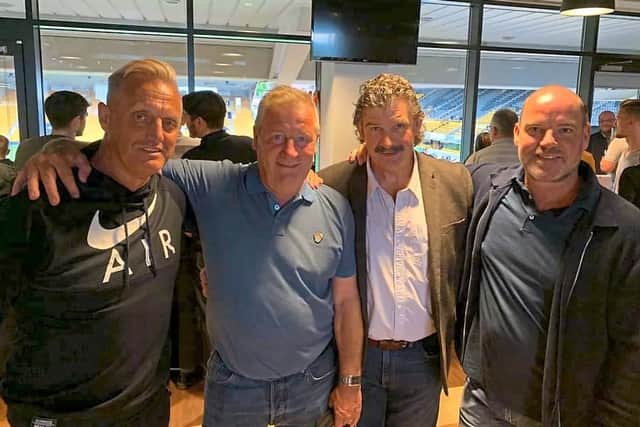
“Wolverhampton Wanderers is still there today, it never went out of business, and that is always the most important thing.”
Palmer, meanwhile, is, along with Paul Dougherty, the only player to represent Wolves in all four divisions, with those memorable Wembley wins a distant memory as he rounded off his illustrious career against Preston in October 1986.
“I’d gone from winning at Wembley to running out in front of one man and his dog, and this was for Wolverhampton Wanderers, the historic team of the Fifties,” he says.
But if there was one positive to come out of such a low Molineux gate, and a figure which you imagine might never be ‘beaten’ for a first team fixture, then it concerned the matchday programme.
The club had toyed with dispensing with their normal programme and simply producing a duplicated teamsheet, but decided to stick with a 16-page publication which contained all the usual features.
Retailing at 40 pence, it sold almost 1,000 copies. Some much needed income to add to the paltry gate receipts. Every cloud.