
Wolves, Blackburn and the opening-day story that could be a very good omen
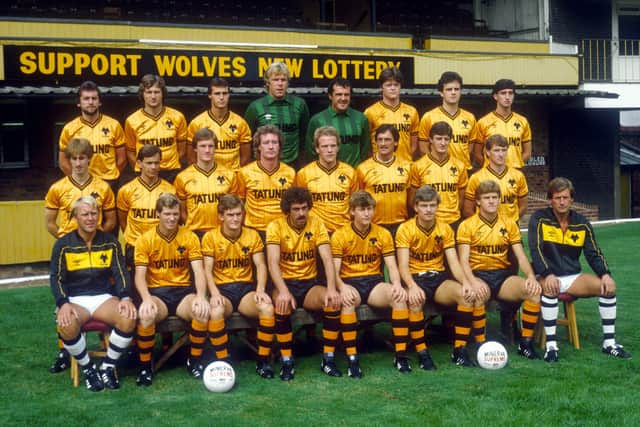
Here we go then, and the start of another Wolves’ league season. Welcoming Blackburn brings back memories of a similar opener back in the early Eighties. Which, despite coming during a time of turbulence, proved a healthy omen! Paul Berry takes a look, with the help of the two-goal matchwinner, the captain and the young debutant who set up the decisive moment.
Playing at Molineux for the first league game of the season. Check.
Blackburn the visitors on opening weekend. Check.
Just been relegated from the top division. Check.
A new manager at the helm for his first league fixture. Check.
Kick off with three points and end up getting immediately promoted back to the top flight? Who knows. But let’s hope so.
Tomorrow night’s Championship opener is one which carries plenty of similarities to that of the 1982/83 season. Wolves against Blackburn, at an expectant Molineux.

The two, who met in the final when Wolves last won the FA Cup in 1960, are not unlikely bedfellows when it comes to locking horns on the opening day.
Between 2003/04 and 2015/16 they were in the same division for seven of the 13 seasons. And kicked off the season in opposition on three of those seven. All of them at Ewood Park, with a sobering 5-1 thrashing in the club’s first ever Premier League fixture in 2003. Steve at the double as Ward and Fletcher secured a 2-1 success in 2011. The ‘hand of Eddo’ then played its part in grabbing the winner after Benik Afobe’s opener had been cancelled out four years later.
And this last time the two met on the opening day at Molineux, some 44 years ago, also ended in a 2-1 victory for the men in gold and black. But that doesn’t even begin to scratch the surface as to the full story of Wolves at that time.
Because just four weeks earlier, at the end of July, they had almost gone out of business.
“I thought we’d gone,” admits Geoff Palmer, who would end up sharing captaincy duties that season with Kenny Hibbitt.
“It went to the last day of the deadline for someone taking the club over, and it was getting very close to 5 o’clock.
“I was by the radio all day, listening in, because we didn’t really know anything and that was the only way I was going to find out.
“It ended up going down to maybe three minutes to five I think. So yes, I’d definitely had a few thoughts about what I might do next if I wasn’t a footballer.
“I think I’d have ended up pushing a milk float around somewhere you know!”
And yet, four weeks later, there was Palmer, leading Wolves out for an opening day victory that provided the perfect launchpad to the season and strong impetus for a superb first couple of months under the new regime.
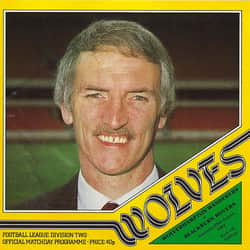
That new regime? It was the one featuring the notorious Bhatti Brothers, owners of Allied Properties, and a figurehead who was already both well-known and extremely popular among Wolves fans from his time as a player: Alexander Derek Dougan.
The summer had been one of turmoil with various power struggles taking place behind the scenes which, at times, knocked the Falklands War off the top of the headline news. Because no club had really been in this situation before, let alone one like Wolves, who twice landed one of the game’s major trophies within the previous eight years, and had been pioneers across Europe less than three decades earlier.
The 1981/82 season had been a disaster, finishing second from bottom and being relegated, but also suffering serious financial difficulties, worsened by the splashing out of £1.5million on the new Molineux Street Stand.
Described as ‘Marshall’s Folly,’ in reference to chairman Harry Marshall, the declining financial situation prompted efforts to remove him from office, initially sparked by Roger Hipkiss bringing together fellow shareholders to deliver a vote of no confidence at an extraordinary general meeting in early June.
Various controversies followed, including around whether a ballot of shareholders, ending in Marshall’s favour, was valid, but ultimately there was sufficient heat generated to prompt the Chairman’s resignation.
Doug Ellis and former Wolves keeper turned successful businessman Malcolm Finlayson took over as chairman and vice-chairman respectively, but they soon realised there was no other option than liquidation, with official receivers brought in.
‘Wolves have gone bust’, read the Express & Star headline of July 2nd, citing debts of £2.5million with the club’s existence now very much under threat.
Much went on both in public and behind the scenes as the weeks progressed but, to cut a very long story short, as the deadline approached, amid a confusing picture, it was reported that there were still four main candidates.
Dougan’s consortium, another led by Walsall chairman Ken Wheldon, which included backing from Sir Jack Hayward, one from Rotherham’s chairman Anton Johnson, and, waiting in the wings, Ellis.
As the deadline neared, eventually it was the Dougan-fronted group which secured the necessary funding, and the deal was done.
A lot of the groundwork to help put together the rescue package to keep the club afloat featured Doug Hope, who is still very much a Wolves fan around the city today, who would become Dougan’s Vice-Chairman.
Manchester property dealer Michael Rowland and architect John Starkey were the representatives from Allied Properties, and eventually Mahmud and Akbar Bhatti would become more involved.
On taking over Dougan quickly set about stamping his authority on proceedings. Commercial manager and Wolverhampton’s World Cup final referee Jack Taylor was soon dismissed, as was first team manager Ian Greaves. There was speculation that Shrewsbury boss Graham Turner – who would actually take the helm four years later – might be his replacement but ultimately that responsibility fell to Graham Hawkins, Turner’s then assistant.
Hawkins, then 36, had previously been on the Molineux groundstaff and made 35 appearances for the first team, and was billed as the first ‘Wolves man’ since Stan Cullis to occupy the managerial hotseat.
“I have not come here with any preconceived ideas,” Hawkins told the Express & Star upon his arrival.
“I just want to get my tracksuit on and watch the players work.”
Mel Eves, like Palmer, a boyhood Wolves fan who had grown up in the city, was another of the more experienced members of the squad at that time.
“We had all got on really well with Ian Greaves and were surprised when he was dismissed – we’d have been very happy to carry on working with him,” says Eves.
“But in the end it proved a masterstroke to bring Graham in.
“He was a lovely bloke but also a very good coach, and brought in Jim Barron as his number two who was also excellent.
“After listening to Graham and what he wanted to do, we all bought into it straightaway, and set about trying to put it into practice.”
Hawkins had three-and-a-half weeks to mould a team for the Blackburn opener. One hugely key signing was to bring in John Burridge from QPR. The much-travelled and highly experienced ‘Budgie’ was a key addition not just for his goalkeeping but his impact behind the scenes.
“Budgie became my room-mate, and like most goalkeepers, he was that little bit eccentric,” says Eves.
“On the night before an away game, I’d have to throw oranges across the room so he could test his reflexes.
“But in the dressing room, he was incredible. He just kept everyone on it and alive, and helped make the atmosphere different class.
“You don’t play at the top level as long as he did, into his Forties, without a commitment to the highest of standards, but when the pressure was on, he would often tell one of his stories, and that pressure was just lifted off.”
That dressing room atmosphere would prove vital. Club captain John Richards was sidelined with a knee injury, and would later join Derby on loan after his opportunities became limited. Fellow striker Andy Gray, already suspended for the first two games of the season, cracked a bone in his elbow in a friendly against Oxford although recovered quickly enough to return for the third.
So it was that Wolves lined up on opening day with a 16-year-old debutant David Wintersgill, normally a full back but played in midfield in front of Palmer on that occasion, Billy Livingstone, who had just turned 18, making his first start up front, and winger Paul Butler, also just 18, on the bench.
For Butler, it would prove a special afternoon. He had arrived at Wolves from his native Stockton-on-Tees as a 16-year-old, initially on a two-week trial, before being taken on as an apprentice.
“David is up from my neck of the woods as well, and the three of us, David, Billy and myself, were hoping to make our debuts,” Butler recalls.
“I was feeling good in training on the Friday, and then I remember seeing all the BBC vans at the ground, which is how you knew that the game was going to be on telly.
“Then I was on the bench, and those feelings of nerves, which tend to disappear once you get on.
“It’s a funny one and I say to my mates now. If I am playing squash against them or whatever, and there's two people watching, I’m really nervous.
“But thinking back to playing football in front of 20,000 people, it never seemed to bother me!”
For Hawkins meanwhile, his first game in charge came against a team he had represented as a player. It was to prove quite the occasion.
Dougan, ever the flamboyant showman, helped whip up the atmosphere amongst the fans, with a pre-match message in the Express & Star, calling for ‘everyone to stand up and be counted’, then heading onto the pitch pre-match before watching the remainder in three of the different stands. He was also pictured on the front of the match programme.
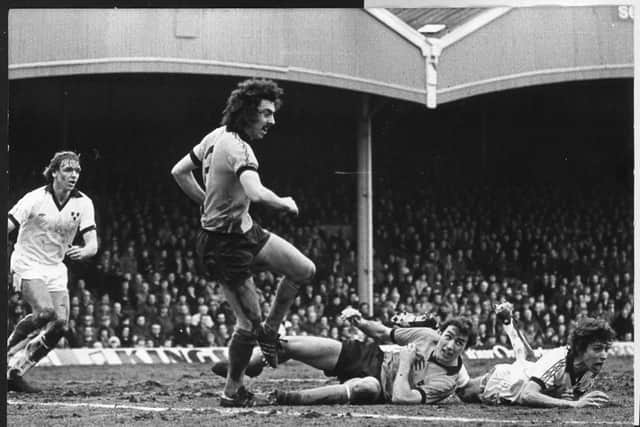
Simon Garner put Blackburn in front midway through the first half as they aimed to spoil the party, but Wolves held firm, and it was Eves who was to prove matchwinner, two second half headers ensuring the majority of the 15,605 crowd went home happy.
“It’s strange because I don’t think any of Andy, John or myself were over 6 foot tall, but we were all pretty decent in the air, the other two especially so,” says Eves.
“So, for me to get two headers that day wasn’t completely unusual.
“It is always so important to get off to a good start, especially after everything that had gone on in that summer, so to be a goal down at half time wasn’t ideal.
“That’s where Graham as the manager earns his corn, he fired us up for the second half, and the fans stayed with us, which did the trick.
“People went away from the stadium with a bit of optimism, and it gave us some momentum to kick on at the start of a new era.”
Another who certainly went away with some optimism was debutant Butler, coming off the bench to replace Livingston in the 76th minute, and crossing for Eves’ winner barely 60 seconds later.
“I wasn’t sure I’d get on but then I got my chance, and it was all about trying to take it,” says Butler.
“I think Branigan was the name of the Blackburn full back, and I managed to take him in and put a good ball in, and Mel was on the end of it!”
That goal sealed a win which not only brought a positive vibe to what had been a very turbulent summer. As Eves recalls, it brought momentum, and plenty of it.
There were some very big clubs in the Second Division that season. Wolves drew their next two games on the road at Chelsea and Leeds, both 0-0. Also in the league were Newcastle, Sunderland, Leicester, Fulham, Sheffield Wednesday.
Yet Wolves blazed a trail ahead of all of those in the early weeks. After those two draws, they won their next five league games, scoring 12 goals and conceding none.
In all, they were unbeaten for the first ten league games, also going 817 minutes without conceding a league goal, and whilst they were ultimately overhauled by QPR after struggling at times in the second half of the season, it was still more than enough to secure promotion as runners-up.
For Palmer, especially as captain, coming three years after being one of four players to win his second League Cup with the club, it was a proud moment.
“There wasn’t a lot of experience within that side, and when you think of the debutants like David, who was 16, and Billy and Paul Butler, both 18, it was a great opening day,” he says.
“Especially with the Doog going on the pitch and then in the stands – I think there were more cameras focused on him than the match!
“It was a close game but a very good start and quite an achievement to get promoted because there were some big clubs in the league that season.
“Being captain was definitely a proud moment.
“I remembered how when I was a young kid, the senior players looked after me, and that’s what I tried to do that season, along with the other experienced lads.
“It was a responsibility but a nice one to have at that stage of my career, because you have to think a lot more about your team-mates than yourself.
“Given what had happened in the pre-season and how Graham Hawkins had to quickly build a team, it was a great achievement to get promoted.”
It was also a proud moment for Eves, finishing as top scorer with 18 goals, Gray (10) and Wayne Clarke (12) also hitting double figures.
“We had a lot of different attacking outlets that season and it showed with the success that we had,” Eves recalls.
“What had happened in the summer wasn’t ideal but Graham got us organised pretty quickly and we just controlled the controllables and didn’t worry about anything else.”
After such an impactful debut, Butler would go on to make 35 appearances in total, scoring two goals, including a late equaliser past Burridge in a 2-2 draw at Sheffield United a couple of seasons later.
A loan spell with Hereford proved the prelude to what would be a permanent move in 1985, chalking up over a century of appearances, and yet, all these years later and settled back in Teesside, the Wolves memories are still very strong.
“I was on the bench a lot but played a few games for Wolves and got a couple of goals, but when Hereford came in for me, (manager) Tommy Docherty told me that the club was going downhill and advised me to leave,” he recalls.
“When I look back now, I loved my time at Wolves, and, any chance I get, I tell people up here that I was fortunate to play for the club.
“When I was there, I was in digs a couple of doors up from the Crown on the Wergs Road, and made some good friends there, although we have lost touch over the years.
“It’s all changed massively now of course, but I still keep an eye out for the results and am proud that I made those appearances.”
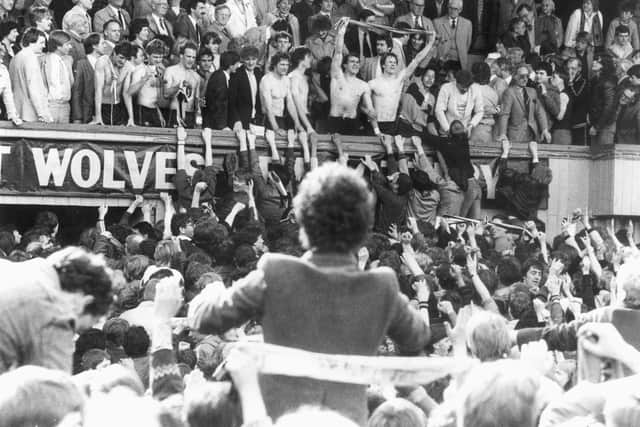
Butler enjoyed his role at Wolves and in the promotion, as did the team. But it would prove as good as it got for many years, as the club embarked on three successive relegations, nearly going out of business again, before the late Eighties revival.
And that was a demise which no one would have predicted that on a sunny opening day afternoon when Dougan took centre stage, and Wolves kicked off with three points against Blackburn.
Comment Guidelines
Iconic Media encourages reader discussion on our stories. User feedback, insights and back-and-forth exchanges add a rich layer of context to reporting. Please review our Community Guidelines before commenting.