
The lively career of Wolves loanee and Ipswich hero Carlos Edwards
Saturday’s game between Wolves and Ipswich promises to be a pretty lively one given the two clubs’ positions in the Premier League table. But not as lively as the career of a winger who represented both. Paul Berry catches up, not literally, with Carlos Edwards.
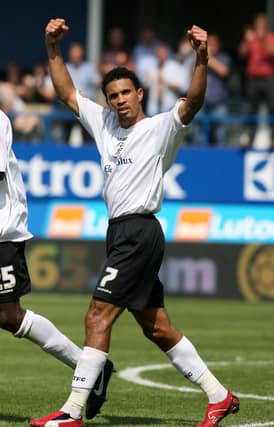

From shooting a gun to shooting at goal. From sun-drenched days in the Caribbean to the sometimes bracing cold and wind of North Wales. From playing in the Trinidad &Tobago league to running out at Anfield and Old Trafford.
The footballing journey of Carlos Edwards is quite the story. And he wouldn’t have it any other way. “I should write a book,” he says with a hearty laugh.
“It could be a bestseller!”
The affable Edwards, now 46, has something of a stake on both sides of this weekend’s massive Premier League encounter between Wolves and Ipswich at Molineux.
Perhaps more so for the visitors – he is an ambassador for the Tractor Boys and his family home is in the area – but that’s not to say he hasn’t still got fond feelings for all things Wolves following an ultimately all-too-brief spell on loan in late 2008.
That Championship-winning season, packed with so many exciting attacking threats and so many goals. It may have been a small role, part of the supporting cast, but Edwards played it.
A winger, and later a wing back, with the capability to glide across the playing surface with the ball at his feet, not to mention chip in with assists and goals, the freedom to play his game was always the priority for this particular footballer.
“From the day I first stepped inside the training ground, I really enjoyed my spell at Wolves,” recalls the Trinidad & Tobago international.
“There was such a good group of attacking players there such as Kightly and Jarvis, Sylvan Ebanks-Blake and Chris Iwelumo, and so many other good guys including Karl Henry and Kevin Foley.
"They were all so tight knit, even in just a short space of time I could see how Mick (McCarthy) and TC (Terry Connor) had got them all playing and being all together as a unit.
“Everyone was enjoying their football, both playing and in training, even the guys that weren’t in the team.
“In the end it was a shame I had to leave so quickly as I was called back by Sunderland, just as I was getting into my stride.
"I was about to come back from international duty when I got the call from my agent that I was to head back to Sunderland, even though I had a month of the three month contract remaining.
“When I went back, I wasn’t really starting games so it’s a shame I wasn’t able just to finish the loan off even if it wasn’t going to lead to anything else.”
Roy Keane was the manager of Sunderland at the time, prompting Edwards to be slightly surprised that the loan had been sealed with Wolves in the first place, given the history between him and then Republic of Ireland manager McCarthy following the fallout from the Saipan affair at the 2002 World Cup.
The two had, however, long moved on from that controversy, even though it is set toreturn to the public consciousness with the release of a film next year starring Steve Coogan and Eanna Hardwicke.
“That should be an interesting watch,” Edwards admits.
In truth, he believes that both managers adopt very similar characteristics when it comes to their approach and styles of leadership.
Relentless, demanding, uncompromising, but equally willing to forgive and forget mistakes if they can see 100 per cent effort and work rate.
For Edwards, the ability to deliver that level of approach and commitment alongside his undoubted technical ability helped him shine under both, for Keane at Sunderland and later when signing for Ipswich, and for McCarthy in that short stint at Wolves and also later at Portman Road.
“Roy used to tell me that if I saw I was giving 100 per cent every game, even though he knew I wasn’t going to be outstanding every game, he could work with that,” Edwards explains.
“And Mick was the same, he was always demanding hard work off everyone and what you saw is always what you got.
“He was always honest, and if you weren’t playing, he would always get you in the office and tell you why.
“Even if it was something you didn’t want to hear, it was always better that way, and he would always tell you what you had to do to get another opportunity.
“TC is a top man as well, and a great coach, and I enjoyed working under them both.
“I think maybe because Mick and Roy were quite similar in their approach, that could be why they fell out that time, but they definitely knew how to get the best out of players, and they both did that with me.”
The sort of hard work and determination which Edwards showed throughout his career was a trait developed in his formative years, with quite the different, potentially unique, football upbringing.
Born in the tiny rural enclave of Patna Village, near the town of Diego Martin situated to the west of Trinidad & Tobago’s capital Port of Spain, Edwards attended St Anthony’s College in Westmoorings, as did his future team-mate for club and country, striker Kenwyne Jones.
In terms of an ‘apprenticeship’, how about three years of intensive military training, alongside playing in the Trinidad & Tobago professional league, including with the hugely successful Defence Force team?
Even though, having left school and initially combined a labouring job with playing semi-professionally, it wasn’t necessarily the path which Edwards was looking for.
“I really didn’t want to go into the military – I was like, ‘hell no!’” he admits.
“I was a scaredy cat – it wasn’t something I was even considering.
"But the one day, my college coach drove to my house at 5 o’clock one morning, and literally banged on my door until I woke up.
“He said I was going to military training and told me to get changed and I quickly stuck on my boxers, shorts and a t-shirt and chucked some other stuff into a plastic bag.
“He drove me to the military base and the rest is history – three years of very hard grit and grind.
“Because we are such a small island, it wasn’t training to prepare to go off and fight a war somewhere.
“But we have a country to defend from domestic and international issues just like any other, so that is what it was all about.
“We were doing everything that was needed to be in the military.
”When he says ‘everything’, does that include practising warfare, learning to use weapons? “Absolutely,” Edwards replies.
“The whole shebang! We weren’t messing about with water pistols.
“But when I look back now, it was a blessing in disguise for so many reasons.
“First of all, it was a stable job, getting a salary from the government, and not having to worry at the end of each month about where the money might be coming from.
“And then, it was also a new opportunity, meeting new people, and going through the training and learning so much about discipline and being able to do things that you didn’t really think you would be capable of.
“I think what I experienced over those years was what propelled me to make a career in England, the hard training gave me what I needed to be successful in the challenging environment of professional football.”
Nigel Grosvenor was the college PE teacher who helped launch the careers of both Edwards and Jones, but it was another Jones – Welsh legend Joey – who arranged a three week trial with Wrexham with Dennis Lawrence and Hector Sam after scouts had noticed plenty of footballing talent operating on the island.
“It was back in December of 1998 and I didn’t really know what on earth to expect when arriving in North Wales,” Edwards recalls.
“It was that cold I was expecting to see some polar bears and penguins roaming about.
“I always remember one of the games when I was on trial, it was behind closed doors, away at Shrewsbury on a cold and wet Tuesday night.
“The first time I got the ball, their centre back absolutely cleaned me out and, as I got up, mud all over my face, he said: ‘Welcome to England.’
“He was right though, it made me realise it wasn’t all about the flair of the football we played in Trinidad & Tobago and that I needed to have the physical and aggressive side too.
“Fair play to that defender, it opened my eyes to what football was all about and what I had to expect.
“It all went well and they wanted to offer me a deal but it then took ages to get a work permit, going to hearings and appeals and all sorts.
“Fair play to Joey, he stuck it out with me, and eventually I signed in July of 2000.
“That was the start of a fantastic five years with Wrexham which could hardly have gone any better – I absolutely loved it."
The many career highlights of Edwards’s 16 years in the English game were numerous, and began during that initial spell in North Wales.
Twice in succession he was named in the PFA’s Team of the Season, as he would be once more with Sunderland, he helped Wrexham win promotion from the equivalent of League Two, as well as the Football League Trophy with a 2-0 victory over Southend at the Millennium Stadium in 2005, former Wolves midfielder Darren Ferguson among the goalscorers.
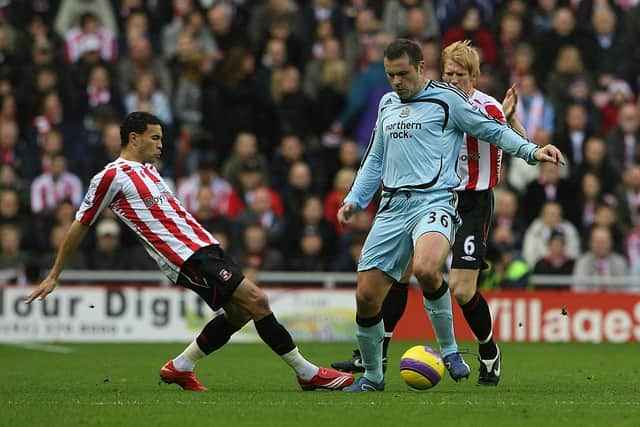
From Wrexham, Edwards moved up to the Championship with Luton, and then Sunderland, for a hefty £1.5million, where his career continued to escalate. It was on Wearside where he picked up his treasured 35 Premier League appearances, having played a key role in helping the team get there, most notably during an epic five-goal thriller against Burnley towards the end of 2006/07.
That was the season when McCarthy’s young and hungry Wolves lit up the Molineux fanbase by reaching the play-offs, but Sunderland would go one step better, two in fact, by not only securing automatic promotion but also the Championship title.
The final home game of the season saw Burnley visit the Stadium of Light for a tumultuous Friday evening’s entertainment in front of a raucous crowd of 44, 448.
Edwards, who was destined to play such a decisive role, explains it best.
“When I was at Sunderland so much of it felt like we would have everything in our hands and then, in the last minute, throw it away,” he admits.
“Burnley was almost one of those games but ended up being the opposite. “We took the lead, missed a penalty to go 2-0 up and Burnley equalised with a penalty and then took the lead.
“I got brought down for a foul and David Connolly scored the penalty before, with ten minutes left, I managed to get the winner.
“It was one of my best ever goals, a shot from distance into the top bins, and is one of those moments which I will never ever forget.”
It was a hell of a strike. Like an Exocet, arrowing into the back of the net in the blink of an eye.
There were more highlights to follow having later been signed by Keane at Ipswich, including a run to the League Cup semi-finals, becoming captain and being named Players’ Player of the Year.
His career on British soil was rounded off at Millwall, before returning to Trinidad & Tobago for a couple of short stays before heading back to set up his family home back in Suffolk.
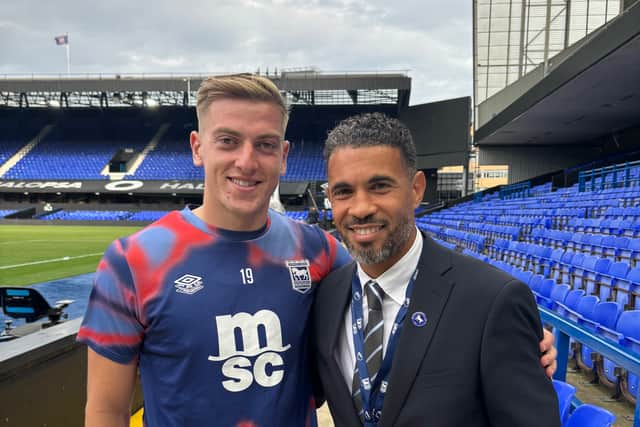
Now an ambassador with Ipswich, Edwards was also still playing in non-league as recently as last year, with Hadleigh United, before finally hanging up the boots, with the exception of charity games.
“I loved playing football, but I just couldn’t do it anymore,” he admits.
“I still felt I could do a job down the wings but my range became in and around the centre circle, trying to spray passes around!
“I’ve had my time, and weekends now if I’m not at Ipswich are about family, including my daughter who loves football.
“She is doing really well, and enjoying playing, but I have to say it’s been my wife who has been the head honcho with pushing her to get involved and picking the right teams and so on.
“She is now playing for Ipswich Under-13s girls, which is brilliant, and I love watching her and taking her to training.
“We always enjoyed living in Ipswich, so coming back and calling the place home was the perfect thing to do, my wife and kids are all really happy here."
With his current roots and the longevity of his time with Ipswich, Edwards could be forgiven for siding with the Tractor Boys in Saturday’s crucial showdown featuring two of the Premier League’s bottom three.
Ultimately though, he looks out for the results of all of his former teams and is keeping fingers crossed that both Wolves and Ipswich can escape trouble at the foot of the table.
And while life now may be located in the blue half of East Anglia, Edwards will always cherish home, and the incredible achievements which he first dreamt of backin the village of Patna in Trinidad & Tobago.
None more so than chalking up over 90 appearances for his national team, and appearing at the 2006 World Cup in Germany – only the fourth country from the Caribbean to do so - which included being goalless for 80 minutes against England before falling victim to a couple of late goals.
Those achievements with the Soca Warriors earned Edwards the award of the Chaconia Medal, the second highest decoration of Trinidad & Tobago, whichhonours long and meritorious service to promote national welfare or community spirit.
A remarkable accolade to illustrate a remarkable career.
“Getting to the World Cup with Trinidad & Tobago was unbelievable, just to be on the biggest stage of world football is something we had all dreamed of,” says Edwards.
“To represent your country on that sort of stage is something I can’t really find the words for, and something no one can ever take away from me.
“Sometimes it’s difficult to believe, that I came from a small village and went on to fulfil my lifelong dream of not only playing in England but also in the Premier League and at a World Cup.
“A lot of it was about belief, I always knew that I had to believe in my ability, whoever I was coming up against.
“I always wanted to challenge myself against the biggest names and the biggest teams as that was the only way to see if you could go to the next level.
“I will always feel I was so blessed to have the chance to live my dream – and I enjoyed every single moment of it.”
Comment Guidelines
Iconic Media encourages reader discussion on our stories. User feedback, insights and back-and-forth exchanges add a rich layer of context to reporting. Please review our Community Guidelines before commenting.