
Liam Hughes finds his happy place
Looking in from the outside, Liam Hughes had everything.


A tall striker with a decent turn of pace, strong in the air with a powerful left foot and a clinical eye for goal.
At 18, after spending a large part of his childhood within Wolves’ Academy, he signed his first ever senior contract. A step closer to the first team, a step closer to the one place where he had always wanted to be.
On the inside however, Hughes certainly didn’t have everything. More accurately, he had nothing.
On the inside he was desperately struggling. Mentally, he was in pain. Unable to understand why, and, for the most part, uncomfortable about speaking up.
At the age of 20, Hughes was released by Wolves. A regular routine of fast cars, late nights, and various substance abuse – all to try to mask the mental anguish – was simply not conducive to the life of a burgeoning professional footballer.

A year later he was involved in the robbery of a local shop not too far from his home in Gornal. That led to a jail sentence, prior to which he was stabbed in an altercation.
That, in summary, provides the nuts and bolts of the Liam Hughes story. A story of missed opportunity but also of misunderstanding, of unrelenting pain and unbearable torment.
Behind it, the words and emotions offer a sobering reminder of the suffocating expectations and pressures which can afflict a young footballer who throws everything at their hopes of a career.
Yet fast forward a few years, and it also becomes a story about the power and resilience of the human spirit.
Hughes is acutely aware that he has let people down. That so many relationships with family and friends suffered because of his behaviour. But now he is making amends.
There is an argument, at one stage a likelihood, that he might not even have been here to be able to tell the tale. Thankfully, he is.
We meet for a coffee on an early Tuesday evening at the café at Morrisons supermarket in Bilston. Hughes bounds in with a spring in his step and a smile on his face. He has a very early start the next day, off to Leeds where he supports friend Chris with running several cafes.
His business ambitions also include – and this is the Holy Grail – one day opening a football academy in Tenerife.

By the end of the conversation, there is very much the impression that this should not be labelled as the story of a failed footballer but one of recovery and redemption. There is much that he still wants to do.
“Yeah, things are good at the moment. I’m feeling great and enjoying life,” he begins. “I’m still here you know, because I’ve been in such a dark place that when I look back, as bad as things were, sometimes I haven’t got a clue how I made it through. I was a kid who didn’t know what to do or where to go in life, and I just kept all those feelings in and eventually they just built up and it all spilled over.
“To be honest, it could have been way worse because I could have carried on living that life and carried on being in all that pain.
“But it’s done now, and I can talk about it, because I’m in a good place, with good people around me, and where I believe I can help others who might be going through similar experiences – I have found what I need to do and where I need to be in life.”
Hughes’ footballing story began like thousands upon thousands of others, as a young boy, kicking a ball against a wall for hour upon hour every day near his home in Gornal, playing for a local junior team, dreaming of what might one day be around the corner.
He was first taken on by Wolves Academy at the age of 10 and recalls with fondness the wise counsel of coaches and staff such as John Trewick, Glyn Harding, Carlo Federici and John Perkins, both on and off the pitch, not to mention the highlight of those formative years, winning the Shizuoka World junior tournament out in Japan in 2001.
Then at 18, the dream moved a step closer to realisation, as Hughes signed that first professional contract. And yet, if it looked like the footballing career was progressing nice and serenely on the surface, mentally, Hughes was kicking and screaming below the water line.
“I can still remember getting the call about my professional contract, which is all I had ever wanted,” he recalls. “But it just didn’t make any difference, I was completely stuck in a rut. I’d been losing myself from about 16 onwards, I can’t put my hand on why and there was nothing in particular that happened, but I was on a slope, and I couldn’t stop falling.
“How I was living, what I was doing away from football, it just wasn’t right. Instead of eating the right foods, preparing properly for football, getting enough sleep, I was doing all the things that I shouldn’t do – going out late, getting in with the wrong crowd, not giving my body time to rest.
“I just couldn’t understand myself, and I was weak mentally, so I would be a people pleaser and wouldn’t be able to say ‘no’ to all the other stuff away from football.
“I was a young lad who wasn’t living right, and was going at 100 miles an hour whether that was fast cars, drinking, going out – I just never knew how to slow it down.
“And at that time, I just felt it would be a weakness to speak out, to try to tell people how much I was struggling.”
What is clear throughout that this conversation is that Hughes admits there is absolutely no one else to blame but himself. There is no bitterness or recrimination, no feeling that Wolves could, or should, have done more.
He remembers first team managers Glenn Hoddle and Mick McCarthy being available and approachable, Terry Connor – then a coach – exactly the same, and it was also the time when young players had access to counsellors Mike Wood and former midfielder Jeff Whitley, brought in by McCarthy to deliver advice and guidance to the club’s young talent.

Under the encouragement of McCarthy and Wood, Hughes took the opportunity to try to address his issues, with a 28-day stay at a Sporting Chance clinic in Hampshire, receiving specialist mental health support.
“Mick and ‘Woody’ were great with me, they tried everything, and I owe them the utmost respect,” says Hughes. “They got me into Sporting Chance, which is an unbelievable place.
“I have never felt as good as I did when I came out, so sharp mentally and physically, and in the best shape of my life. I was getting up early in the morning, fresh and ready, I was training well, and yet, two or three months on, I gradually slipped back into the old habits of doing the wrong things.
“So, while the help was there, I can only ever blame one person, and that is myself.”
Hughes was still performing on the pitch even though he was experiencing such darkness with his mental health.
He picked up his four senior appearances on loan at Bury, and had another temporary stay with Stafford Rangers under the management of Steve Bull, and was still scoring goals for Wolves reserves whilst relishing taking on some of the big boys such as Steven Gerrard with Liverpool and Jonny Evans and Gerard Pique with Manchester United.
But when the inevitable rejection arrived, even though there were offers including heading out to Hoddle’s Academy in Spain, Hughes didn’t want to leave his home turf.
He admits he was ‘scared’ to spread his wings, but in staying at home, and not escaping that chaotic environment, his decline continued.
There is a quote that says that reaching rock bottom teaches you lessons that mountain tops never will. And Hughes was about to hit rock bottom.
In February 2010, he and a friend ended up robbing a local shop in Lower Gornal, claiming to have a gun, an incident which would ultimately lead to him serving 14 months of a 32-month sentence, before being released on tag.
There had even been time for him to get stabbed in an altercation before being apprehended and taken into custody.
The robbery was not planned or premeditated. The complete opposite. Hughes was strongly under the influence of drink, and in need of money, and, in the spur of the moment, sunk to his lowest depths.
“I had been on the wrong road for a while and was no good for anything,” he recalls. “That is where I was mentally, going around doing stuff off the cuff, and it was a terrible, terrible thing to do – it should never have happened.
“That was rock bottom, it couldn’t get any lower than that and I think I finally realised that it was time to stop.
“I was in hospital after being stabbed when I was caught and ended up in jail walking around with a Zimmer frame. I wouldn’t say I have ever properly thought about killing myself, but at that point I wasn’t scared of dying, and remember thinking that if it was going to happen, then let it happen.
“But do you know what? I knew that was my worst point, being in jail where you need to look after yourself, and not being able to walk properly, but it was from there that things started to get better.
“I found myself in a good routine, getting up and making my bed, going to work in the prison and doing courses in areas like decorating and labouring, and there was enough there to keep me mentally right.”
On being released, Hughes stayed away from football for a few years, blaming the game for his traumatic experiences, and found obtaining work difficult, due to his criminal record. But he was now equipped enough to negotiate life’s up and downs with both strength and humility and, to his immense credit, continued to move forward.
He eventually returned to play football at non-league level, including to prolific effect at Sporting Khalsa, which also featured returning to Molineux to score in the final of the JW Hunt Cup.
More recently, he has greatly appreciated the invitation from Jody Craddock and Mel Eves to turn out for Wolves Allstars, where he once again found the net at Molineux in a game earlier this summer.
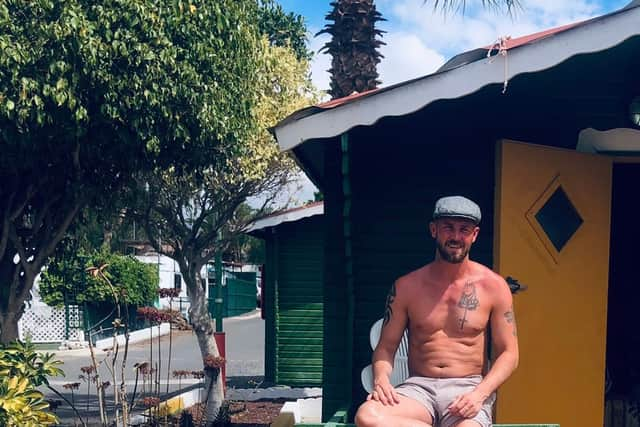
Work-wise, things have also been looking up, with those cafes and business interests alongside his friend in Leeds, and plans to retake the coaching qualifications gained many years ago as part of an ambitious plan to one day open his own football academy in Tenerife, a place he feels fortunate to be able to visit regularly.
For players who are struggling to cope with rejection, players who need some support and guidance before trying to return to the system, there can surely be no better advocate.
“I really I think I might be able to help people now, and the long-term ambition is to open an Academy, to try to help players of all ages, but particularly those that may have been rejected or have nowhere else to turn,” he insists.
Mentally, Hughes is now in a very different place. Whilst in prison, he took great strength from starting to pray, a process he has continued, and one which brings him energy and lessens any weight when tough times come calling.
He also reads, and can turn to meditation and yoga when necessary, as well as listening to more relaxing music, all of which is designed to quieten the mind which had become so accustomed to operating at 100 miles an hour.
“I believe that the way I was going, what happened to me had to happen to me if I was ever going to change,” he admits. “Life sometimes doesn’t work out like we want to, and of course I’d prefer the footballing journey to have worked out – we might be having this conversation in a mansion if it had!
“I do sometimes have to remind myself where I have come from and what I have been through, and at first it was hard to look in the mirror and be honest with myself, but now I feel so much gratitude in my heart, and my life is in a much better place.
“Nowadays I can get up and take pleasure in feeling happy and fresh in a morning, just looking outside and seeing the flowers growing and the sun coming up. Because there was once a time when I probably wouldn’t have been able to tell you if it was day or if it was night.”
Comment Guidelines
Iconic Media encourages reader discussion on our stories. User feedback, insights and back-and-forth exchanges add a rich layer of context to reporting. Please review our Community Guidelines before commenting.