
How Wolves plunged to the lower leagues and nearly ceased to exist - Part 1: Calm before the storm
In more detail than ever before, the Express & Star tells the full Bhatti brothers story - a troubled era which saw Wolves plunge to depths of the lower leagues and face financial oblivion. In part 1, we look at the calm before the storm - how the bold ambitions of the football club's former chairman Harry Marshall plunged the League Cup winning side into crisis.


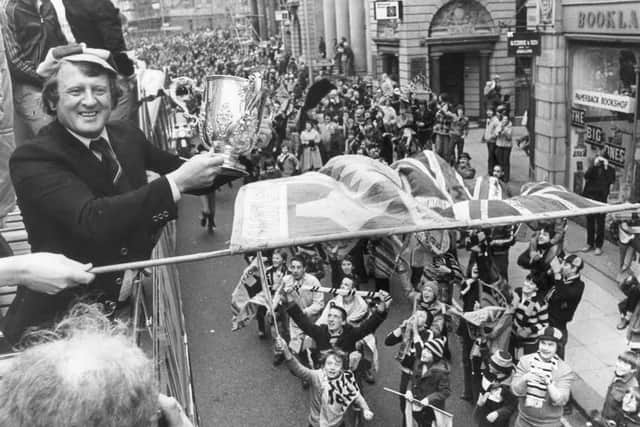
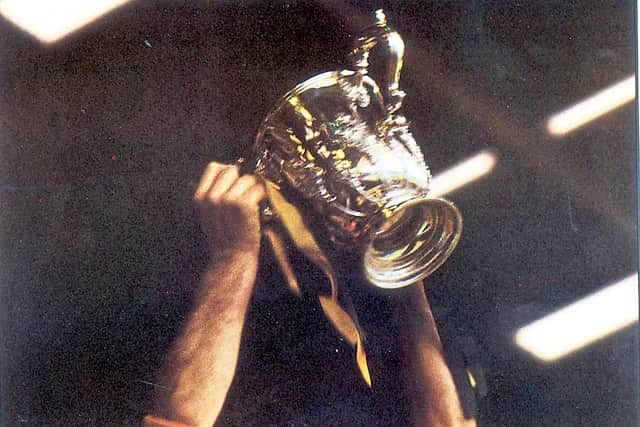
"King Andy makes Wolves £1m pay-off", screamed the headline on the front of the Sporting Star. Five months after signing for Wolves in a deal that broke the English transfer record, Andy Gray appeared to have paid off a big chunk of that fee with a goal that won Wolves the League Cup.
Manager John Barnwell said that while the win had secured Wolves a place in the UEFA Cup, his sights were now set higher than that.
"Now that we are in Europe, we can look forward to the ultimate, the European Cup, just like Nottingham Forest did after Clough and Taylor arrived there," he said.
Wolves skipper Emlyn Hughes was equally ebullient. He said there was no reason why the club couldn't dominate English football in the 1980s in the same way that his old club, Liverpool had done in the 1970s.
Wolves striker Mel Eves, who had been with the club since 1975, remembers how it seemed the club was on the brink of another golden era.
"We had signed Emlyn Hughes, and then Andy Gray from Aston Villa for £1.5 million, more or less. We thought we could win something which we did, and we thought we would then bring another two or three players in, and really go for it."
It wasn't hard to see why there was so much optimism around. The signing of Gray from Villa at the start of the 1979-80 season demonstrated that Wolves had the ambition to outbid any club in the country in pursuit of the best players. And the completion of the new state-of-the-art Molineux Stand was supposed to mark the start of a bold new era for the club.
Let's just say things didn't quite pan out that way.
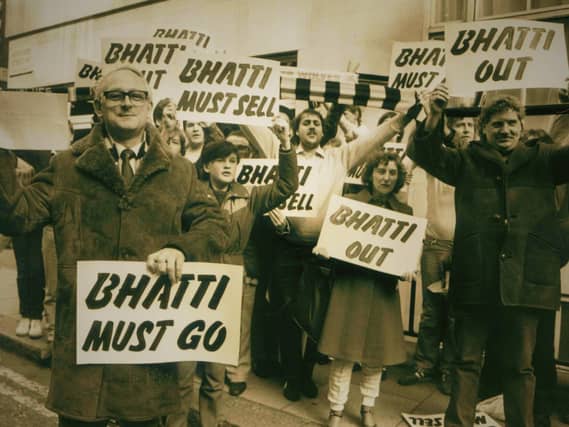
Enter the Bhatti Brothers.
Their very mention is enough to bring Wolves fans of a certain age out in a cold sweat. Few people remember their first names – for the record, they were Mahmud and Mohammad – but the legacy they left is unlikely to be forgotten any time soon.
Far from bringing a revival of the 1950s halcyon days of Cullis and Wright, the 1980s would prove to be the darkest chapter in Wolves' proud history. During this decade, they were twice placed into receivership, and they plunged through the league into the depths of the Fourth Division. Training sessions would be held in a car park, whip-rounds would be held to pay the milkman, and games would be played in front of empty stands. And all hopes were eventually pinned on a promising young striker called Steve Bull, who had recently been bought from arch-rivals West Bromwich Albion....
In truth, Wolves' triumph over Nottingham Forest on March 15, 1980, masked deep-rooted problems at a club who had been living beyond their means for some time.
Nobody could have accused chairman Harry Marshall of lacking ambition. And there was no doubt that in the late 1970s, the club appeared to be going places. What nobody expected was that the place they were heading for was the small Lancashire town of Chorley, where they endured their most humiliating defeat of all time to non-league minnows in the FA Cup. And that this journey would be via a bizarre spell that saw long-time Aston Villa chairman Doug Ellis briefly hold the reins, before being outwitted and forced to hand control to a pair of Saudi tycoons who didn't exactly bestow the club with riches. But let's start at the beginning.
Plans to redevelop Molineux into a stadium with a 70,000 capacity were first put forward as early as 1958, but stalled when the council refused planning permission.
The ground saw little investment over the next 15 years, but the Safety of Sports Grounds Act 1975 brought matters to a head. It was decided to completely redevelop the ground to create a modern 40,000-capacity stadium by 1984.
Questions were asked about the scale of the plans, for which Marshall had budgeted £10 million, which was 20 times the record-breaking transfer fee Hamburg had paid Liverpool for Kevin Keegan. But money was not a problem, insisted Marshall.
"It is a bold move on our part and the design is revolutionary," he said in July 1978.
"But we want to start something future generations will be proud of as we move into our second 100 years."
The club had generated £750,000 in revenue the season before, and Marshall said the investment would bring in £2 million a year.
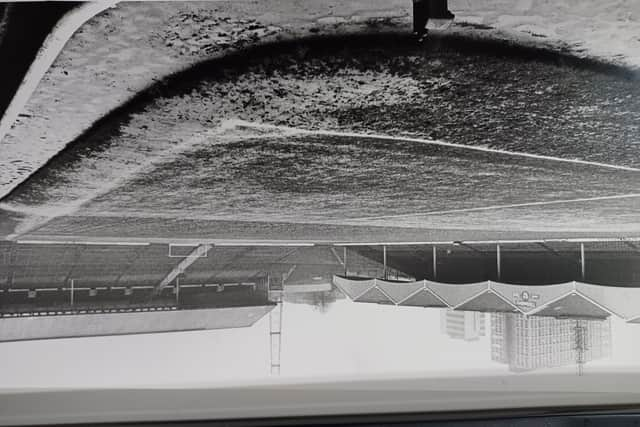
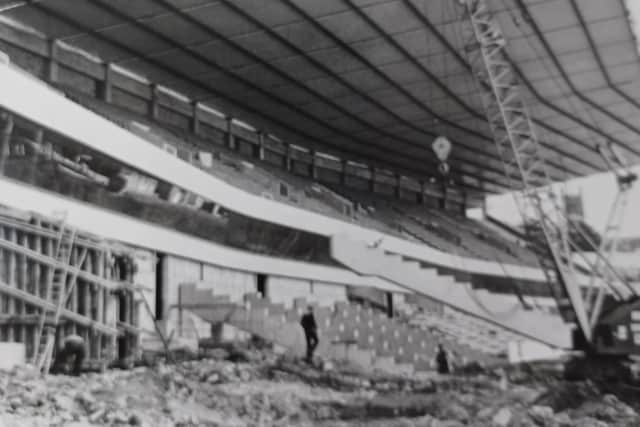
The most pressing need was to replace the wooden Molineux Street stand, which no longer complied with the legislation, despite having been converted to become all-seater. The club purchased and demolished 76 old terraced houses which lay next to the ground, and began building a new stand behind the existing one. The new stand, 9,500 all-seat capacity, would be at the cutting edge of modern football architecture. Its 42 executive boxes with their plate-glass frontages would exploit the commercial opportunities presented by the new generation of corporate fans.
The stand, initially unimaginatively named the Molineux Stand, opened for Wolves' first home game of the season. The 3-0 win over Ipswich was also manager Barnwell's first appearance in the dugout since being injured in a serious car accident in April.
Writing for the Express & Star, television pundit Gary Newbon said: "If Wolves had hired a script writer he couldn't have done a better job for the day Wolves opened their new stand – apart from a bigger win and a bigger crowd."
There were one or two eyebrows raised at the red plastic seats – couldn't they have found some in gold, or even black? The distance from the pitch, due to it having being built behind the old wooden stand, was also a problem. But given that the whole ground was going to be rebuilt, the pitch could always be moved, couldn't it? The Molineux stand was the future. And it looked exciting.
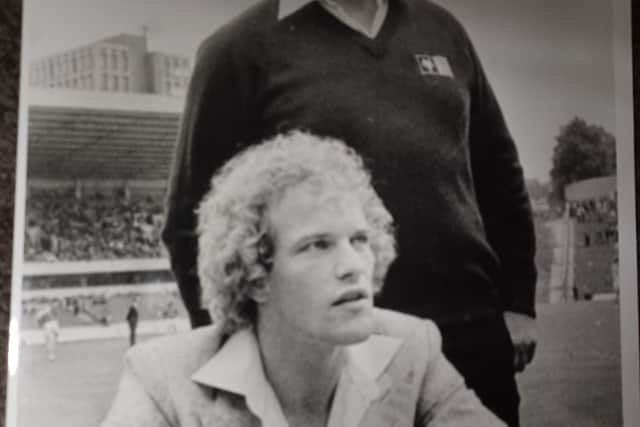
Even more exciting was the progress being made on the pitch. Wolves fans may have been a little disappointed to lose England B international Steve Daley to Manchester City for an English record £1,437,500. But they quickly got over this when they learned who his replacement would be – Andy Gray, Aston Villa's star striker who would move across the Midlands for an even bigger fee, £1.469 million.
Two years younger than Daley, who would prove to be a flop at Manchester City, Gray was arguably the most exciting young player in English football. He was joint winner of England's golden boot with Arsenal's Malcolm Macdonald in 1976-77, his 29 goals helping Villa to a fourth-place finish and victory in the League Cup. He won the PFA Young Player of the Year and Players' Player of the Year awards, a double not matched until Cristiano Ronaldo took both titles in 2009.
On arriving at Molineux, an excited Gray said he felt he was now at a club where he could win things.
"Barnwell is the main reason I agreed to move to Molineux," he said.
"My new boss convinced me about his ambitions. I have had a good look around Molineux and Wolves are the club for me. They have a great future, and I want to be part of it."
And win things he did, well at least one trophy. His winning goal in the League Cup final was all the sweeter for the fact that it was against Nottingham Forest, the team who under Brian Clough had become the model that other provincial clubs sought to emulate.
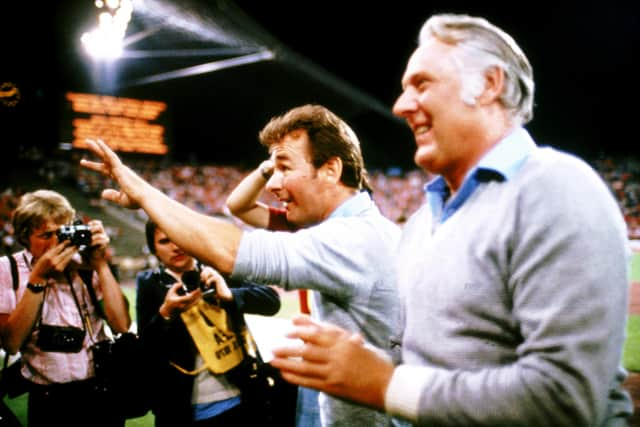
Forest had only been promoted to the First Division in 1977, but on their first season back in top flight they clinched both the league title and the League Cup. The following year they finished runners-up in the First Division, but won the European Cup and retained the League Cup. That Wolves had been able to deny them a hat-trick of League Cup wins was a great achievement, and manager Barnwell saw no reason why Wolves could not follow in their footsteps.
Ironically, it was Wolves to whom Forest owed their elevation to the top flight. Already promoted in 1976-7 but wanting to leave the Second Division as champions, Wolves won their final game of the season 1-0 at Bolton to deny the home side promotion and enable Forest to snatch third place.
The lavish expenditure on the new stand convinced the Express & Star headline writer to rename the ground Mo£ineux, but this extravagance would quickly prove to be a millstone around the club's neck.
The new stand cost Wolves £2.5 million to build, and while Marshall had banked on it bringing in the extra revenue to pay for itself, a national slump in football attendances would swiftly put paid to these hopes.
*Part 2 will be available on Express & Star Plus on November 23.
Comment Guidelines
Iconic Media encourages reader discussion on our stories. User feedback, insights and back-and-forth exchanges add a rich layer of context to reporting. Please review our Community Guidelines before commenting.