
Graham Turner has given Wolves fans 40 years of glorious memories
It will be 40 years next Wednesday since one of the most influential Wolves managers of recent times arrived at Molineux. At a pivotal time in the club’s history. Paul Berry looks back.


Consider this as an ‘intro’ to an Express & Star match report: ‘Graham Turner made it plain it will take more than some vitriolic chants from jaundiced fans to drive him away from Molineux.’
You would immediately be thinking: Was the manager going through a particularly difficult time? Experiencing some bad results? Lost the dressing room? Overstayed his welcome?
Or was, as in this case, a manager facing fan unrest having literally just set foot inside the door. And enjoyed his first win, on home soil, 2-1 at home to Tranmere.
Fair to say it wasn’t the warmest of welcomes when Turner arrived in the Molineux hotseat in October 1986, 40 years ago next week.
And that wasn’t anything against him, even though he had been relieved of his duties with local rivals Aston Villa just three weeks earlier.
It was, purely and simply, that Graham Turner was not Brian Little, who had been put in interim charge at the start of the season when the club changed ownership, and had quickly become very popular.
After a spectacular demise which had seen Wolves tumble unceremoniously through the divisions from First to Fourth, little by little you might say, some hope had emerged.
A 2-0 win at Scunthorpe with goals from Dean Edwards and Matt Forman left the team 10th in the league with 13 points from their first nine games.
But Dick Homden and Jack Harris, who had headed up the consortium which had helped prevent the club from going out of business in the summer, sensed an opportunity when Turner came back on to the market. He had almost landed the Wolves job when his assistant Graham Hawkins took the helm in 1982, but, not least because of the superb work delivered in charge of Shrewsbury, he was very much back on the radar.
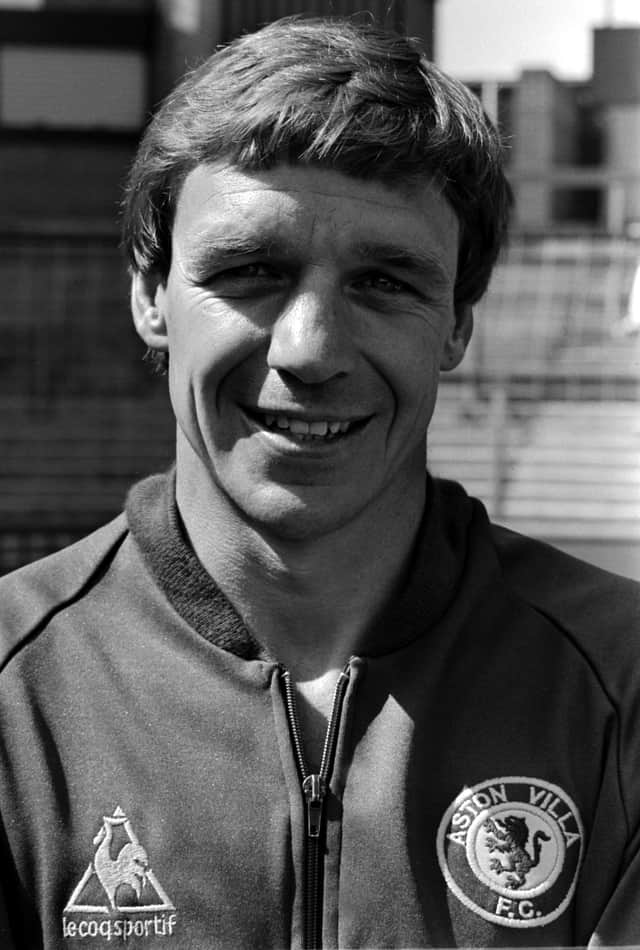
“Telling Brian Little he was sacked was the worst job I have ever had to do,” Homden revealed at the time.
“I have been sacked for doing nothing wrong,” was Little’s verdict.
He was right. And we will never know what might have happened had he landed the role on a permanent basis, particularly given his later managerial successes.
And yet, would he have done a better job than Turner? Well, looking back all these decades on, that would have been a monumental task.
Yes, a month later Wolves suffered one of the worst results in their history in being thumped 3-0 by Chorley from the Northern Premier League.
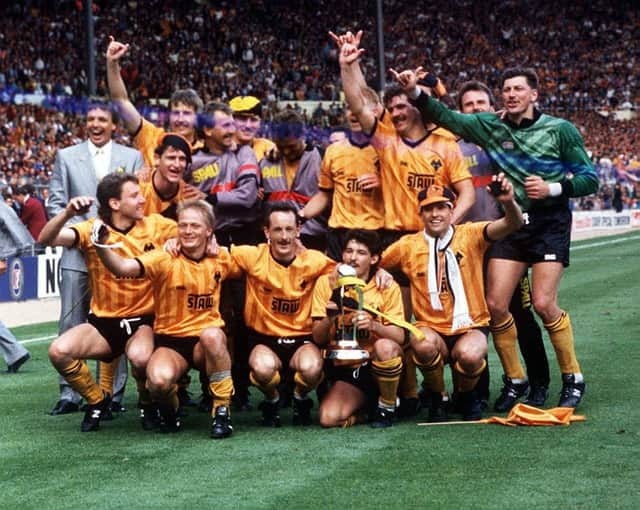
But 18 months after that, they were following up the Fourth Division title by winning the Sherpa Van Trophy at Wembley in front of a crowd of 80,841, including at least 50,000 of a gold and black persuasion.
Twelve months later they landed another league title, back-to-back promotions returning the team to the realms of respectability in the Second Division.
And 40 years later? Turner will certainly never have to buy a drink in Wolverhampton again. He is cherished and revered whenever he makes an appearance at the club or in the city. Rightly so.
“When we just walk around the ground now it takes us half an hour to get from one side to the other,” says Graham’s son Andy, who now accompanies him on trips back to Molineux from his Dad’s home in Hereford, where he also enjoyed plenty of success as a manager later in his career.
“People stop him for a picture, or a chat, which is lovely to see.
“The good times he had at Wolves were so good, and it’s nice to see that they haven’t been forgotten.”
Of course, the passage of time does indeed make the heart grow fonder, because there were plenty of tough times during Turner’s Molineux reign, particularly those which eventually saw him tender his resignation.
But the sheer longevity of his stay – only three Wolves managers were in the dugout for more matches – and the impact it had, was an incredibly important one at a time Wolves were facing huge problems on and off the pitch.
Even though he had to win over the Wolves fans right from his very first day at the office.
‘I was a Wolves supporter, a fanatic’
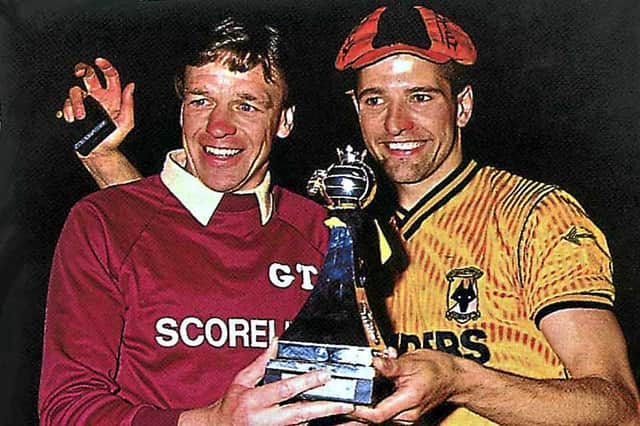
“With the way the club was at the time, if it hadn’t been Wolves, there’s not a chance I would have even considered it,” says Turner. “The reason I did? I was a Wolves supporter, a fanatic without going to too many games, and had grown up in Ellesmere Port just down the road from where Stan Cullis lived.
“There were so many connections with Ellesmere Port, while many people from the Midlands used to walk to Ogden Ironworks to get jobs.
“On top of that, when I was around 10 years old, I wrote a letter to Billy Wright asking for his autograph.
“I didn’t even enclose a stamped addressed envelope, but Billy sent me a programme which he had signed, and I’ve still got that programme to this day.
“So that was the background to my decision, because everyone who was around Wolves at the time can remember the state of play.
“The downward spiral of three successive relegations, two sides of the ground closed, the state of the dressing rooms, the kit, the footballs – there was an apathy about the place and an acceptance of their plight.
“It was a run-down football club in its very worst situation, but I was a supporter. It was my club. And that is why I said yes.”
With that decision, Turner himself made the same descent from First to Fourth divisions as Wolves, given his previous job with Aston Villa had been in the top flight.
But for all those reasons above, he didn’t need too much convincing after Harris and Homden made him their number one target.
He also received assurances that Little had only been placed in interim charge and not on a permanent basis, as, even in the often brutal world of football management, he wouldn’t have taken the job had that been the case.
“The potential here is tremendous,” Turner said at his unveiling. “You only have to look at this season’s average gates of 5,800 to realise the people of Wolverhampton want football here.”
Seeing that figure as a positive was a sign of how low Wolves had tumbled, close to going out of business in both 1982 and 1986, a few months before Turner checked in.
And yet, within 18 months, there were those tens of thousands of Wolves fans piling down to London to enjoy Sherpa Van success against Burnley. Out of darkness cometh light.
The change during that time came not just with results and fan numbers but also personnel.
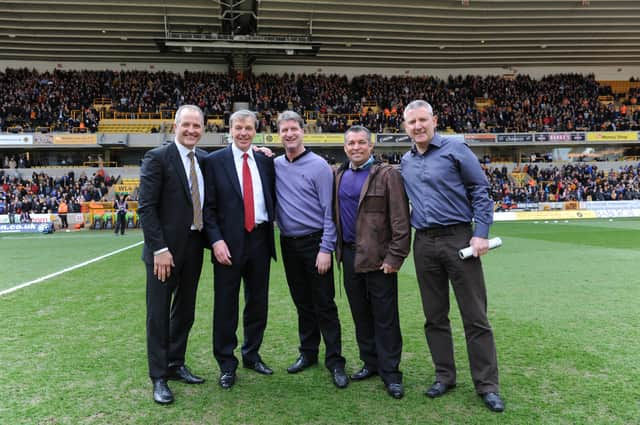
Just four starters of Turner’s opening win against Tranmere – Floyd Streete, Ally Robertson, Mick Holmes and Andy Mutch – also started at Wembley a year-and-a-half later.
And one of Turner’s most astute ‘signings’ was to bring in renowned chief scout Ron Jukes, whom he had worked with at Shrewsbury.
Of course, so memorably and magnificently, so much of Wolves success in the years to follow came thanks to acquisitions from ‘down the road’ courtesy of local rivals West Bromwich Albion.
Robertson, already at Wolves, would lift the Sherpa Van Trophy as captain, and Robbie Dennison, who scored a spectacular free-kick, would spend 10 years at Molineux, came later.
In between those two, just a month into Turner’s tenure, and with thanks to Harris having to put his own hand in his pocket to initially fund the signings, came two of the best value-for-money arrivals in Wolves’ history.
Steve Bull and Andy Thompson, for the princely collective fee of just £65,000. A club record goalscorer and an expert penalty taker. A total of 1,012 combined appearances, and so many memories. ‘Thank you very much’, etc, etc...
Bull and Mutch would go on to forge an incredible partnership, albeit it took a few months or so for Turner’s new team and approach to reap its rewards.
The big turning point was a home game against Stockport in February 1987 when Wolves, a goal down with 11 minutes remaining, came back to win 3-1.
Just 3, 238 were there to witness it, myself included. What a finish.
Unsurprisingly, it is still regarded by many as one of the most crucial 11 minutes in the club’s history, as Wolves then powered their way to the play-offs, and while missing out in a two-legged final against Aldershot, responded by blazing a trail to successive league titles.
‘The Wanderers are back, and we’re on the winning track’, as the song goes.
50,000 march on Wembley
‘I've learned that people will forget what you said, people will forget what you did, but people will never forget how you made them feel.’
The famous quote from American civil rights activist Maya Angelou.
And so perfectly suited to Wolves of the late 1980s.
For me, as a football-crazy young teenager, it was simply the best. A new band of heroes to both cheer and cherish, and memories of Molineux and various lower league footballing outposts that will never be forgotten.
Even supporters of an older vintage who had enjoyed the successes of that brilliant Wolves team of the Seventies still go misty-eyed when thinking about the Bully-inspired revival.
Try and condense that whole magnificent revival into 90 minutes and it came courtesy of that May afternoon at Wembley in 1988 when a tournament for the Third and Fourth divisions attracted two of the Football League’s founder members and such a brilliant occasion.
Andy Turner was eight years old at the time. Long before the days of mascots becoming a commercial enterprise, he was one of Wembley’s first ever, joining Robertson in leading out the team.
“I think my Dad pulled rank,” he says with a chuckle.
“At the time, I probably didn’t realise how lucky I was and if you look at the video I certainly made the most of the moment,” he adds. “I was only a young boy but I had the kit on and in my mind I was walking out at Wembley as one of the players!
“It was such a brilliant time for us all, and I can still remember sitting in Dad’s little office at Molineux, a really rundown office, and going in with him on a matchday.
“Or there was another room, I think it was called the ‘Gold Room’, where I’d hang around, and later we sat in a box.
“I can remember watching one game with Robert Plant when I didn’t really know who he was – how incredible is that – and on other occasions wandering around into closed off areas of the stadium after the game when I was waiting for Dad to finish.
“In those first few years I just remember thinking we were going to win every match – they were such special days.”
“Those facilities were awful, but we made the most of it, and the players were brilliant,” adds Turner senior, who turns 79 on Monday. “Finding decent training facilities was a nightmare because we’d lost Castlecroft, and, as everyone now knows, the one Friday we trained on the North Bank Car Park, and because we won the next day, it became a tradition.
“As a professional person you just couldn’t look at that and say it was any way good preparation, but it cemented the team spirit and togetherness of that group.
“Myself and the coaches would join in and everyone would vote for the worst player who would then have to wear a yellow jersey – I’m pleased to see I never ‘won’ it although maybe that’s because no-one was brave enough to vote for the gaffer!
“And the Sherpa Van Trophy final, which came in between the two promotions, was absolutely unforgettable.
“It wasn’t like the FA Cup when you don’t get many tickets, we got so many, and there were 50,000 Wolves fans at Wembley – I’m not sure that will ever happen again?
“It was all achieved with such a small group of staff, both on the football side and in the office at Molineux, and everyone just mucked in.”
The day after that Sherpa Van Trophy final came an open top bus parade around Wolverhampton, prompting more incredible celebrations. And memories.
The pride had returned to Wolves fans who had suffered years of derision during the plummet through the divisions. Atmospheres at Molineux, even with half the stadium closed, were electric. The South Bank stood large and loud as one of the most impressive terraces in the country.
Fans will never forget how that made them feel.
View from the top (of the scaffolding)
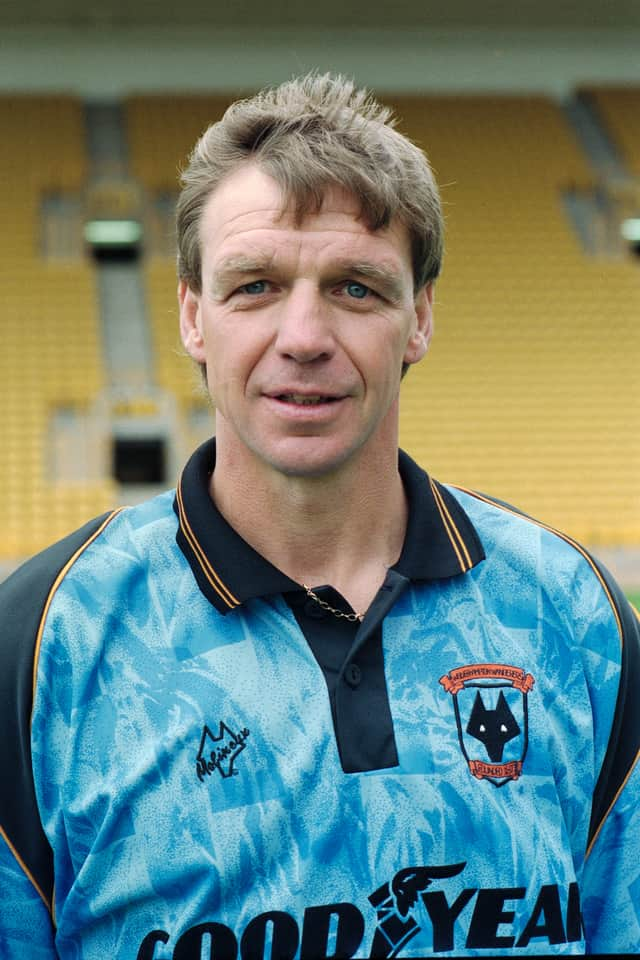
For a long time, Turner didn’t even work under any sort of long-term contract at Molineux. All this while often having to scramble up scaffolding to get a decent view of the pitch at a ramshackle Molineux.
But that all changed when Sir Jack Hayward took over the club in 1990. Initially the purse strings were tight on signings as the stadium was so spectacularly regenerated and improved. The house that Sir Jack built.
And with that came increased pressure and expectation, albeit one which Turner relished.
The 1993/94 campaign will always feel like his best chance. He had been allowed to spend, bringing in Geoff Thomas, David Kelly and Kevin Keen alongside the experience of Derek Mountfield. With the likes of Bull, Mike Stowell, Mark Venus, Paul Cook and Paul Birch still in situ.
On a gloriously sunny August afternoon the season kicked off with such optimism at Molineux and a 3-1 win against Bristol City. But Thomas, such an influential presence, picked up a serious injury after scoring a superb solo goal at Sunderland, and Bull was also a long-term absentee, leaving an anticipated promotion campaign on the wane.
“We’d been waiting for that money while Sir Jack had rebuilt the stadium, and I think we spent it wisely,” Turner insists. “But if you were going to sabotage that team, you would have taken out Thomas and Bull, and that’s exactly what happened with injuries.
“It was my seventh season and the crowd were growing restless, and having lost in the FA Cup at Chelsea we had to play Portsmouth two days later and we just didn’t turn up.
“I had got on well with Sir Jack’s son Jonathan who was now chairman, but at the end of the game he came in and started berating the players, who were already feeling down enough with the result.
“I couldn’t accept that, and the next day offered my resignation.
“It did hurt me to leave, but I also understood I had been trying for four years to get into the top division.
“I could understand the drive and the anxiety to get there but I just feel there should have been a bit more understanding around losing two of our top players that season.”
Wolves fans, all football fans, can ride the gamut of emotions quicker than in any other industry.
Twelve months after fan Alan Blount’s memorable ‘climb’ through the window into the dressing room after the Sherpa Van semi-final success against Notts County, fans put the windows through after defeat against Torquay ended hopes of a second successive trip to Wembley.
The popular fanzine A Load Of Bull once summed up the fan division by selling a copy complete with two free badges, one saying ‘Turner must go’ and the other ‘Graham Turner’s Gold and Black Army’.
“As I was getting older I do remember when things were getting difficult with fans on radio phone-ins and my sister Sam getting a bit of abuse walking to her car after a game,” recalls Andy. “It got tough towards the end but looking back now I understand the frustrations but will always only remember Wolves fondly.
“For me as well, I got to know all the players and go through experiences that other kids of my age just weren’t able to enjoy. It felt like a really privileged football upbringing.”
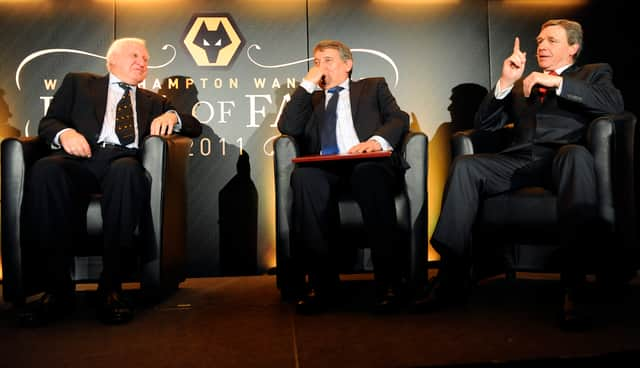
Turner’s final record in charge of Wolves was 179 wins, 110 draws and 123 defeats from 412 games.
But those stats alone will never fully convey the power and the emotions of his lengthy spell at the helm.
A club lifted from its knees and tantalisingly close to the big time after rising from the ashes.
“It does cross my mind as to what we failed to achieve and what might have been had we been able to take that last step,” says Turner. “But the positives will always far outweigh anything else, without a shadow of a doubt.
“When I look back there is so much pride in what we achieved, and all I see is the happiest of times.”
Far cry from the resentment Turner initially had to face in that first game in charge, almost 40 years ago, although it didn’t take too long for him to win fans over.
By full-time in that opener, the fans were singing, albeit slightly tongue in cheek: “We’re gonna win the league.”
They did just that. Twice. And so much more. Those were undoubtedly the days my friend.
Comment Guidelines
Iconic Media encourages reader discussion on our stories. User feedback, insights and back-and-forth exchanges add a rich layer of context to reporting. Please review our Community Guidelines before commenting.