
Cheeky b*******! Former Wolves skipper Curle on his Black Country derby rivalry
Paul Berry catches up with uncompromising former Wolves skipper Keith Curle
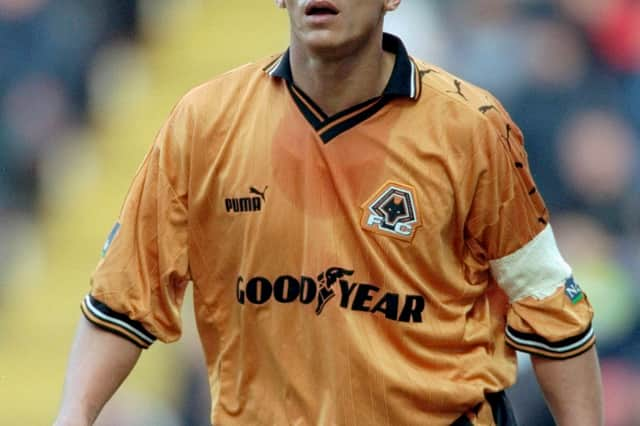
‘There’s only one Keith Curle.’ A familiar terrace refrain at Molineux and on the road between 1996 and 2000.
A Wolves fanbase who had perhaps been shorn of his sort of leadership for a few years quickly recognised the quality and influence of the character within their ranks.
Not least as previous signings of the more experienced bracket didn’t have a hugely successful record, part of the motivation between the infamous ‘Golden Tit’ interview from Sir Jack Hayward, lamenting the wasting of funds a year before Curle’s arrival.
The £650,000 shelled out for Curle certainly fell into the excellent value for money bracket from an otherwise patchy era.
He arrived as a 32-year-old, still fit as a fiddle having not only maintained but improved his fitness levels after Manchester City had been relegated, coming back for pre-season in better shape than anyone at the club in a powerful show of strength.
He was an England international – including making a European Championship appearance under Graham Taylor – and a captain, who inspired on and off the pitch, even with, by his own admission, a lively refuelling routine which was more in keeping with the game at the time.
Ironically he was injured very soon into his Wolves career, but once back and in the team, he was never again out of it.
And yet, to address early on the sizeable elephant in the room, for all of his Wolves’ excellence, the Molineux faithful weren’t the only Black Country fanbase to sing his name during his four years at the club.
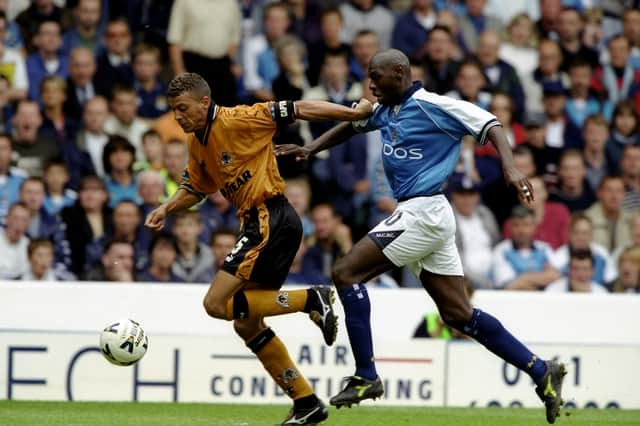
In successive seasons, Curle scored an own goal which settled one big derby at the Hawthorns in Albion’s favour, and then missed a penalty in a home clash which left Wolves with one point which could have been three.
Hence why the Baggies’ recital of the Curle ditty was delivered with way more sarcasm than the genuine affection with which it was sung by Wolves.
Such was his afore-mentioned leadership skills, experience and unshakeable mentality that it is probably just as well such high-profile misdemeanours befell Curle and not another of the Wolves contingent from the late 1990s.
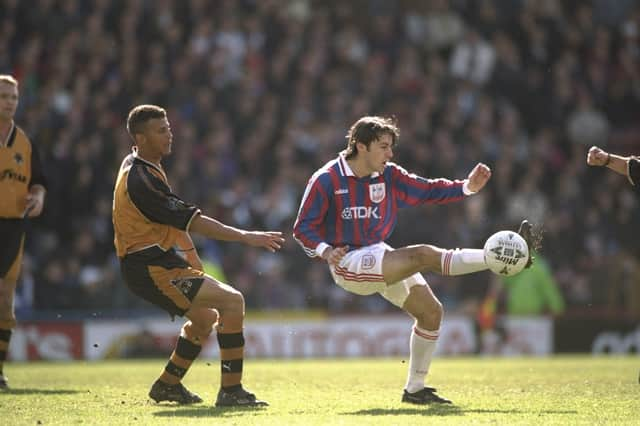

He was big enough and shoulders broad enough to be able to handle the resulting fallout. And now, look back and reflect with a touch of humour as well.
“I remember I think I finished fourth in Albion’s Player of the Year awards the one season, and they sent me a trophy,” he recalls.
“Cheeky ******s! I can still remember that own goal even now.
“Peschisolido made a run across me, but I knew I could give him two or three yards and I got to the ball first.
“I knew where my goalkeeper should have been stood. But as I passed the ball back I saw Stowelley (Mike Stowell) appear in my eyeline and was like, ‘what the **** are you doing there’?
“We had a couple of arguments and went for a drink afterwards and, at the end of that, it was still Stowelley’s fault!
“But with that, and the penalty miss, life is always about how you deal with disappointment because everyone, no matter how privileged you are, you are going to face disappointment.
“No disappointment in my life was ever going to define me as an individual, and I have always accepted challenges and been able to move on.”
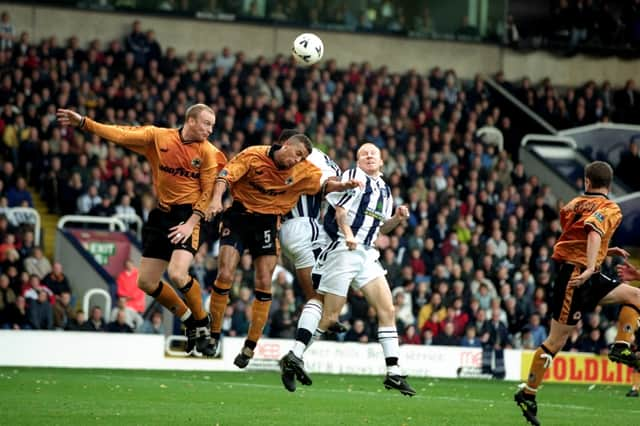
Ironically, there was a time when Curle almost moved to Albion as assistant manager after being approached by Denis Smith, but the timing wasn’t quite right, and his first coaching opportunity eventually came at Sheffield United.
He has always been a character who made decisions with plenty of confidence.
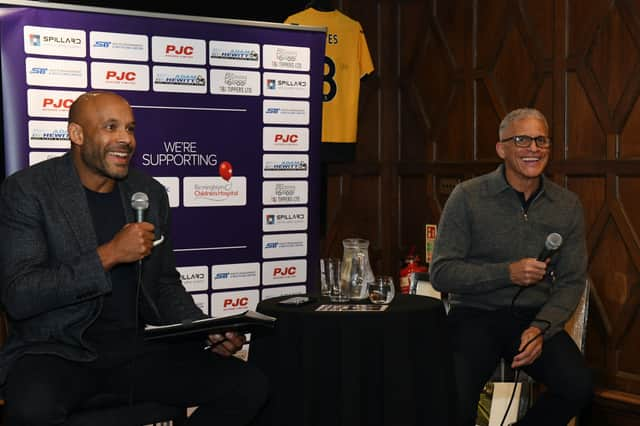
We are speaking in a meeting room at the Mount Hotel before he goes on stage to chat to former Wolves keeper and younger team-mate Matt Murray for a charity event in aid of Birmingham Children’s Hospital and Pancreatic Cancer UK, organised by well-known fan and fundraiser Carl Falconer.
Curle is an excellent and articulate communicator, perhaps no surprise for someone who became such a leader as a captain before moving into several roles as a manager.
There is also a character and resilience sparked, as with so many, by overcoming obstacles and challenges in his formative years. Scoring an own goal or missing a penalty against Albion was certainly not his first rodeo.
“I was at Bristol City as a schoolboy but got released at 16 because the manager said that I wasn’t good enough to have a professional career,” Curle explains.
“My girlfriend at the time, who later became my wife – well, her Dad used to sponsor Bristol Rovers, who had Terry Cooper and Clive Middlemass as their management team.
“They managed to get me a trial game but, because the season wasn’t far away and they had already got all their apprentices, I played as a 16-year-old in an under-15s fixture.
“I played centre forward and scored seven goals, and on the back of it they added me to their group of apprentices.
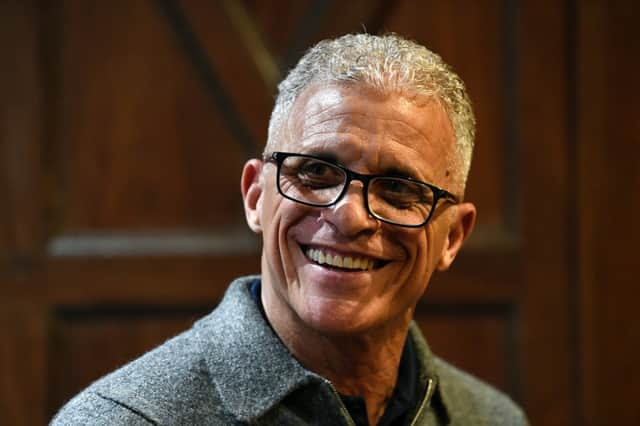
“And there I learned so much, got a complete grounding where I was taught good habits and good disciplines.
“It’s very different to a modern Academy because nowadays they don’t sweep the changing rooms or clean the toilets.
“Even when I made it through to the first team at Bristol Rovers, on the Sunday I’d be back out on the pitch, putting the divots back to help the groundstaff, and then painting the stands in the summer.
“It was character building, and within a year of becoming an apprentice, I had made my debut, as a 17-year-old against Chester.”
Curle scored on that debut, as a right winger, and, with his pace a major asset, started his career playing further forward.
The problem was, Rovers had players like Tony Pulis and Brian Williams at the time, who, even in training, didn’t take kindly to young and nippy colleagues, and would regularly dish out a spot of harsh treatment, even to their own team-mates!
That prompted Curle to consider moving further back to the defence, where he could see all the game in front of him but still use his pace as an asset.
It wasn’t until later, and after a short spell with Torquay, that the switch became permanent, when previous Rovers boss Cooper had taken Curle back across the city - to Bristol City.
Regular centre back Bruce Halliday was suspended, so Curle was asked to step in, alongside Forbes Phillipson-Masters, a defensive partner packed with physicality, who could head every ball, while Curle mopped up around him.
And the rest is history. After that one game, Middlemass told Curle he would play for England. He was right. He would also make over 800 senior appearances and go on and captain so many different clubs.
Including Manchester City, whom he joined after spells with Reading, which featured a relegation and Simod Cup triumph, and the ‘Crazy Gang’ of Wimbledon, fresh from winning the FA Cup prior to his arrival.
It was Curle’s form at Wimbledon that secured him the switch to City for a club record £2.5million, also the joint highest fee paid by any British club for a defender.
And it was at City, with a fifth-placed topflight finish, that Curle forced his way into England contention, his three senior caps under future Wolves boss Graham Taylor including one in the Three Lions’ opening 0-0 draw against eventual winners Denmark in the 1992 European Championships.
He was played, out of position, at right back, and would surely have enjoyed more caps in his natural position were it not for the likes of Des Walker, Tony Adams and Martin Keown. But at least the three he picked up means he has one cap for each of his three children.
It was from that backdrop - England recognition and five years with City - that Curle arrived at Wolves to lead a squad packed with ability, experience and personality which yet somehow couldn’t make it over the line to reach the Premier League.
For someone so fit, there was an irony in picking up an Achilles injury before he’d really got started, so a brief appearance off the bench in a game at Oxford was all he had until a full debut - and a much more palatable local derby experience - in a 2-0 home success against Albion in January of 1997.
It was that first season that would prove the closest of his four for Curle in terms of trying to lead Wolves to promotion.
Finishing third in the Championship, but then losing a two-legged play-off semi-final to Crystal Palace having conceded late in a 3-1 defeat at Selhurst Park, and winning 2-1 at Molineux on a night when the atmosphere crackled like no other.
“That Palace game and that season, under Mark McGhee and Colin Lee, that was when we should have gone up,” Curle reflects.
“I can still remember Dougie Freedman scoring that third goal for Palace after Jamie Smith had pulled one back, which left us with so much to do in the second leg.
“The atmosphere at Molineux that night was amazing, and we scored a great goal through Mark Atkins but they got one back and we just couldn’t do enough.
“With the squad we had and the momentum we had, that was the year when we should have done it.
“There were some really great memories that season but they are easy to forget when you don’t get promotion which is what we were all aiming for.”
Ninth, seventh and seventh were the final league positions for Curle’s other seasons at Molineux, when both Mark McGhee and Colin Lee took the team to the fringes of the play-off picture without being able to break in.
But the other big highlight was the FA Cup run of 1997/98, a superb 1-0 giant-killing away win at Leeds in the quarter finals one which has remained in the memory bank, prior to losing by the same scoreline to eventual double winners Arsenal.
In the quarter finals Curle was headbutted by Jimmy Floyd Hasselbaink after he missed a late penalty – but stayed on his feet – whilst that last four clash with the Gunners remains a talking point all these years on for McGhee’s team selection and leaving Robbie Keane and Steve Bull on the bench.
“If you talk about some of the confrontations, I think you’ll find that I never started it,” Curle insists, with a glint in his eye!
“On the pitch I was one of those antagonising people where I tried to find someone’s weak spot, what it was that would make them flip and start thinking about me and not playing their own game.
“I enjoyed finding that pressure point where an opponent would end up wanting to elbow you or try and headbutt you, because at that point I knew that I had them.
“That day at Elland Road was a great atmosphere and we had such great backing, and we knew what we were about.
“We knew we could get a goal and we know that defensively we were solid, well drilled and well organised.
“When it got to the semi-final, I think when you consider how good Arsenal were at the time the manager’s thinking was about keeping our defensive shape, nullifying their threats and then having our own armoury on the bench.
“For large parts of the game I think we did nullify them, and then the last 10, 15 or 20 minutes was the time when we could go and score a goal.
“The only thing is, when we brought the subs on, possibly a bit too late in some cases, we didn’t create enough opportunities.”
Even though Curle departed Molineux for Bramall Lane in the year 2000, part of his legacy lived on.
Like Murray, Lescott was a young player coming through the ranks at the time, and he credits Curle with playing a major role in his development,
“Joleon was probably one of the reasons why I left Wolves!” he says with a chuckle.
“He was so good, and I could see early on that he was going to absolutely fly.
“He had something about him even then, he had a steel, a quietness, but a determination that meant you knew he was going to be successful.”
And on Wolves as a whole, even though it came at what was a difficult time personally in his family life, Curle still has very fond memories.
“It was a difficult time in my life because I was going through a divorce at the time which changed my direction as an individual,” he reveals.
“So, I enjoyed the nightlife, meeting some interesting people around the city and some who are now lifelong friends.
“I also really enjoyed the football at Wolves, I was always a player who enjoyed not just the matches but also the training – I used to love training.
“And I’m still in touch with a few of the lads, I’ve seen people like Bully and Mark Atkins, and it’s always good to meet up like I did with Bully a few weeks ago to play golf.”
It was a mix of playing and coaching for Curle after leaving Wolves, initially playing for and working with Neil Warnock at Sheffield United, and playing for Barnsley and Mansfield before becoming purely a manager, initially at Field Mill.
Other assignments since have taken him the length and breadth of the country, from Torquay to Carlisle, whilst he led Northampton to promotion from League Two via the play-offs.
Now though he has embarked on a new chapter and a new phase, as CEO of Macclesfield Town, currently sitting sixth in National League North, a couple of leagues below League Two.
“It’s an opportunity for me to go the other side of the corridor so to speak, away from the changing room where I have always been before,” he says.
“It’s a journey of discovery at a football club which has some very successful businessmen as owners, but hopefully I can help them on the football side.
“They have ambitions to try and get into the league and I’m enjoying being a part of it – life is good.”
Not only does Curle have all this football experience – and he has also been a mentor for the League Manager’s Association working with other young bosses - he has also built a strong reputation in business in both property and sport.
His has been a rich and varied career, on and off the pitch, and, at what feels like a very young 63, with the potential of more chapters to come.
There’s only one Keith Curle. But he has always made an impression.
Comment Guidelines
Iconic Media encourages reader discussion on our stories. User feedback, insights and back-and-forth exchanges add a rich layer of context to reporting. Please review our Community Guidelines before commenting.