
Matt Maher: Gareth Southgate moved mountains with England - but he couldn't reach the summit
Gareth Southgate’s England reign delivered everything but the trophy.
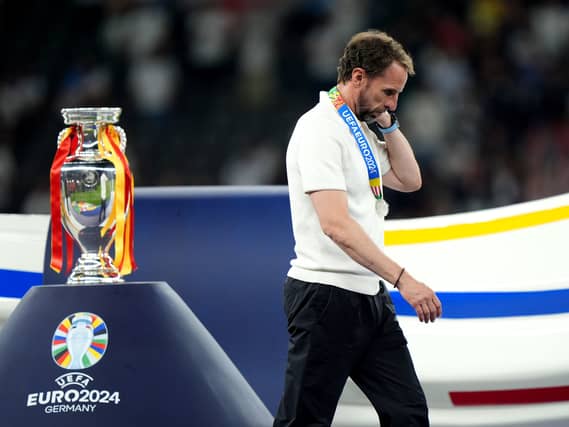


In nearly eight years at the helm, he oversaw an unprecedented run of success, reaching two major tournament finals, along with a World Cup semi-final and quarter-final.
Perhaps more importantly, he repaired a connection between the national team and their public which had become dangerously frayed through years of underachievement and off-field scandal.
Under Southgate, watching England became enjoyable again, with a team who were easy to root for. When one national newspaper recently described him as the man who saved the national team, it did not feel too wide of the mark.
Not bad, all told, for someone first given the job as an emergency stand-in with the FA embroiled in crisis.
When Southgate took interim charge in September 2016, after Sam Allardyce was forced to resign having spent just 67 days in the post, he wasn’t sure he was up to the full-time job.
Then seven years on from having been sacked by Middlesbrough, his only previous managerial job in senior football, he appeared to be nobody’s choice for the permanent Three Lions role, not even his own.
And yet, rather quickly, it became clear he was an ideal fit. Southgate’s work with the England youth teams meant he knew the talent coming through the system and was not afraid to trust it, first demonstrating his boldness by dropping and effectively ending the international career of the country’s then all-time top scorer, Wayne Rooney.
England went to the World Cup in 2018 with a relatively inexperienced team and with expectations low. They reached the semi-finals, narrowly losing out to Croatia in extra-time, while becoming the first England team to win a penalty shoot-out along the way.
From then on the results kept on coming and the hoodoos banished. The delayed Euro 2020 tournament brought a first major tournament final since 1966. It was followed this summer by a first ever on foreign soil. In total, Southgate oversaw nine knockout tournament wins, three more than the 12 men who had previously followed Sir Alf Ramsey in the job managed between them.
Southgate made things fun for the fans but most importantly the players too. Capped 57 times himself, he was acutely aware of how heavy the pressure of playing for the national team could weigh and set about changing that environment.
With the help of the FA’s press department, more doors were opened to the media than ever before, in an effort to build relationships and alter the us-versus-them culture which had negatively impacted so many previous teams.
Certainly up until at least the most recent tournament, it worked. Far from feeling the burden, players began to genuinely relish England duty. That enjoyment and bonding built into a belief which undoubtedly transferred to the pitch.
Players were empowered to speak and when there were serious matters to confront, such as the night in 2019 when Raheem Sterling and Tyrone Mings were racially abused in Bulgaria, Southgate would always lead from the front.
An eloquent and intelligent man, his words on numerous societal issues – but particularly racism – put many politicians to shame.
“A proud Englishman,” as he once more stated in yesterday’s resignation statement. Englishness might be hard to define but Southgate personified the ideal of what it should be with his class and decency.
Always respectful and rarely flustered, even when he was the target of beer cups a few weeks ago, he was never less than honest. “I’m involved in a sport that I love and an industry that at times I don’t like,” remains one of the most accurate and profound statements on professional football of the last decade. In Southgate, here was someone to like. You could not help but root for his dreams to come true.
Alas, they proved agonisingly elusive. Sunday’s defeat to Spain was the latest near miss though on reflection, perhaps, it is the loss to Italy three years ago which will sting the most.
England were leading in the second half at Wembley but unable to see the game out, eventually losing on penalties. Southgate, not for the first or last time, was criticised for his failure to make the necessary in-game changes. Suspicion he lacked sufficient tactical nous was something he was never able to shake. Too often, it was the little details which let him down. Frustrating, when he got so much of the big stuff right.
Even without the trophy, Southgate’s success compared to so much of what came before means he leaves with his head held high.
For the FA, there is merely the headache of how to replace him. This is not the scenario they would have wanted. The governing body’s track record of selecting England managers, prior to stumbling on Southgate, might be termed mixed at best.
It is why former Blues midfielder Lee Carsley, who has followed a similar path to Southgate and is currently in charge of the under-21s, should not be discounted. The Birmingham-born 50-year-old may well be placed in interim charge which, at the very least, would add some more spice to September’s Nations League clash with the Republic of Ireland, the country for whom he was capped 40 times.
The two high-profile English candidates are Eddie Howe and Graham Potter, the latter still out of work more than 15 months after being sacked by Chelsea, the former on not exactly solid ground at Newcastle having failed to reach Europe last season. Mauricio Pochettino, Thomas Tuchel and Jurgen Klopp are alternatives should the FA choose to switch tack and appoint a foreign manager.
Southgate departs having moved a mountain. The simple task, for whoever succeeds him, is scaling the one summit he couldn’t.
Comment Guidelines
Iconic Media encourages reader discussion on our stories. User feedback, insights and back-and-forth exchanges add a rich layer of context to reporting. Please review our Community Guidelines before commenting.