
Johnny Phillips: Southgate did well – but he could have done better
Gareth Southgate’s eight-year stint as England manager will be remembered for the raising of the bar when it came to taking the country deep into international tournaments.
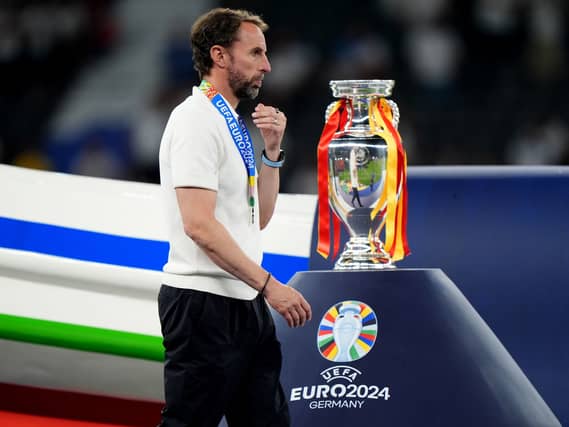

He leaves a united group of players behind who had a real pride and belief in their work at international level – something that has not always been the case when it comes to analysing England squads of the past.
Yet, despite the clear progress at tournament level there is also a sense that Southgate’s cautious style was a barrier to delivering even greater success.
It is not contradictory to hold both the former and latter view when it comes to examining an eventful period of international football.
It began with a reluctant Southgate taking temporary charge of the team following Sam Allardyce’s untimely departure. After the role was made permanent he quickly galvanised a young group of players and that togetherness characterised his squads at two World Cups and two European Championships.
Southgate deserved more than the empty beer cups aimed at him after England’s dour draw with Slovenia in Cologne.
But there is no escaping the evidence for that criticism even if the method of protest was undignified; this squad should have performed better despite reaching the final.
Such are the fine margins of football that Southgate was only one victory away from delivering a first trophy in 58 years, but it would surely have masked events on the pitch.
England’s performance at Euro 2024 can be summed up with this quote from Gary Neville: “It’s so bloody hard to play without the ball.”
Apart from one half of football against The Netherlands, England were ultimately a team who somehow progressed through the competition without the ball.
The lack of control and failure to dominate possession cost England dearly in the final, but the warning signs were there throughout their time in Germany.
It could have been different, and Southgate will surely regret beginning the tournament with an experiment in midfield and an over-reliance on a clearly out-of-form Harry Kane in attack.
Southgate’s early England spell was when his popularity reached its peak. After leading England to the World Cup semi-finals in 2018, the waistcoat gained its own fan club.
By the time of the Euro 2020 final – one year delayed – against Italy, the England boss even had his own song in the form of a remix of Atomic Kitten’s Whole Again.
This was a time when England looked confident in knock-out football and developed a resilience that served them well in the face of adversity.
The reigns of Roy Hodgson and Fabio Capello seemed a distant memory.
If one of the legacies Southgate leaves behind is the idea of an England squad who are not hindered by fear of nervousness when it comes to knockout football, then supporters will be thankful.
There was a time when England’s players cowered during penalty shoot-outs.
But at Euro 2024 that assuredness in the heat of battle seemed to desert the players at times. Instead of accomplished displays the team became about moments.
There were some brilliant ones in there. Jude Bellingham’s bicycle kick and Ollie Watkins’ instinctive finish will live long in the memory. Last gasp at its very best. But to be number one, England needed more than these flashes of brilliance.
The timing of Southgate’s departure is probably right.
He could have left after the World Cup in Qatar but the timing of that tournament in late 2022 would have left less time for a successor to make a mark before this summer in Germany.
Now, the Football Association has the opportunity to get a replacement lined up ahead of a traditional summer World Cup. It has become a more attractive job than it was when Southgate first took charge and that is another nod to the way he has developed in the role.
Over time, the shortcomings of England this summer will fade, and Southgate will be remembered for consistently taking England far into tournaments. He leaves behind a hugely talented group of players and he will take immense pride in the unity that characterised his squads throughout his time as England boss.
It is a strong legacy and deserving of one of the most decent men in football management. He was a brilliant ambassador who did not treat the responsibility of the role lightly, particularly when issues outside of the pitch raised their head.
Some supporters did not like the stance he took on societal issues and it took a brave man to step outside of his comfort zone to confront these wider issues, particularly regarding racism.
Above all else, that dignity off the field has remained until the very end of an eight-year spell which the man himself should treasure with immense pride.
Comment Guidelines
Iconic Media encourages reader discussion on our stories. User feedback, insights and back-and-forth exchanges add a rich layer of context to reporting. Please review our Community Guidelines before commenting.