
Johnny Phillips: Slow-motion VAR replays need kicking into touch
The unsatisfactory application of VAR has risen its head in recent weeks.

It has been a difficult opening few weeks of the season for the PGMOL, but to their credit the organisation is attempting greater transparency with supporters by offering to explain its decision-making processes.
On Monday night I was at the City Ground to witness the controversial decision to disallow an apparent winner for Burnley, scored by Lyle Foster after some good build-up play by substitute Sander Berge.
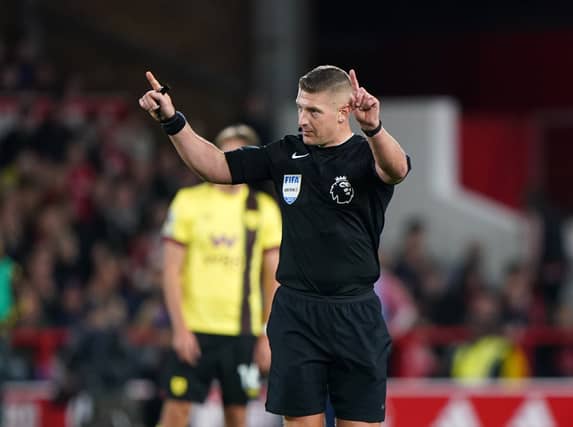
Referee Rob Jones and his officials saw fit to let the goal stand but the VAR got involved and it was ultimately disallowed when Jones, having been sent to the pitchside monitor, concluded Berge handled the ball in the build-up.
It was an incredibly unsatisfactory outcome, reached primarily through Jones being shown slow-motion images of Berge’s actions.
I have said before, and repeat it again, decisions like this should never be reached on the evidence of slow-motion images. Life does not take place in slow-motion and if real-time replays are not conclusive enough to suggest a decision should be changed then no action should be taken.
Berge’s upper arm may have brushed the ball as he raced past Scott McKenna but there was absolutely no evidence that this was a deliberate action – one of the three tenets on which VAR intervenes in handball cases. Another principle that must be followed by VAR in this instance involves the ball changing course of direction. Again, it did not.
Burnley boss Vincent Kompany did well to keep so calm in his post-match interviews, reluctant to focus on an incident that had passed and instead preferring to concentrate on his own team’s performance. But it cost the Clarets two points and who knows what difference that will make come May.
At the weekend, Newcastle were awarded a penalty when Anthony Gordon took a tumble over Brentford keeper Mark Flekken as he came out to meet the ball. Gordon certainly initiated the contact but Flekken’s leg was there to be used as an obstruction, even though the ball was no longer in Gordon’s control.
Once the penalty had been awarded, VAR could not overturn it as there was simply not enough conclusive evidence to do so, even though it was probably the wrong on-field call. VAR should not be criticised here but the incident stands comparison with the City Ground one. If VAR could not overturn the Newcastle penalty it certainly should not have overturned the Burnley goal.
Earlier this season PGMOL chief Howard Webb apologised for two big VAR errors. The first one involved Manchester United goalkeeper Andre Onana’s foul on Wolves forward Sasa Kalajdzic at Old Trafford on the opening weekend of the season. VAR did not ask referee Simon Cooper over to the monitor.
The second occurred during the first half of Manchester City’s win over Fulham when Nathan Ake’s goal was allowed to stand despite Manuel Akanji standing in an offside position and interfering with Fulham keeper Bernd Leno’s line of vision.
The PGMOL has initiated a commendable move with a VAR review series of television programmes aimed at explaining the working process behind decisions – both good and bad. Webb has made it a priority to bring more transparency to the organisation and, while human error will never be eradicated, at least supporters have the opportunity to understand the process more.
With a spate of Select Group 1 officials retiring in the past couple of seasons, the PGMOL lost a lot of experience and is still working on filling that void. Sheffield United manager Paul Heckingbottom accused match officials of lacking understanding of football last weekend, when his goalkeeper was instructed to restart the game quicker. Heckingbottom’s argument was that Spurs had changed their strategy at goalkicks and his keeper needed time to adjust. There may be an element of truth in this but there were also occasions when the Blades were clearly slowing the game down.
With the continuing expanse of the game and more matches scheduled for television coverage in coming years, the focus on officials will never go away. VAR has added an extra layer to this and more often than not it is another stick to beat officials with. One solution I’ve heard mentioned might be for VAR to be administered by specialists who do not referee games and stick solely to that role. I’m not sure that would provide a satisfactory outcome. Ultimately, it is about the competence of whoever is doing the job.
Comment Guidelines
Iconic Media encourages reader discussion on our stories. User feedback, insights and back-and-forth exchanges add a rich layer of context to reporting. Please review our Community Guidelines before commenting.