
Joe Clarke left watching on as Olympic history slips away
Joe Clarke was not where he wanted to be.
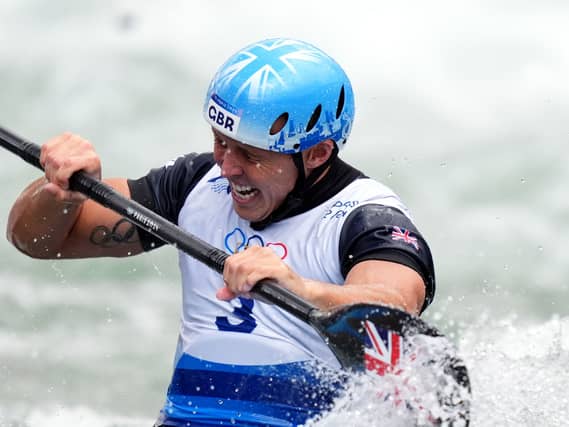


As the music began to blare, announcing the start of the medal ceremony for the canoe slalom K1 event, the Stone paddling star found himself not standing behind the podium but instead in front of journalists, trying to find the words to sum up his frustration at a fifth-placed finish.
In a cruel twist of fate and unfortunate placement, the ceremony of which he had so desperately wanted to be part was being broadcast on a big screen no more than 20 yards away. At one point, Clarke risked a look and just maybe, you thought, there was a slight wince as he reflected on the moment which got away.
Not even two hours earlier the mood at Vaires-sur-Marne had been very different. Clarke set the fastest time in the semi-final, putting his finger to his lips and kissing it after crossing the line. The Rio 2016 gold medallist’s dream of becoming the first ever two-time men’s Olympic champion in kayak singles seemed very much on.
But this is a sport where the only run which really matters is the last one. Clarke’s final time was by no means bad, just three-tenths slower than that of earlier in the afternoon. The trouble was four other paddlers were just that bit quicker, that bit smoother through the whitewater.
Spain’s Pau Echaniz, who scraped into the final with the 12th fastest qualifying time and was the first man off, laid down a big early marker by going faster than even Clarke had earlier.
Only two men, by the finish, had bettered him, Italy’s Giovanni de Gennaro taking gold ahead of France’s Titouan Castryck.
Clarke gave it everything but a mistake at gate six, which briefly blew him off course, proved costly.
“I just got slightly stuck and had to correct it and that’s probably the difference between a podium and not. That’s canoe slalom, how tight it is,” he reflected. “I knew it was a good run and I am fully capable of doing that myself. Given another run, I think it is possible. I think if you re-ran the final my run potentially would have won.
“It is that kind of course, it is tricky, there are a few minor tweaks here and there, bit better water here and there, would have made all the difference. But you get one run and that is that. It wasn’t to be.”
In a sport determined by fractions, it does not take much to mess up your day.
The difference between success and failure was demonstrated in the semi-final when Peter Kauzer, runner-up to Clarke eight years ago, set a blistering time but was then subjected to a 50-second time penalty, judges ruling on review he had failed to complete a gate.
This was the Slovenian’s fifth and probably last Games and in the second it took to change the scoreboard, his Olympic career was over. Kauzer sat in his kayak in the finishing pool, open-mouthed in disbelief.
Shortly after, there was also a nervous wait for Clarke as the judges checked a possible infringement on his run.
De Gennaro was only eighth quickest in the semi-final but flew down the 300 metre course when it mattered.
One by one, the remaining seven tried to beat him. But defending champion Jiri Prskavec hit two gates, incurring a four-second time penalty. Castryk, whose successful passage through each gate was met by roars from the home crowd, started strongly before a mistake halfway down cost him dear.
That left Clarke, who was smiling at the top of the run but finished with his hands on his head.
He was later asked whether going last was actually a disadvantage.
“Probably for those inexperienced but I have been there before and lived under that pressure,” he replied. “The biggest amount of pressure is that which I put on myself. The crowd here, I just feed off it and take great pleasure from hearing people supporting me.”
Clarke had no shortage of the latter, whether they be friends or family. Hugo, his 18-month-old son, was in the crowd wearing a T-shirt emblazoned with the words “Go Daddy”.
For Clarke that provided some perspective. At 31, he is a very different character to the one who won in Rio. The thirst for victory remains the same, yet the eyes are wiser. Clarke’s Olympics are a long way from finished. The kayak cross, which begins on Friday, is his strongest suit.
“I am sure he (Hugo) is going to be very proud of me,” he said. “He doesn’t know the difference between first and fifth.
“He will just be happy to see me afterwards.If I feel gutted right now, I will walk over and see him in five minutes time and be fine.”