
Matt Maher: Wolves continue to be proven right on VAR
It rather goes without saying Wolves haven’t got too much right over the past few years.


Yet when it comes to VAR, they increasingly appear the sanest club in the room.
It was in 2024 that Wolves tabled a motion for VAR to be scrapped in the Premier League, arguing “the price we are paying for a small increase in accuracy is at odds with the spirit of our game”.
The rest of the league disagreed, voting unanimously against the proposal and instead agreeing to a six-point plan aimed at improving its use.
Nearly two years on, however, progress is difficult to spot. Just when you think VAR can’t get any more daft, it does, as evidenced by this week’s Carabao Cup semi-finals.
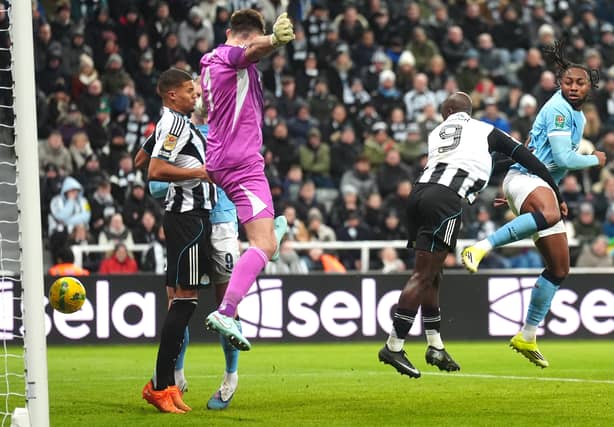
Perhaps disallowing Antoine Semenyo’s second goal for Manchester City against Newcastle was technically the correct call.
Erling Haaland’s foot, on closer inspection, appeared to be beyond that of Magpies goalkeeper Nick Pope. You could argue, after reviewing the replay from several angles, the Manchester City striker was impeding defender Malick Thiaw as the ball passed by the pair of them and into the net.
The margins were tight enough, however, for none of those things to be considered an issue at the moment the goal was actually scored. No-one in a Newcastle shirt, whether on the pitch or in the stands, spotted any infringement. Only after more than five minutes of painstaking review, first by VAR Stuart Attwell and then on-field official Chris Kavanagh after he had been advised to consult the pitchside monitor.
This was not clear and obvious. More to the point, this was not entertainment, not least for the 52,000 or so who had paid to be at St James’s Park and were left in the dark while Attwell and Kavanagh laboured toward their decision.
When someone as biased toward Newcastle as Alan Shearer is saying you got a call in their favour wrong, you know it was wrong.
Frustration over the episode was still simmering 24 hours later when, in the other semi-final, Arsenal’s Ben White scored an almost identical goal which, this time, was allowed to stand. So much for consistency.
But then the greatest trouble with VAR is the misguided belief it can ever be the solution to all of football’s refereeing ills.
The truth is no technology, no matter how accurate, can overcome the human variable. So long as men and women are operating the machines and interpreting its results, there will always be mistakes. The main difference now, compared to the pre-VAR days, is you have to wait a lot longer for those errors to be made.
Match-going supporters long sick of VAR - and every survey conducted says that is a comfortable majority - will therefore be delighted to learn that far from ridding football of technology, the game’s powerbrokers are instead considering changes which would see it needed even more often.
At least that will be the case if Arsene Wenger’s proposal to change the offside law ever sees the light of day (no pun intended).
You suspect most fans would favour a system which gives the attacking player the benefit of the doubt in tight calls.
Under Wenger’s scheme, however, the margins would be more heavily weighted in that direction, meaning a player is only offside if there is clear “daylight” between them and the final defender.
“If I was still an assistant referee I would have resigned if it had come in,” Darren Cann, who officiated in more than 1,000 professional matches, told The Times this week.
Cann did a very good job of summing up the added difficulties such a law would pose.
“From an assistant referee’s point of view, if you are looking across the line it is much easier to see a bit of the attacker’s torso or leg sticking out beyond a defender rather than looking for a tiny sliver of daylight,” he explained.
“I believe it would mean more VAR decisions, so more delays, and would make it much harder for an assistant referee to judge if a player is offside or not.”
Cann has argued players who would be judged offside by more than a yard under the current laws would be ruled onside by Wenger’s proposal, which though it might have the intention of making the sport fairer, would in practice add another unnecessary layer of complication.
The good news is both the FA and Uefa are opposed to a change they believe would be too drastic and fundamentally change the way the game is played, with defences forced to sit much deeper.
The bad news is Fifa is far less sceptical and will push for trials to be authorised by the international lawmaking board, Ifab.
In his interviews this week, Cann pointed to last weekend’s VAR-free FA Cup third round as an example of the expertise of England’s assistant refs, who made few errors of note across 32 ties.
Certainly, for fans of Premier League clubs, it will have felt like a throwback to a previous age, one when they were free to celebrate goals as soon as the ball hits the net without the nagging fear a fraction of a boot, heel or shoulder might have been out of place, leading to a lengthy wait for disappointment or relief.
For supporters of Football League clubs, of course, it was business as usual.
There is perhaps some irony in the fact that is where Wolves, the one club to make a public stand against VAR, appear to be heading. If you’re looking for a positive in their likely relegation, that may be it.
Comment Guidelines
Iconic Media encourages reader discussion on our stories. User feedback, insights and back-and-forth exchanges add a rich layer of context to reporting. Please review our Community Guidelines before commenting.