
'An anti-climax': When Wolves took their place in the first UEFA Cup Final 53 years ago
A major European final involving two sides from England. A win for Tottenham after a tight and tension-filled battle. Speculation surrounding the future of one of the two managers.
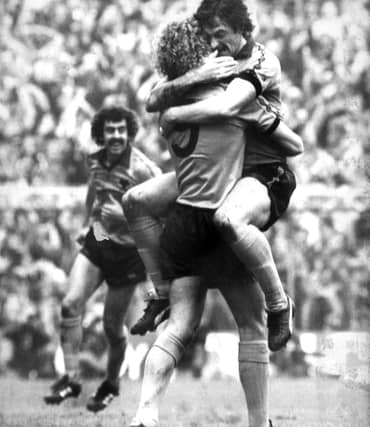

Last week’s Europa League swansong between Spurs and Manchester United?
Well, maybe. But also, throw it back 53 years, to the first ever UEFA Cup Final, between Tottenham and Wolves.
When, having traversed the continent to take on all-comers in the competition’s inaugural tournament, two familiar foes in the upper reaches of the First Division at the time went toe-to-toe across a two-legged finale.
“When I saw all the publicity surrounding the final, it brought back memories of our game all those years ago,” Wolves legend Kenny Hibbitt recalled this week.
But Hibbitt and fellow Molineux icon John Richards admitted they didn’t even watch the competition’s denouement last week. Richards was, however, pleased to see Spurs win, given his boyhood affiliation of having Jimmy Greaves as his hero. But the game itself? It didn’t really appeal.
And that also perhaps took them back to the May of 1972, when facing another English team in the final took a fair bit of the polish away from such a memorable run through the competition.
Big Phil Parkes, Wolves’ goalkeeper throughout that UEFA Cup run, is currently recovering in hospital after a serious accident.
When talking previously about facing Spurs in the final, he was typically forthright.
“The biggest letdown ever,” Parkes reflected. “To reach the UEFA Cup final and play two legs against another team from England just felt like two normal games.”
The rest of the team, although mindful it was a final, with a lucrative competition to try and win, harboured similar thoughts.
“We probably felt exactly the same as Manchester United feel now,” says Richards.
“Losing a European final against another English team just feels like another domestic fixture. Had we played and lost to AC Milan, who Spurs beat in the semi-final, I think it would have been a bit more positive in defeat.
“We had beaten so many top teams on the way to the final, the likes of Juventus and Ferencvaros, and then we get there, and it was Spurs!
“Even the medal was a bit of an anti-climax.
“It’s a bit like one of those tokens you collect from the petrol station, just with UEFA on it.
“All in all, it was an anti-climax after such an incredible run to play another English team in the final, and took a lot of gloss off it as far as I was concerned.”
What then, of that run? The string of games that took Wolves across Europe and into the final. Variety was certainly the spice of life.
Portugal, the Netherlands, East Germany, Italy and Hungary stood in Wolves’ way as they progressed through two-legged ties all the way to the final. Thousands of miles spent on planes, trains and automobiles for the away trips. And then Tottenham!
There was pretty much a story in every port.
Wolves, who played the away leg first all the way to the final, started with a comfortable two leg win against Academica Coimbra during which John McAlle scored in both legs, two of only three goals the defender registered in 508 games for Wolves.
An equally comfortable success against Den Haag in round two included a 4-0 Molineux success in which Derek Dougan was the only Wolves’ goalscorer. He grabbed one – the rest were all own goals!
Round three saw a trip behind the Iron Curtain, to Carl Zeiss Jena in East Germany, Richards getting the only goal of the away leg in which Parkes recalls a feeling of ‘being watched’, everywhere they went.
Into the quarter finals, and the challenge stepped up a level, with a tie against Italian giants Juventus.
Boss Bill McGarry produced a masterstroke for the away leg, taking across John Charles, the Welshman who became a legend with ‘The Old Lady’ following his spell playing for the club, which took the sting out of any supporter animosity and help Wolves settle.
They drew 1-1, future England manager Fabio Capello, then a Juventus player, was so ruffled that he spat at Parkes, and Charles said that the Italian team’s star names wouldn’t bother coming across for the second leg. He was right.
Big centre forward Helmut Haller did make the trip, and then disappeared to a local hostelry with Wolves’ Danny Hegan after the Molineux men’s second leg triumph, to the extent that a search party was dispatched to help him make the flight home.
Dougan and Hegan provided Wolves’ goals in the 2-1 second leg victory that took them to the cusp of the final, namely a semi-final showdown with Hungarian’s finest of the time, and the current home of Robbie Keane, Ferencvaros.
After a 2-2 draw in the away leg, Wolves prevailed 2-1 in the return, thanks largely to a penalty save from Parkes in each game, and a ridiculously early goal in the second from a young Steve Daley.
“I think it was timed at 17 seconds,” Daley explains.
“A brilliant moment as the ball came in from Alan Sunderland and I managed to make contact – it could have gone anywhere!”
As for the penalty saves.
“I went the wrong way both times,” said Parkes.
“And saved them with my left foot.
“Back then we didn’t have analysts or any idea where the kickers were going to put their penalties, so I just stayed on my feet in the middle of the goal for as long as possible. A lot of it was also instinct and trying to guess from the run-up.”
So now, Wolves were in the final. What a journey it had been with so many trials and tribulations, but also so many incredible highlights.
Wolves had won eight and drawn two of the ten matches which took them to the final, scoring 25 goals and conceding seven.
“It had been amazing, as a young player, to go to all those different countries to play football,” recalls Hibbitt, who struck a couple of goals enroute to the final.
“Coming from Bradford Park Avenue just a few years earlier, to playing in the UEFA Cup against all those incredible teams, what a crazy feeling, but an absolute pleasure and wonderful journey.”
A wonderful journey indeed, with Dougan grabbing nine goals, and Richards three, to take Wolves into the final and the chance of European glory.
So then came that final. Over two legs. The first at Molineux, and the second at White Hart Lane. What perhaps made it feel even less of a big European occasion was that, sandwiched in between, Wolves played the epic final league game of the season with Leeds when a 2-1 victory prevented Don Revie’s men from winning a league and FA Cup double and ensured Derby took the honours.
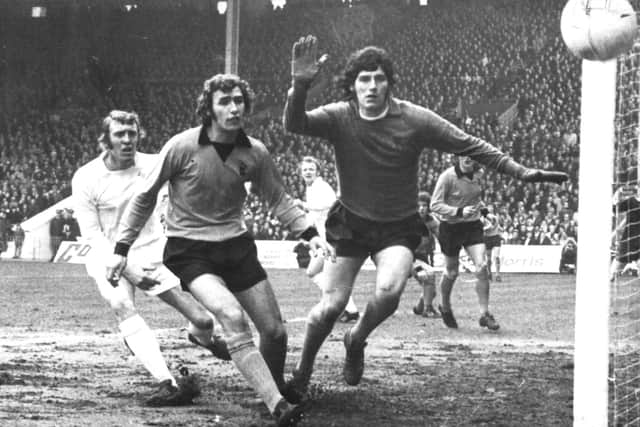
Before that came the first leg of the final at Molineux, in front of 38, 362. Two goals from Martin Chivers, the second a thunderbolt in the 87th minute, either side of a response from Wolves acting captain Jim McCalliog, only passed fit on the afternoon having suffered an eye problem, gave Spurs the edge.
‘There is no question about it,’ esteemed Express & Star Wolves correspondent Phil Morgan wrote in his match report. ‘Wolves should have won the first leg of the final – and they probably would have done were it not for a striker of the calibre of big Martin Chivers.’
“Chivers was definitely the difference that night,” Richards confirms.
“It was a cracking game, and a 50-50 sort of game, but his goals, especially the second which was fantastic, gave Spurs a first leg lead.”
Wolves again did all they could in the second leg a fortnight later, watched by a White Hart Lane audience of almost 53,000.
Alan Mullery extended Spurs’ advantage with a bullet header on the half hour mark before Dave Wagstaffe levelled on the night with a long range drive.
Wolves pressed hard in the second half for the goal which would have brought parity in the tie, but found Spurs keeper Pat Jennings in confident mood, and, as penned by Morgan in the introduction to his match report, it was a case of ‘what might have been’.
“Again, it was a very close game in the second leg which could have gone either way, and we put them under a lot of pressure in the second half,” recalls Richards.
“After Waggy equalised, we were the better team, but we just couldn’t get the goal which would have taken it to extra time.
“If we had, I am very confident we’d have gone on to win, but ultimately it just wasn’t to be.”
“I still remember Tottenham’s manager Bill Nicholson coming into our dressing room after the second leg and saying we were the better side,” adds Hibbitt.
“Maybe that is easy to say when you have won a final but Bill was very honest and up front and I do feel we deserved to win over the two legs.
“But that’s cup football, we all know what can happen.
“Tottenham were always something of a bogey side during my time at Wolves, and they did enough to come out on top.”
Cup football indeed. Wolves were pretty good at it back then.
Of course, there were the two League Cup triumphs in ’74 and ’80, still the club’s most recent major trophies, and the Texaco Cup in ’71.
Later in the decade there were the FA Cup semi-final defeats to Arsenal and Tottenham respectively in ’79 and ’81, but earlier, if you take the three seasons from ’71 to ’74, Wolves won the UEFA Cup, lost in an FA Cup semi-final to Leeds and League Cup semi-final to Spurs, and then won the League Cup after defeating Manchester City.
“In the cups we were outstanding, especially in the early Seventies, but to only win one of them in those three years was actually disappointing,” reflects Richards.
“On our day we were capable of beating any team either in England or Europe.”
“The camaraderie and team spirit in the camp were fantastic,” says Hibbitt.
“That had all been built up by the manager and coaches, and we also had some great players as well.
“We went out on the pitch to win, and in that UEFA Cup run we performed particularly well away from home, before coming back to Molineux where I always felt we effectively had a one-goal start because of how amazing our fans were.”
To refer back to the speculation surrounding one of the managers as mentioned earlier, it seems all the more incredible that Wolves went so close to lifting major European silverware amid doubts over the future of boss Bill McGarry.
In the build-up to the second leg, the back page of the Express & Star carried a story from Morgan in which he regarded the departure of the manager to Coventry City, ‘almost as a certainty’.
And yet, once the game was out of the way, and following a three-hour board meeting, McGarry was offered a new five-year contract, which he signed, ultimately going on to complete eight years in the Molineux hotseat in his first stint, and masterminding that League Cup triumph in ’74.
Sadly, it wasn’t a victory in Europe in ’72, albeit it wasn’t Europe when it came to the final, which is what leaves a lingering numbness about what was otherwise such an incredible tournament and experience.
“Even after the final, we just got on the coach and went back home,” says Richards.
“In one respect, and with hindsight looking back, getting to the final was a big achievement which we deserve credit for, but put it this way, it didn’t feel like that at the time.
“We might even have looked at it differently if the final had been a one-off game played at a neutral venue like the Europa League last week.
“When you speak to the fans, their memories of that year aren’t so much about the final, but about the games which got us there.
“They don’ t talk about those two legs against Tottenham, they talk about the journeys that they went on, the places they saw.
“I suspect that for a lot of supporters, in their minds the final isn’t the memory that it could have been or the memory that they have kept.”
Hibbitt concurs.
“We all have our favourite memories of that journey and it’s nice to look back on with the fans who travelled all over the place to watch us.
“I am very proud of what we achieved, and still feel privileged to have played in that team, but it’s such a shame that we didn’t lift the trophy.”
The achievement in reaching the final is certainly set in stone. And etched in Wolves’ history. Never before had they reached what would be termed a major European final, and never have they since.
Nuno’s Wolves did reach the quarter finals of the Europa League back in 2020, a year after being agonisingly close to making a first FA Cup final in six decades, but again, it wasn’t to be.
For both Richards and Hibbitt, and especially with the make-up of the Premier League in the modern era, reaching a cup final, of any description, is long overdue for the Molineux masses.
“I was ready to book my tickets and take my grandson to the FA Cup Final until that last minute of the semi-final against Watford,” Hibbitt reveals.
“There was a bit of a relegation scare around Wolves for the first half of this season, but hopefully that makes sure it doesn’t happen again, and we are not in the same position next time around.
“I still hope that in my lifetime we can see Wolves win another cup somewhere, and see that open top bus going around the city with a trophy once again.
“I’ve been reading about Liverpool doing it, Tottenham doing it, Crystal Palace doing it, and Newcastle, and that is what our terrific bunch of fans deserve to be able to enjoy in the future.”
“I think cup competitions should be treated as a priority,” adds Richards.
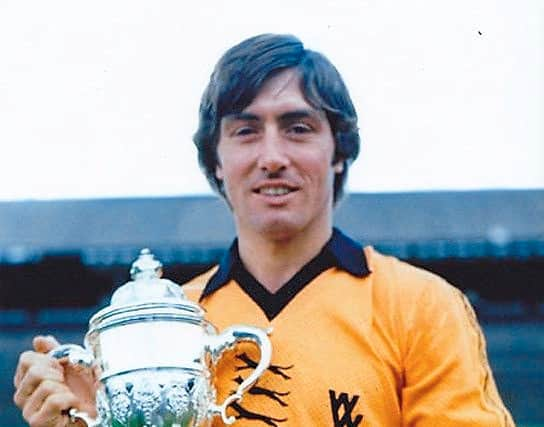
“I remember managers like Brian Clough and Sir Alex Ferguson talking about wanting to entertain and wanting to please the fans, and I don’t think there is anything that could please Wolves fans more than another trip to Wembley.
“It’s not just footballers who dream of going to Wembley, it’s the fans too, and that is what we all want isn’t it? To give the fans those memories.”
That Wolves team of the Seventies remains such a popular and special one for those of a Wolves’ persuasion.
The tributes paid to League Cup final hero Gary Pierce who sadly passed away last week, and the groundswell of support and fundraising for Parkes following his accident, offers another palpable sign of just how fondly they are remembered.
So, they didn’t win the UEFA Cup Final of 1972, and it may have been an anti-climax to face another English team in the final, but they certainly won plenty of gold and black hearts along the way.
Comment Guidelines
Iconic Media encourages reader discussion on our stories. User feedback, insights and back-and-forth exchanges add a rich layer of context to reporting. Please review our Community Guidelines before commenting.