
Mark Atkins: Premier League winner to play-off heartache with Wolves
Quiz question: How many Premier League winners have moved to Wolves later in their careers?
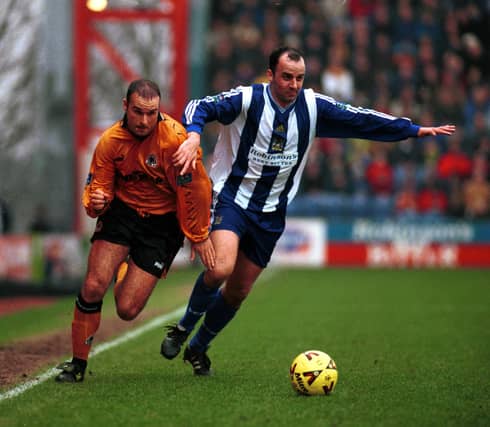

It’s not an exhaustive list, but there have been a few.
Darren Ferguson, Paul Ince and Denis Irwin from Manchester United. Oleg Luzhny and Jeremie Aliadiere – on loan - from Arsenal.
And, from Blackburn Rovers, Robbie Slater, another who moved to Molineux on loan, Bobby Mimms – who served as goalkeeper coach at Wolves - and Mark Atkins. Blackburn also had Tim Flowers, who did it in reverse, starting his career at Wolves and going on to become a Premier League winner, just as Joleon Lescott did with Manchester City.
It is 30 years since the team from the East Lancashire town delivered one of the more romantic tales of the Premier League era, wrestling the title away from Manchester United’s dominance to become champions of England for the first time in 81 years.
As a similar forerunner to the remarkable title triumph achieved by Leicester 21 years later – the two are still the only non ‘Big 5’ representatives to have claimed the trophy – Blackburn had been in the Championship very recently prior to top-flight success, but had flown on the crest of the Jack Walker wave.
The Blackburn-born businessman and industrialist bankrolled a major investment into the Rovers squad, bringing in the likes of Alan Shearer and Chris Sutton, and, with Kenny Dalglish as manager, eventually it paid dividends.
For Atkins, nicknamed ‘Super Atko’ as a result of his substantial contribution during the season, the title win would actually prove to be his last Blackburn stand prior to joining Wolves.
“After getting promoted, we’d finished fourth and then second in the topflight so I wouldn’t say it was a surprise that we were in contention,” he recalls.
“Of course, it was still one of those fairytales that can happen in football, not just for the team but for me as well.
“When I first moved to the club, it was from Scunthorpe in the Fourth Division, so it was a big step up, especially as Blackburn had been in the Championship play-offs so were at the top end of the division.
“I got straight in the team, played 60 games in my first season and it all went on from there.
“As soon as Jack Walker got involved, I think we knew something special was going to happen.
“He was so passionate about the football club and wanted to take it to where it actually got to in the end – so all credit to him for that.
“Kenny coming in changed things, and then bringing in such top players, it was like a different world.
“It raised the standards massively, and meant that those of us already there had to improve, and that was the one thing I always remember about Kenny.
“If you played well, whoever you were, and however much you had cost, he would keep you in the team.
“He was very loyal to players who did what he wanted them to, and I always knew I had to give 100 per cent in each and every game and training session to keep myself out there.”
On this week three decades ago, Atkins scored in successive games in crucial wins against Sheffield Wednesday and Wimbledon.
As a box-to-box midfielder, hugely effective at both ends of the pitch, his total of six goals for that 1994/95 season made him third top scorer behind Shearer (37) and Sutton (15).
And, this Wolves week now back in the present, prompts plenty of happy memories from Atkins’ career.
First of all, for obvious reasons, last weekend’s FA Cup tie between Blackburn and Wolves, for which he was part of the BBC Lancashire commentary team.
Then, this weekend, Sunday’s trip to Anfield, the venue where Rovers clinched the Premier League despite defeat, as the chasing Manchester United failed to win at West Ham.
As mentioned, it was only a few months after Atkins picked up his Premier League medal that he moved to Wolves, for £1million, in September of 1995.
But his flirtations with all things Wolves weren’t confined just to the four years spent at Molineux as a player.
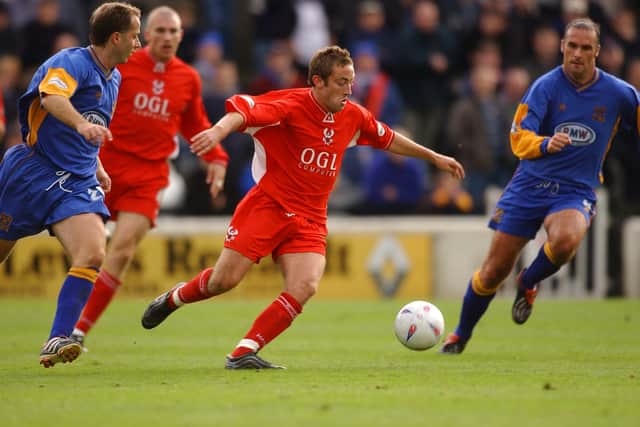
Towards the end of his career, whilst at Shrewsbury, Atkins’ one game as caretaker manager included giving a debut from the bench to a 17-year-old Dave Edwards, who would later chalk up over 300 appearances in the Wolves’ midfield.
And right at the start, during his time as a young professional at Scunthorpe, he lined up at right back against a Wolves attack featuring Steve Bull and Andy Mutch.
“I always remember Wolves because it was the first time I had ever seen the away end full at Scunthorpe,” he recalls.
“Wolves fans always travelled in such big numbers.”
It was at Blackburn that their legendary coach Tony Parkes, then as caretaker manager, converted Atkins to the central midfield position where he would play 34 games of their Premier League winning season, forming a deadly partnership with Tim Sherwood.
Ha form and consistency drew admiring glances from Wolves boss Graham Taylor, who had enquired about Atkins long before finally managing to secure his signature.
Blackburn had been trying to tie him down to a new contract, but the offer of a further two years was on pretty much the same terms as his previous deal, which was well below what most of his Rovers team-mates were earning.
Atkins was happy to stay on those terms if a three year contract was on the table, leading to a testimonial, but with that suggestion rejected, there were several other clubs interested in bringing his seven-year stay at Ewood Park to an end.
Wolves won the race for his signature, thanks to the appeal of working with Taylor and the challenge of helping another sleeping giant reach the Holy Grail of the Premier League.
There was much in common between Wolves and Blackburn. Founder members of the Football League, rich histories, and generous local benefactors in Walker and Sir Jack Hayward.
But that was where the similarities ended.
As any Wolves fan will painfully remember from the 1990s, this was a decade when, for whatever reason, and however much money was spent, Championship purgatory trumped promotion to the Premier League.
And that was despite several quality squads being built with good players, good personalities and a strong dressing room spirit.
“I just don’t know,” is Atkins response to the perennially asked question of why Wolves, who would suffer three Championship play-off semi-final defeats until finally making it in 2003, could never quite make it over the line.
“Even from the time I got there, I felt we had a very strong squad.
“From Stowelley (Mike Stowell) in goal, to Dean Richards at the back, Geoff Thomas in midfield, Bully and Don Goodman up front, I always thought we’d got half a chance of getting promoted.
“It was a great dressing room with plenty of players who could tell a lot of stories, but very good footballers as well.
“Not to mention some really good youngsters coming through who went on to have impressive careers.
“Robbie Keane was my bootboy when I first arrived, and what he went on to achieve in his career was fantastic.
“But why, when putting all that together, we couldn’t ever get promoted and what it was that was missing is probably something I just can’t put my finger on.”
The season when Atkins feels most strongly that Wolves let it slip was in 1996/97, under Mark McGhee, which opened with a Bull hat trick on a glorious opening day at Grimsby and featured a double over West Bromwich Albion, including a 4-2 victory at the Hawthorns.
Bolton were the Championship’s runaway leaders, consigning Wolves to a tussle for the second automatic promotion spot alongside Barnsley, an excellent 3-1 win a Oakwell in late February nudging McGhee’s men into favouritism.
But a painful run of three successive defeats in March, taking only one point out of 12, handed the momentum to the Tykes who took full advantage to snap up the runners up spot, leaving Wolves with a play-off semi-final against a Crystal Palace team they had finished three places and five points ahead of.
The script, from there, was all too familiar.
A crazy finish to the first leg at Selhurst Park saw Wolves with a 3-1 deficit and, even with one of the greatest atmospheres witnessed at Molineux of that or any era, and a 29th minute opening goal from Atkins, a 2-1 win wasn’t enough to repair the damage.
“That was definitely the season I think we should have done it,” Atkins acknowledges.
“And it still forms one of the biggest regrets of my career that I didn’t get promoted with Wolves.
“The passion of the fans was unbelievable, it was a different feeling to how it was at Blackburn, and the way they took you in as players was fantastic.
“I say all that time that the Crystal Palace game was one of the best atmospheres I ever played in, it was absolutely electric.
“We tried to take that onto the pitch, and while I always knew we would win, it was whether we could do it by two clear goals.
“It was great for me to score after a lovely little pass from Geoff Thomas, but ultimately it just wasn’t enough and we couldn’t quite get there for the result that we needed.”
In total, Atkins made 155 appearances for Wolves, and scored 12 goals, also featuring in several different positions including as a sweeper when luckless new signing Adrian Williams suffered a cruciate knee ligament injury on a pre-season tour of Austria.
“That was a spell I really enjoyed and was probably when I played some of my best football at Wolves,” he recalls.
“We had Froggy (Steve Froggatt) and Jinky (James Smith) as the wing backs and with those lads and the strikers we could always score a few goals!”
Atkins continued his career after Molineux with spells at York, Doncaster, Hull and then Shrewsbury, one of several experienced players alongside the likes of Nigel Jemson and Ian Woan recruited by manager Kevin Ratcliffe to pass on their experience.
And the stint would end with that one game in interim charge of a Football League fixture at the end of the 2002/03 campaign, ironically against Scunthorpe.
Atkins rounded off his playing days in non-league including with Harrogate Town, during which he also enjoyed some coaching duties, setting the scene for a later stint of six years managing Matlock Town.
He actually returned briefly to manage Matlock at the end of last season, helping guide them to safety, although all his time within non-league was accompanied by running a family plastering and dry-lining business with his brother-in-law, and radio commitments with BBC Lancashire Sport.
“I really enjoyed managing Matlock but it was very hard work, doing a lot behind the scenes and budgets being difficult while only training with the players twice a week,” he explains.
“We did our best and produced some good results, including beating Mansfield in the FA Trophy in the year they won the Conference, and then only losing to Luton in the last minute.
“It did get to a point around ten years ago when I needed a break, but I was called back towards the end of last season when Matlock were struggling.
“We ended up winning four out of the last eight games to survive and there was a conversation about whether I might stay on, but it didn’t really come to anything.
“As it happens, I still have the radio work, covering different clubs from the area including Blackburn, which is another thing I really enjoy, and have still been involved with my brother-in-law in the family business which my Grandad started in the 1940s.
“That’s actually going to come to an end very soon, but it’s fair to say I’ve been kept very busy since my playing days came to an end!”
Atkins has also kept in touch with several of his team-mates from the Molineux days, notably Goodman, who he regularly sees on the football circuit through his own media work, Andy Thompson, and Bull, who travelled with wife Kirsty to attend the wedding of Atkins’ youngest son last summer.
“I had Bully snoring his head off in my house,” he says with a laugh.
And of course, he keeps in touch with the fortunes of all his former clubs, sometimes in person – as at Ewood Park when Wolves won on Sunday – or sometimes further afield.
Wolves visiting Anfield this Sunday will no doubt draw recollections from that incredible afternoon, 30 years ago in May, when, even in defeat, Liverpool hero Dalglish and his Blackburn team were able to celebrate an historic Premier League title.
Atkins had been struggling with a muscle injury during the closing, nail-biting weeks of the season, and had initially been named among the three substitutes for the seasonal decider.
But on the morning of the game, Dalglish changed his mind as, with Stuart Ripley playing whilst suffering from a slight thigh strain, he opted for more direct cover on the bench in Slater.
And that meant quite an unorthodox way for Atkins to spend his pre-match.
“When we got into the changing room before the game, there four or five of us who weren’t involved and Kenny told us to get ourselves up into the bar instead,” he reveals.
“He knew we’d be nervous as hell if he didn’t, just hanging around without really being able to do much to support the lads.
“So off we went into the sponsors bar, had two or three pints before the game and then back down to watch and celebrate with everyone else when the United result came in!”
Man management at its finest. But it’s fair to say probably not something any of the Wolves players will get involved in on Sunday!
Comment Guidelines
Iconic Media encourages reader discussion on our stories. User feedback, insights and back-and-forth exchanges add a rich layer of context to reporting. Please review our Community Guidelines before commenting.