
'Like the majority of these women, Katherine Harley believed in peaceful protests' - Your Letters: June 23
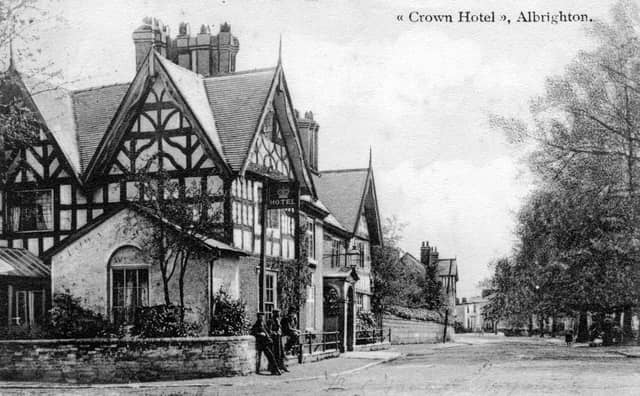
PICTURE FROM THE ARCHIVE: The Crown Hotel, Albrighton, from a postcard sent by a C Tanner, dated May 12,1907, with the message: ‘Bishton Manor, Wolverhampton. Dear Madam, I was very pleased to get your letter and will try and write to you in the week, after I have been to Albrighton. It is about 2 1/2 miles from here.’

SUFFRAGETTE WAS NOT A MILITANT
The impression was given in the Star that Katherine Harley was a militant Suffragette. I wish to correct that as her name has been mentioned regarding the possible replacement of the statue of Clive of India in the square in the town of Shrewsbury.
She like many women campaigned for universal women's suffrage ie the right of women to vote in General Elections. Like the majority of these women she believed in peaceful protests and was a Suffragist. In 1913 she helped organise the Great Pilgrimage in which an estimated fifty thousand women marched over the course of a month to Hyde Park. They converged on London along three different routes having made their way through many towns and cities. Photographs of the time show many men as well as women among those who sympathised with their aims lining the routes. The Prime Minister Herbert Asquith praised these women showing that their peaceful protests did have an effect on public opinion.
Katherine Harley is on the lists in Condover Church and St Mary’s Church in Shrewsbury of those killed in the World War 1. She had run a couple of war time hospitals in France being awarded the 'Croix de Guerre' by the French. After being asked to move to the Balkan front she created an all women motorised ambulance unit. The women brought hundreds of Serbian casualties day and night from the front line dressing stations to hospitals a journey of at least 10 hours but as much as 30 hours after rain and snow. She was later killed aged 61 by shell fire in the besieged city of Monastir, in Serbia, where she had been rescuing injured Serbian women and children by ambulance. At the suggestion of a French general she was given a grand military funeral attended by many hundreds of Serbian troops as well as generals and the Crown Prince of Serbia.
She is buried in an English military cemetery in Thessaloniki Greece where her epitaph on a large memorial states in Serbian and English "Instead of flowers the gratitude of the Serbs shall blossom there".
Ronald Repath, Much Wenlock
POET IS FED UP THIS MORNING
A false face on things
Too much laughter, not real
Big big smiles and congratulations
Pats on backs, huggings
A mutual love fest
‘Stop it!’ That’s the new one
As in, ‘stop being so wonderful!’
As in, ‘stop being so am-a-zin!’
As in ‘stop being so delicious’
When food is tasted
An orgy of flashing impossibly white veneers
A show within a show:
‘The Amazing Dancing Teeth!’
Like The Tiller Girls on Sunday Night
At The London Palladium
Tiller Girl teeth!
Then the masks of empathy and sorrow
For the misfortune and tragedy bits.
And: ‘let’s get Britain talking’
How about, Let’s get Britain to shut up
For a minute!
Alan Jones, Halesowen
DEBATE OVER BAN OF THE BURQUA
I read with interest the letter from Ayesha Naseem accusing political leaders of making up assumptions about the wearing of the burqa. I am well aware of the sensitivities around this subject but I cannot let her commentary go without challenge.
The current debate about the burqa arises from a question asked by a reform MP of Keir Starmer at PMQs. The questioner asked why the PM did not ban the wearing of the burqa in the hope of fostering good relations with other European nations who have formally banned the wearing of the burqa. Amongst those who have a formal ban are France, Denmark and Austria. There are we should note also partial bans on the burqa active in Muslim countries, Turkey and Tunisia being prominent in these.
There will be many reasons these nations have banned the burqa but it does rather prove that concern about the issue is not confined to an out of touch far right sentiment confined to this nation.
The problem I personally have with the burqa is that it makes normal human interaction impossible. When we speak we share non verbal signals that we pick up and respond to. The burqa makes this impossible. A further problem is that it separates us placing a physical barrier between people.
It is also not the case that the burqa is required by Islam. The Koran enjoins modesty but in no chapter is face covering a requirement of a good Muslim.
Burqas can also be used for criminal means. Indeed it is a matter of record that one of the London bombers escaped to Italy wearing a burqa as a disguise. It is also obvious that let us say, the proprietor of a jewellery shop would not allow a burqa to be worn in their shop. This may well be true of many other commercial operations. Of course this does not suggest a majority of those wearing a burqa are intent on stealing but one must admit the possibility that a minority however small may well be.
In her last paragraph Miss Naseem suggests that this issue is minor and that our political leaders would be better advised addressing social justice and issues of poverty. For me social cohesion and integration is a key issue. Government must pursue policies that foster good relations between different ethnic and religious groups. After all we are all British and our first concern must surely be the duty we have to one another as Britons whatever our faith, colour or ethnicity.
The UK is a multi cultural society. We are tolerant of the religions of others who have settled here whilst retaining the values bequeathed to us by our history and the culture it produced.
A Britain in which barriers are broken down is one in which people live together. We should avoid separate communities dominated by one ethnicity or religion. It is far better that people of all differences mix and live together in the fullest sense.
For myself I see the burqa as a means of separation. It speaks of difference and places the wearer outside the main social order. It is a barrier to integration that is not required by religious faith and is therefore a conscious choice to be separate and outside.
Martin Bristow, Wolverhampton
Send us your letters for publication to [email protected]
Comment Guidelines
Iconic Media encourages reader discussion on our stories. User feedback, insights and back-and-forth exchanges add a rich layer of context to reporting. Please review our Community Guidelines before commenting.