
Why our schools are letting down white working-class children - and how we must confront the problem
White working class children are being left behind at school. Education expert Roshan Doug explains why urgent action is needed.
We talk endlessly about inequality in education – but one of the most disadvantaged groups in Britain is often left out of the conversation.
This week’s report by the BBC confirms that - despite what some race activists call ‘white privilege’, fewer than one in five white working-class pupils achieve strong GCSEs in
English and maths. It’s a stark figure, but not a new one. If anything, it carries a weary sense of déjà vu.
I’ve spent much of my life in and around education – as an academic, a writer, a governor - and, perhaps more importantly, as someone who knows that background shapes expectation.
You don’t need a spreadsheet to tell you that some children begin the race several strides behind.


I remember classrooms in the 1970s where potential was obvious but confidence was not.
Bright pupils who had already, by fourteen, quietly decided that top grades were ‘not for the likes of us.’ That phrase tells you more about educational failure than any data set ever could.
For years, policy has rightly focused on closing attainment gaps for disadvantaged groups, including many ethnic minority communities who faced structural barriers. In several cases, that focus has worked. Outcomes have improved. Expectations have risen.
But here’s the uncomfortable question: in trying to address one set of inequalities, have we allowed another to settle in plain sight?
I raised this at a national education conference not long ago. I suggested – cautiously – that the strong focus on Black and Asian pupils, while understandable, might be leaving white working-class children comparatively overlooked. The response was swift. I was told I was ‘creating a divide’ simply by raising the issue.
There is an irony in that. Highlighting inequality should not itself become controversial. If anything, refusing to talk about it entrenches division.
Because the reality is difficult to ignore. Think of Ashmore Park, Low Hill, Bushbury, and Wednesfield North in Wolverhampton.
In many such areas, white working-class pupils – particularly boys – are now the lowest performing group. Not the most discussed. Not the most politically visible. But, by most measures, the most left behind.
So much for ‘white privilege.’
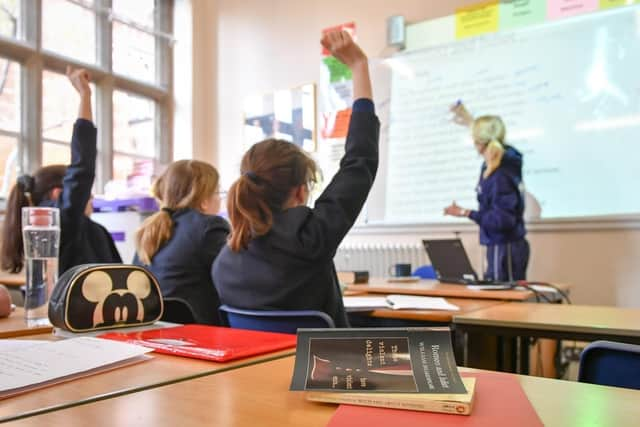
And yet the conversation remains hesitant, as though acknowledging this risks diminishing the struggles faced by others. It doesn’t. We should be capable of holding two truths at once: that racism continues to affect many minority communities, and that poverty, low expectations and cultural disengagement are quietly undermining white working-class children too.
So why is this happening?
Part of the answer is simple: class still matters. If you grow up in a home where books are scarce, where parents had a poor experience of school, where financial pressure is constant, education can feel distant – even irrelevant. That’s not about ethnicity. It’s about environment, aspiration and opportunity.
Then there is geography. I’ve worked with schools in coastal towns and post-industrial communities where opportunity hasn’t just declined – it has all but disappeared. You can sense it: a subdued fatalism, a feeling that ambition belongs somewhere else. Schools are doing extraordinary work, but they are battling forces beyond the classroom – fragile economies, limited prospects, and a lingering belief that ‘people like us don’t get on anyway.’
There is also a cultural dimension. In some communities, academic success can carry a faint stigma, as though doing well is a betrayal of identity. I’ve seen pupils play down their own ability simply to belong.
Where the debate goes wrong is in turning this into a competition between groups – as though recognising one form of disadvantage cancels out another.
It doesn’t.
The real failure is not that support has been given to ethnic minority pupils. It is that similar focus has not been applied consistently to all disadvantaged children – including white working-class ones.
We should be asking a simpler question: what has worked, and how can it be applied more widely?
Mentoring. Strong role models. High expectations. Parental engagement. These are not culturally exclusive ideas; they are the foundations of good education.
But policy alone will not solve this. There is also a question of belief. Some young people are encouraged to see education as a ladder worth climbing. Others have stopped believing the ladder is even there.
Rebuilding that belief is not easy. It requires trust – between schools and families, between communities and institutions, and within young people themselves.
Because this is not really about statistics. It is about children – thousands of them – who are capable of succeeding but are slipping through the cracks.
We do not need a blame game. We need the confidence to confront uncomfortable truths honestly.
Ignoring the problem will not prevent division. It will simply deepen it whether we see privilege or not.
* Prof Roshan Doug is an educational consultant and a former Birmingham poet laureate
Comment Guidelines
Iconic Media encourages reader discussion on our stories. User feedback, insights and back-and-forth exchanges add a rich layer of context to reporting. Please review our Community Guidelines before commenting.