
The rocketmen who defended wartime Wolverhampton
And here they are – Wolverhampton's rocketmen.
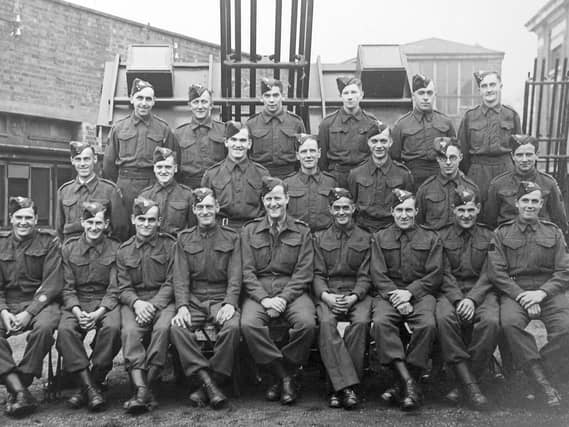

They are posing in front of one of their top secret weapons, part of a rocket battery which protected the wartime town from aerial attack.
Wolverhampton's rocket gun battery was unveiled to Star readers 80 years ago this month and after we put the weapon in the spotlight in a feature the other day local aviation historian Stephen King got in touch to provide more information about it.
Our photo shows the command post and tracking crew of the battery in the autumn of 1944, by which time the weapon was off the secret list. It was originally provided by Ron Bown of Wolverhampton. Mr Bown is middle row, second from left, and recalled that the battery commander was a Captain Black, who is in the middle of the front row.
The battery was operated by members of the Home Guard.
We did question whether it was ever fired in anger, and the answer seems to be... possibly.
Stephen tells us: "I was very interested to read your feature. This would have been one of the anti-aircraft 'Z' batteries placed around the country. The one for Wolverhampton was based at Dunstall Racecourse, and operated by the Home Guard to free up regulars."
The unit, he says, was the 137 AA Battery of the Royal Artillery.
"Many years ago there was a letter in the Black Country Bugle from a chap, from memory, now in Cheshire, who was recalling a wartime lone raider. During the war he lived in Bright Street, Whitmore Reans, and recalled a daytime raider passing over his street, which he believed was an RAF aircraft in German markings, possibly en route to Pendeford airfield.
"Soon after, the Z rockets at Dunstall Racecourse were unleashed at this aircraft. Result – not known.
"In 50 years of looking at all things military, and especially in this area, this was the only mention I have ever seen of this incident. It would be interesting if any readers can verify this account.
"The Luftwaffe did send unarmed photo recce aircraft over this area during the war, photo-mapping. Anti-aircraft researchers have told me in the past that these unguided Z rockets may have been enough to force low flying aircraft to move away from an area, and possibly also be a morale booster for the local civil population."
He added: "It must have been some sight when these Z rockets fired. They shook the whole town when fired."
Another snippet is that a football team made up of members of 137 AA Battery won the Guy Cup in 1944, a trophy played for annually by local amateur teams and named after a well-known family which ran a motor dealership in the town.
One of the players was John Hargreaves of Wolverhampton who, speaking in 1997, told how 1,600 Home Guard volunteers manned the site at the Dunstall Park racetrack to enable 350 regular Army soldiers to go oversees. Each worked from 7pm until 7am one night a week and according to Mr Hargreaves there were 64 launchers, each with two projectiles. The 6ft long steel tubes were in rows of eight, each 10 yards apart.
The rocket gun system needed a lot of people to operate and the Wolverhampton battery was not alone in having problems keeping the system fully manned.
The weapon was hush-hush, at least until it went off, because when they were fired the noise was tremendous. However, by the time the system was deployed the threat to the Midlands from Nazi raiders was greatly diminished, so unless any reader knows differently it seems likely that any firings would have been mostly – and perhaps all – practice drills.