
Obituary: Dr Richard Taylor, a retired medic who shook the political establishment to become MP
June, 2001, and Tony Blair was master of all he surveyed. Heading into what would be a second landslide victory, he, Gordon Brown and John Prescott toured the country on a slick battlebus, delivering the message that a second-term Labour government would deliver record investment in schools and hospitals.
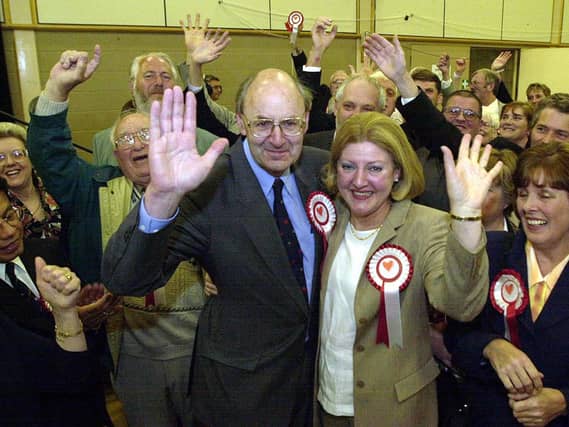


But there was a fly in the ointment. Blair's plans for a £95 million super-hospital in Worcester had led to the closure of the A & E department at Kidderminster the year before. The move prompted an unassuming hospital consultant had decided to stand against one of Labour's rising stars on a Save Kidderminster Hospital ticket.
Dr Richard Taylor's stunning victory in Wyre Forest constituency was one of the biggest surprises in the 2001 General Election. It was not just that a sparsely funded independent candidate had ousted a government minister, with the weight of a giant party machine and a popular prime minister behind him. It was the magnitude of his victory that came as the biggest shock: his majority of 17,630 over David Lock left Tony Blair in no doubt about the strength of feeling about his plans to downgrade Kidderminster Hospital.
The recently retired hospital consultant was little-known outside medical circles when he became involved in the campaign to stop the closure of the A & E unit in 1997. Indeed, it was his persona as a reluctant politician, rather than a tub-thumping activist, that enabled him to bring together a coalition of support from across the political spectrum.
The announcement of Dr Taylor's death on Wednesday, a week before his 90th birthday, has led to tributes from both his supporters and opponents.
Mark Garnier, who eventually defeated Dr Taylor at the General Election of 2010, spoke of his sadness at Dr Taylor's passing.
"He epitomised everything that is good about democracy," said Mr Garnier.
"He stood up for his community on an issue that he cared passionately about and was elected to parliament to fight for that issue."
Graham Ballinger, former leader of Wyre Forest's Independent Community and Health Concern party, said: "It's a sad loss to the community of Wyre Forest.
"He stood up for the rights of the hospital and worked so hard.
"People still talk about him on the doorstep now. He was a wonderfully honest guy: what he said, he did."
Raised in Cambridge, he studied at Clare College at Cambridge University, followed by Westminster Medical School.
From 1959 to 1961, Taylor was pre-registration house officer at Westminster, Kingston and London Chest Hospitals in London. In October, 1960 he was commissioned as a medical officer in the RAF, where he served for three-and-a-half years, and in 1964 he was appointed as a registrar in London.
He moved to Kidderminster General Hospital in 1972 to take up a post of consultant physician, remaining in post until 1995.
He was also a member of the local health authority, and chairman of Kidderminster Hospital League of Friends from 1996 to 2001.
But it was the announcement of plans to downgrade Kidderminster Hospital during the summer of 1997 that brought him out of retirement for an unlikely second career. As the people of Kidderminster took to the streets to demonstrate against the loss of A & E services, Dr Taylor became the figurehead for the campaign. Supported by coachloads of demonstrators, he led a delegation to Downing Street in November, 1998. He handed a 40,000-signature petition to his MP, Mr Lock, on the steps of No. 10. Dr Taylor was told Health Secretary Alan Milburn had been impressed by the passionate support for the hospital – but he pressed ahead with the plans nevertheless, and the services were transferred to Worcester in 2000.
Dr Taylor wryly noted the change in mood from Worcestershire's hospital leaders once he had been elected to parliament.
"I think the most staggering thing this morning is that the chief executive of the trust and one of the important directors of the trust have shaken my hand," he said.
"I've been persona non grata for three-and-a-half years and already they are looking to talk to me."
His election came just as another well-known independent MP – former news reporter Martin Bell – was leaving Parliament. But unlike Mr Bell, Dr Taylor was not a one-term wonder. During an open day at the Express & Star offices in 2005, Dr Taylor took the opportunity to announce he would run for a second term in office. He was re-elected, although with a reduced majority of 5,250, beating Conservative Mark Garnier into second place. The seat was also contested by television chef Rustie Lee, who stood for Ukip.
Dr Taylor did not succeed in reversing the decision to close Kidderminster Hospital's A & E unit, but he did become an influential expert on health policy. Throughout his time in parliament, sat on the all-party health select committee, and became joint chairman of the all-party local hospital group, vice-chairman of the all-party group on cancer, and vice-chairman of the flood prevention group. While most of his work in parliament surrounded health, he was known for holding one or to left-field views – he supported the liberalisation of cannabis laws and the nationalisation of the railways.
He was defeated by Mr Garnier at the 2010 election, and unsuccessfully stood once more in 2015.
Dr Taylor was appointed an MBE in the Queen's 2014 birthday honours for 'services to the community in Worcestershire especially to Kidderminster Hospital'.
He married Ann Brett in 1962, producing one son and two daughters. After this marriage was dissolved he married Christine Miller in 1990 and had another daughter.
Comment Guidelines
Iconic Media encourages reader discussion on our stories. User feedback, insights and back-and-forth exchanges add a rich layer of context to reporting. Please review our Community Guidelines before commenting.