
Wolverhampton-born author explains what should happen to 'forgotten Scots' artefact 'Book of Deer'
To the Scots, it is an iconic artefact of cultural heritage, a gem from early nationhood - a sort of literary Stone of Destiny.
It is the Book of Deer, one of the great Celtic illuminated gospels, written by an unknown monk some time between 850AD and 1000AD and celebrated as one of the principal antiquities of Celtic Scotland and as a Celtic work of art.
And it's in England. At Cambridge University Library, in fact.
But what if, at a pivotal moment in modern Scottish history, a dour and disillusioned Glasgow librarian nicks it and takes it back to its homeland?
It is the premise of a novel by James Christie which weaves in echoes of Raiders of the Lost Ark and a character from the works of famed Scottish author John Buchan, best known for the spy thriller The Thirty-Nine Steps.
"I do rather think it could be turned into a lucrative Netflix serial in the wake of Outlander," said James, who was born in Wolverhampton in 1964, but lived in Scotland for over 50 years. He has lived in Shifnal since 2020.
It all began when he was working at a Scottish stately home as a rare books cataloguer. One day in about 1994 he came upon a Victorian reprint of the Book of Deer, which takes its name from a monastery which was at Deer, Aberdeenshire.
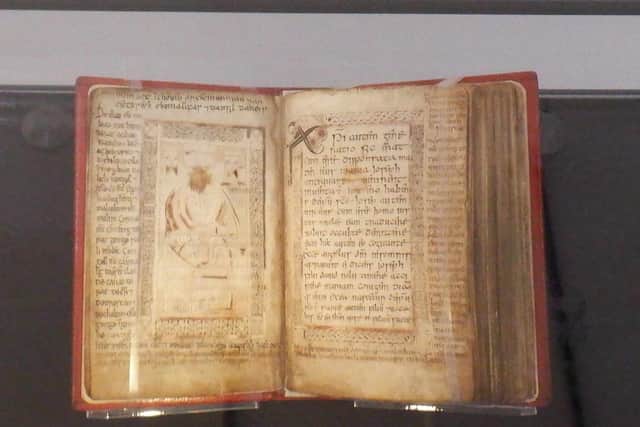

"Like librarianship’s version of the fictional archaeologist Indiana Jones, I came across the Spalding Club’s 1869 reprint of a lost and forgotten work," he said.
"It wasn’t quite the Ark of the Covenant which Dr Jones rediscovered in Raiders of the Lost Ark, but you’re close.
"The Book of Deer is a forgotten Scots icon, predecessor to the Book of Kells, annotated with the first words in Scottish Gaelic. An icon greater, arguably, than the Stone of Destiny. To find and read words and history like this was the nearest real-life equivalent you’ll see to coming across the Ark."
Not long afterwards a sequel written by Andrew Greig was published to John Buchan's novel John Macnab. It gave James the idea to do a book of his own, a second sequel, in which a librarian called John Sandiman would take on Macnab's mantle and steal the Book of Deer on the eve of Scotland's devolution referendum in 1997 - not to be confused with the 2014 independence referendum.
In Buchan's 1925 novel three high-flying but bored men seek to liven up their dull lives by sending notes to Highland landowners, using the pseudonym John Macnab, saying he intends to poach from their estates without getting caught, defying them to stop him.
James' book is called The Legend of John Macnab and was many years in the making. It proved a long and hard road, with a diagnosis in 2002 of Asperger's Syndrome along the way.

James, who is of Scottish descent, says that the librarian who takes matters into his own hands was based on himself.
In fact in 2022 the Book of Deer returned to Scotland for the first time in seven centuries, going on temporary display at Aberdeen Art Gallery. James flew up to see it.
"It felt like a satisfactory culmination of a life’s journey, even though the book itself, encased in an atmosphere-controlled casket, could not be touched."
It returned to Cambridge and last August, during a stay in the city, he asked the university library if he could see it and, to his surprise, was welcomed, once more getting up close to the sacred text.
"The Legend of John Macnab is the only book in modern times essentially to publicise the Book of Deer, a pivotal part of Scotland’s culture and history," he says.
"Although I didn’t physically bring it back across the border from Cambridge, there are actually some parallels between myself and Indiana Jones.
"I am a rare books librarian, self-taught. He was an archaeologist, and by accident or design we both crossed the world, discovered historic icons and brought word or fact of same back to our homelands’ authorities."
But does James think the Book of Deer should return to Scotland?
"I was never a nationalist, nor even much of a unionist. I don't believe in flag-waving jingoism and xenophobia," he says.
However, he added: "I have tried to nudge certain persons discreetly in that direction, not though like the dramatic theft of the Stone of Destiny from Westminster Abbey in 1950, and not getting up in arms against each other - I wouldn't like it to become some sort of nationalist totem. But wouldn't it be an idea to loan it out, or transfer the Book of Deer, from one special collection to another?"
Comment Guidelines
Iconic Media encourages reader discussion on our stories. User feedback, insights and back-and-forth exchanges add a rich layer of context to reporting. Please review our Community Guidelines before commenting.