
Urban jungle: we go hunting for the West Midlands’ wildest weeds
We go out on safari in the urban jungle, to explore the wildlife growing at our roadside

Welcome to Weedwatch, a wildlife safari with a difference - and it’s right up your street.
Instead of spending hours in the middle of nowhere peering through binoculars, the Express & Star’s own nature safari takes you around the heart of the West Midlands, exploring the exotic plant-life growing at the side of our roads, in our gutters, across the pavements.
You would have to have been living under a stone - or at least deep in the undergrowth of a grass verge - not to have noticed the masses of wildlife taking root around the region at the moment. A combination of reduced maintenance budgets, a long, hot summer - not to mention the temperatures being too warm to use weedkiller - have led to many of our urban landscapes being turned into mini-jungles.


But what is out there? Following on from the success of last year’s Pothole Safari, we hit the road armed only with a notepad and a library book on wild flowers, and it didn’t take us long to find some interesting flora. About 100 yards from our office we came across a magnificent butterfly bush sprouting out of the pavement in Lever Street, up the side of Kwik Fit. Comfortably towering over my 6ft frame, this rampant specimen, known in horticultural circles as Buddleja, has a very powerful stem structure, and pointed purple flowers. It’s a pain if you actually want to walk along the pavement, which has been all but overwhelmed by it, but if you want a photograph of wild shrubbery in an unlikely setting, it’s just the job.
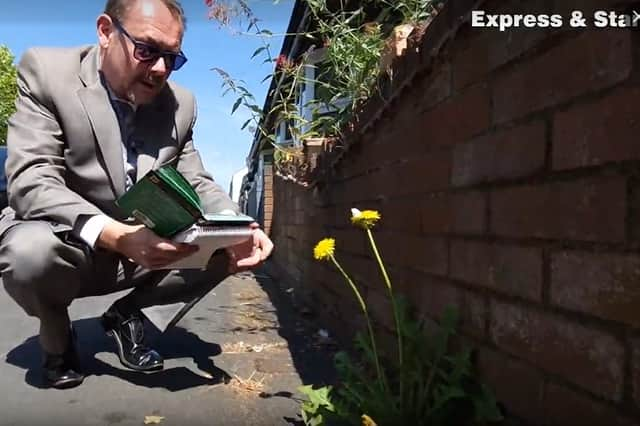
Just around the corner in Raby Street, there is a particularly strong example of a taraxacum officinale, poking out of the pavement, its bright yellow florets lapping up the summer sunshine. More commonly known as the common dandelion, these upright perennials flower from March through to October, and its leaves can be eaten in salads, its flowers made into wine, and its roots roasted as a coffee substitute. Yum yum.

Heading out of the city, we spot an interesting combination of wildlife surrounding a felled tree stump at the side of Wolverhampton Road East. First up is a southern globe thistle, a compact, bushy weed growing to 24in tall, with broad prickly leaves and bearing globes of steel-blue flowers. Commonly found in southern and eastern Europe, it thrives in warm climates. A bit more of a surprise is what is growing next to it - a common sunflower. Not a huge one, admittedly, but not the type of thing you expect to be growing in a verge at the side of a busy main road.

Over in Lomond Road, Sedgley, the forces of nature appear to have got the better of the council workmen who have made a somewhat half-hearted attempt to tidy the area up. The grass has been cut, but rather untidily, with the edges left long, and nature has made a land-grab for the pavement which is now over-run with grass.

On the corner of the street, opposite Ley Rise, is a row of Epilobium Hirsutum - or hairy willowherbs. A tall perennial, it can reach a height of up to 7ft, although these are probably just under half of that - at the moment. Its robust stems are profusely furry with soft spreading hairs, with long, thin hairy leaves and large purple-pink flowers. It is poisonous to cats and dogs, so be careful they do not eat it.
In Ettymore Road, Sedgley, we discovered another butterfly bush, which was probably the find of the day. At least 10ft tall, it was perhaps more wild tree than weed, and its strong spiky leaves and bright purple flowers had attracted the interest of the local bees.
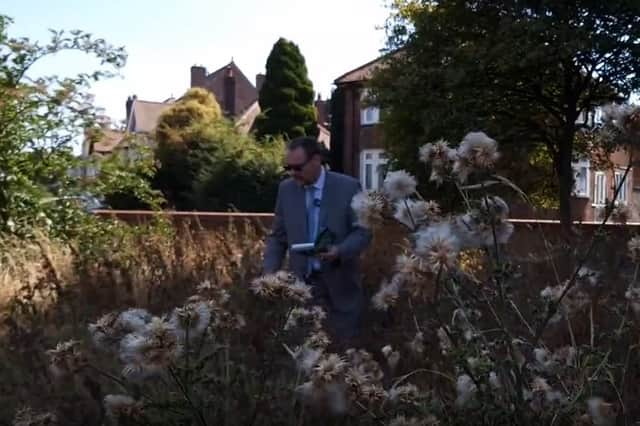
But if it is diversity of species you are looking for best head over to the junction of Birmingham New Road and Sedgley Road in Tipton, which appears to have developed an ecosystem all of its own. Copse bindweed, also known as thicket bindweed is rampant on what was once an orderly landscaped area, along with elm-leaf blackberries, and the horticulturalist’s favourite Urtica dioica, otherwise known as the stinging nettle. But my favourite is the coral berry, or to be more correct, the Symphoricarpos orbiculatus. Try saying that after four pints of Ruby Mild.
Comment Guidelines
Iconic Media encourages reader discussion on our stories. User feedback, insights and back-and-forth exchanges add a rich layer of context to reporting. Please review our Community Guidelines before commenting.