
Walsall war hero finally gets memorial, 135 years after his death

Belated tribute to VC who saved his captain’s life
As the people of the West Midlands stand before our war memorials to remember the fallen, a Walsall man is working to ensure that one of the region’s lesser known war heroes is not forgotten.
For Private James Thompson there is no elaborate monument, not even a headstone. His Victoria Cross is displayed at the Royal Green Jackets Museum in Winchester, and 17 years ago a memorial plaque was unveiled at Walsall Town Hall, shared with the town’s other two VCs, John Henry Carless and Charles George Bonner.
But his final resting place? A neglected, unmarked grave at a long-closed cemetery, a less-than-fitting tribute to one of the town’s greatest heroes.
At least until now.
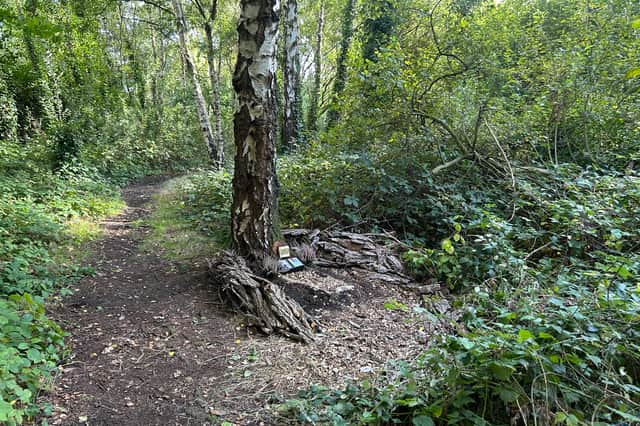

Because after some painstaking research by Walsall bricklayer and amateur historian Spencer Clayton, Thompson has finally got a memorial befitting of a courageous man.
Mr Clayton tracked down Thompson’s remains on the edge of Walsall’s Queen Street cemetery, and has created a monument to telling remarkable story.
Or at least what is known of it.
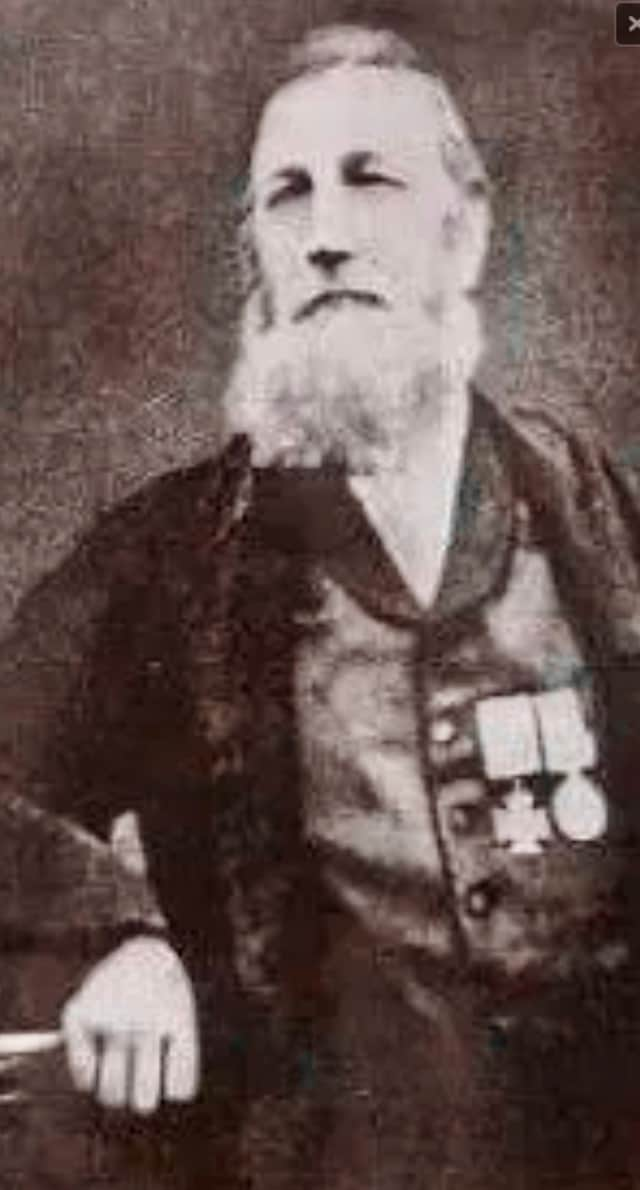
William James Thompson was born circa 1930 at Yoxall, between Lichfield and Burton. Sadly, very little is known about the first 27 years of his life.
“We do know that he enlisted with the 60th Rifles (King’s Royal Rifle Corps) sometime in advance of the outbreak of the Indian Mutiny in Meerut in 1857,” says Mr Clayton.
The Indian rebellion, which took place in 1857-58, opposed the rule of the the British East India Company, which functioned as a de facto sovereign power on behalf of the British Crown.
The mutiny was fed by resentments born of diverse perceptions, including British-style social reforms, harsh land taxes, summary treatment of some rich landowners and princes, and scepticism about British claims that their rule offered material improvement to the Indian economy. Like British rule itself, the mutiny was somewhat divisive. While it had the support of many Indians, many others fought on the British side. The majority, it appeared, were happy to comply with British rule.
After breaking out in Meerut, the rebels quickly reached Delhi, whose 81-year-old Mughal ruler, Bahadur Shah Zafar, was declared the Emperor of Hindustan.
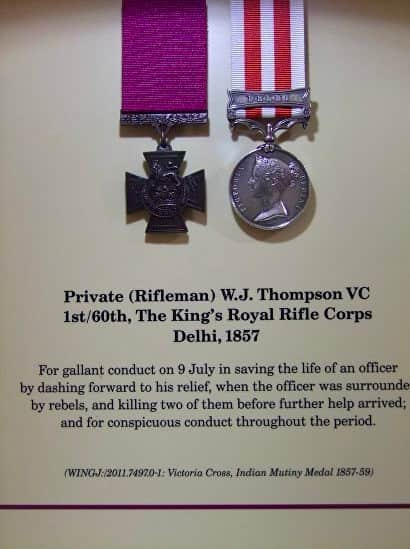
Private Thompson was awarded the Victoria Cross for his actions at Delhi on July 9, 1857, when his captain, a man named Wilton, was surrounded by a party of Ghazees, the fearsome Muslim fighters who resisted British rule with a religious zeal.
The Ghazees appeared from a serai, or roadside inn, and sprung a sudden attack on Wilton.
“Noticing the predicament of his officer, he rushed to his aid, and killed two of the attackers, before further assistance could reach them,” said Mr Spencer.
Just nine weeks later, on September 14, Thompson was badly injured when still fighting in Delhi in a bid to clear the city of Indian rebels. His wounds led to the amputation of his left arm, and he was invalided out of the army.
Thompson was presented with his VC by Queen Victoria at Home Park, Windsor Castle on November 9, 1860.
Just as little was known about his early life, his life after receiving his VC is equally mysterious. We know he returned to his native Staffordshire, and settled in Walsall, dying on December 5, 1891, aged 61. It appears he may have spent his last years in relative poverty, his disability probably making it difficult to earn a living, and he was buried in an unmarked grave at Queen Street Cemetery.
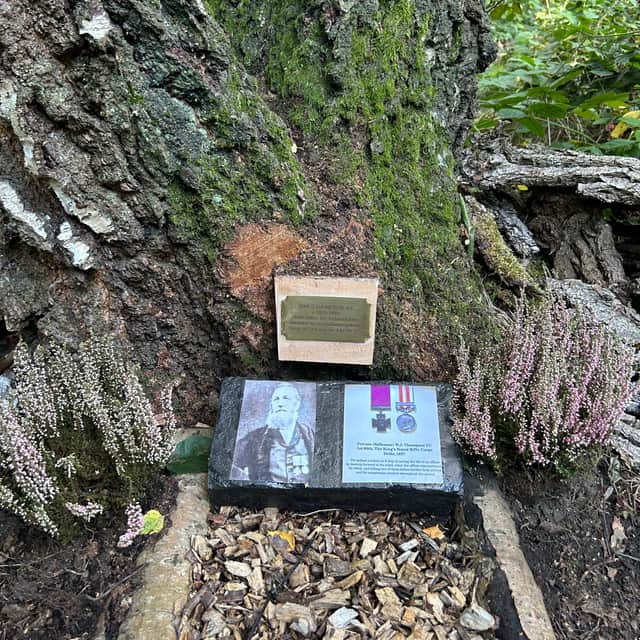
Thanks to Mr Clayton’s efforts, a small memorial outlining his heroics has been placed at the foot of a tree 20ft from the grave, and there is a blue plaque near the entrance to the cemetery.
Thompson’s VC and his Indian Mutiny Medal were owned shortly after his death by a Alexander Duncan of Penarth. but now belong to the Royal Green Jackets Museum in Winchester.
There is a small memorial plaque in St Peter's Church, Yoxall, commemorating his gallant conduct.
Comment Guidelines
Iconic Media encourages reader discussion on our stories. User feedback, insights and back-and-forth exchanges add a rich layer of context to reporting. Please review our Community Guidelines before commenting.