
Walsall plans approved despite protests from green-belt campaigners

Walsall Council’s draft plan approved, and now goes out to consultation
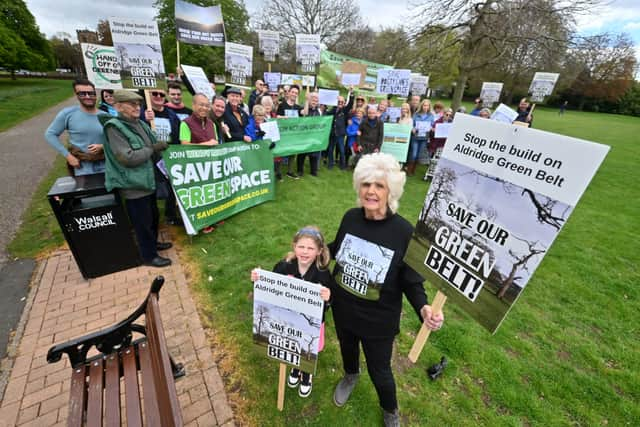
Green-belt campaigners staged a protest outside Walsall Council House last night (Wednesday) ahead of a meeting to discuss plans for meeting the Government’s housing targets.
The campaigners were asking the council’s cabinet to delay the decision on its draft plan, which will set out land-use policy in the borough for the next 15 years.
The Government has told Walsall Council it must build an average of 1,168 homes a year by 2042 to meet its housing requirements.
The new Reform administration has put together a revised plan which it said would address concerns about protecting the green belt. But Wendy Morton, Conservative MP for Aldridge-Brownhills, said the new plan did not go far enough and called on the council to challenge the Government over its targets.
The revised plan was approved in principle at last night’s meeting, and will now go out for consultation, where residents will be invited to make representations before a final version is submitted to the Government in December.
Campaigner David Smith asked the council to delay the decision, so that brownfield sites put forward by the protesters could be considered.
The Reform administration said it had inherited a mess, and would have a plan enforced on it by the Government if it did not submit one of its own by December.
It has met with local campaign groups to listen to their concerns and made some changes to the Plan, but Mr Smith said it has also added further green belt sites into the plan to make up for the area lost.

“The protesters are adamant that the changes have not gone far enough and that the council has moved forward to the next stage of consultation without giving enough notice of the outcome of the previous consultation and its response to it,” he said.
“They are protesting that green-belt sites included in the local plan are not appropriate for housing and that there has been too much concentration on the provision of land for business and employment.”
Mr Smith said campaigners were not objecting to all the sites in the plan, only those they considered inappropriate for housing.
“They want to see low-cost housing built to meet the needs of local people, particularly first-time buyers who need to be given an opportunity to start on the housing ladder,” he said.
“They believe that some of the land that has been allocated for business and employment use would be better allocated to use for house building as an alternative to building at inappropriate locations in Walsall’s green belt.”
They also called for the Government to reconsider its housing targets, saying that Walsall had been disproportionately affected.
“How can it be right for Walsall to be asked to do the heavy lifting when there are thousands of square miles of brownfield sites in the West Midlands that could be developed?” said Mr Smith.
A spokesman for the council said it had taken a ‘brownfield first’ approach, but said previously developed land could only account for about a quarter of the housing requirement.
The council said the revised plan took into consideration the concerns expressed about a previous version of the plan, put forward last year.
Consultation on the new plan opens on September 14, giving residents and businesses the opportunity to have their say on whether they believe it has been prepared correctly and whether it meets the national tests required for approval.
Why public notices matter – and how to find them
Have you ever discovered that a new development has been approved near your home and wished you had known about it sooner? Or found out about a road closure only after setting off on a journey?
Public notices exist precisely to prevent that – and if you know where to look, they can help you stay one step ahead.
What are public notices?
Public notices are official announcements made by councils, local authorities, businesses and individuals to inform communities of proposals, decisions and changes that may affect everyday life.
They are not just bureaucratic paperwork – they are a legal safeguard, giving every member of the public a fair and timely opportunity to respond before a decision is finalised.
Where can you find them?
An easy place to find public notices is the Public Notice Portal – a free, fully searchable platform where you can look up notices by postcode, category or local authority.
You can also register for email alerts, choosing to receive updates daily, weekly or monthly, so relevant notices land directly in your inbox.
Notices also continue to appear in local newspapers, such as the Express & Star, both in print and online.
Who can post a notice – and how?
Notices on the portal are submitted by registered local news publishers on behalf of those who need them placed.
This could be a solicitor administering a will, a business applying for a licence, or a local council giving notice of a planning application or road closure.
How does the Public Notice Portal work?
Local news publishers including Express & Star contribute upload all the notices that appear in their printed newspaper titles to the portal, which displays nearly 14,000 live notices at any given time.
Why do public notices matter?
Public notices underpin local democracy. They ensure transparency and accountability, giving communities the chance to engage with decisions that might otherwise pass unnoticed – from a proposed housing development to a change in local licensing.
Without them, the power to shape your local area would rest entirely with the decision-makers, not the people most affected.
Types of public notice
The Public Notice Portal organises notices into eight categories.
Planning – applications for new buildings, extensions and changes of use. If a developer submits plans to build new homes in an area of the West Midlands, you can search the public notice portal by postcode to find the application and submit your comments before the deadline.
Traffic and roads – road closures, diversions, parking changes and speed limit alterations.
Alcohol and licensing – applications by pubs, restaurants, shops and event organisers to sell alcohol or hold licensable events. If a new venue is applying for a licence, you can find the notice on the portal and raise any concerns with the licensing authority within the stated timeframe.
Goods vehicle licensing, probate and trustee, contract and tender, statutory notices and other discretionary notices are also covered – making the portal a single, reliable destination for the full range of official public announcements.
To search for public notices in your area, visit publicnoticeportal.uk
Comment Guidelines
Iconic Media encourages reader discussion on our stories. User feedback, insights and back-and-forth exchanges add a rich layer of context to reporting. Please review our Community Guidelines before commenting.