
Grit mountain builds up due to mild winter
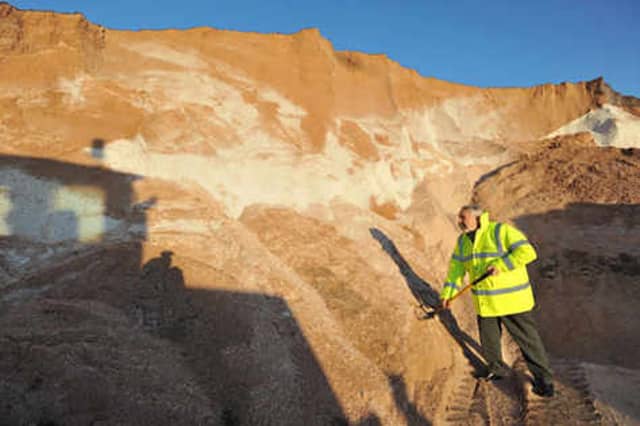

A grit mountain has built up in Staffordshire and the West Midlands, meaning there is surplus stock available for the current cold snap.
A grit mountain has built up in Staffordshire and the West Midlands, meaning there is surplus stock available for the current cold snap.
Councils today revealed their fleets of gritting trucks have up to now been out on the roads half as many times this year compared to last, due to mild winter temperatures.
Bosses are hopeful they will have salt to carry over for next year, despite Britain bracing itself for snow this weekend as bitterly cold weather grips the country.
In Staffordshire just 12,000 tons of grit have been used along almost 2,000 miles of road which the county council treats. Highways boss, county councillor Mike
Maryon, said today: "By the same time last year we had used 24,800 tons but the weather conditions were much more severe."
He added the council had invested in 10,000 tons of "strategic stock" which could be kept covered for up to five years and used in the next season "unless we need to use it before then".
Walsall transport boss Tom Ansell said: "So far this winter we have used 520 tons of salt compared to 2,206 tons by the same time last year.
"There will be no wastage of the salt stock and any surplus left over at the end of the winter will be kept in storage for the following season."
Gritting teams have been out in Wolverhampton 24 times so far this winter, down from 60 at the same stage by February 2011.
Wolverhampton City Council spokesman Paul Brown said: "We currently have around 3,500 tons of grit in stock, enough for almost 100 call outs.
"We have an additional 400 tons on standby should it be required. Any grit not used this winter will be retained for use next winter."
Chiefs in Sandwell say they cannot predict whether there will be a surplus, although crews have so far been sent out on 24 occasions compared to 70. The authority has 5,600 tons of salt, more than double the 2,080 tons this time last year.
Dudley transport boss Patrick Harley said crews had been out 27 times since their first call on November 27. Last year the first treatment was on October 19 and by the start of February teams had been out on 51 days.
The council still has 5,000 of 6,500 tons in stock.
The current cold snap has seen daytime temperatures plummet four or five degrees lower than average for February – traditionally the coldest month of the year.
Forecasters said Saturday will see a cold front sweep south and east across the UK from the west, resulting in snow where slightly milder air meets cold air.
Respite from the big freeze is not expected until Monday, when milder temperatures are expected, along with frost overnight.
Meanwhile, across Europe a severe cold spell has been causing chaos. Rescue helicopters evacuated dozens of people from snow-blocked villages in Serbia and Bosnia and airlifted in emergency food and medicine. The death toll from the cold rose to 83 yesterday and emergency crews worked overtime as temperatures sank to minus 32.5 C (minus 26.5 F) in some areas.
Parts of the Black Sea froze near the Romanian coastline and rare snow fell on Croatian islands in the Adriatic Sea. In Bulgaria, 16 towns recorded their lowest temperatures since records started 100 years ago as four more people were reported dead from hypothermia.
In central Serbia, helicopters pulled out 12 people, including nine who went to a funeral but then could not get back over icy, snow-choked roads.