
Pearl dish spotted by accident turns out to be an ancient treasure worth thousands
A unique dish that was spotted on a sideboard in a Staffordshire home could achieve up to £15,000 at auction after turning out to be a centuries-old treasure.
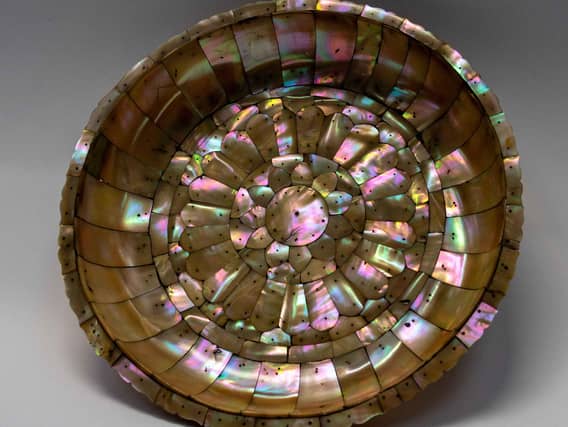


The intricate bowl, that was of little value to its owner, was spotted by Charles Hanson, owner of Hansons Antiques, when he visited the house, near Lichfield, to inspect some French glass and jewellery.
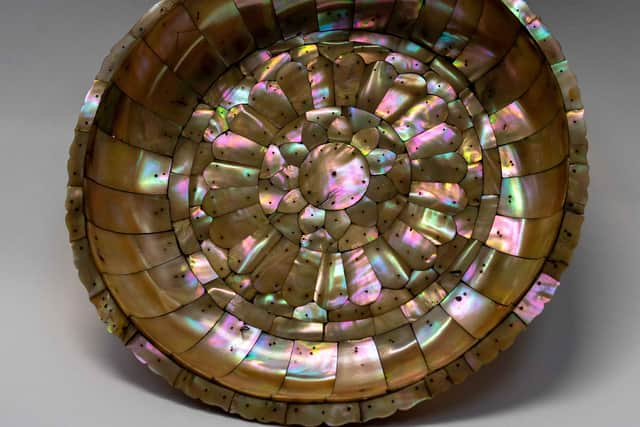
He identified the bowl as a highly valuable Elizabethan mother-of-pearl Indo-Portuguese object of cultural significance, believed to have been crafted in Gujarat on the western coast of India in the late 16th or early 17th century.
It is thought to be a rare survivor of wares popular with the wealthy elite and royalty during the days of the Portuguese Empire.
The owner said her husband had acquired the dish in London in the 70s, and had 'no idea' of its potential value.
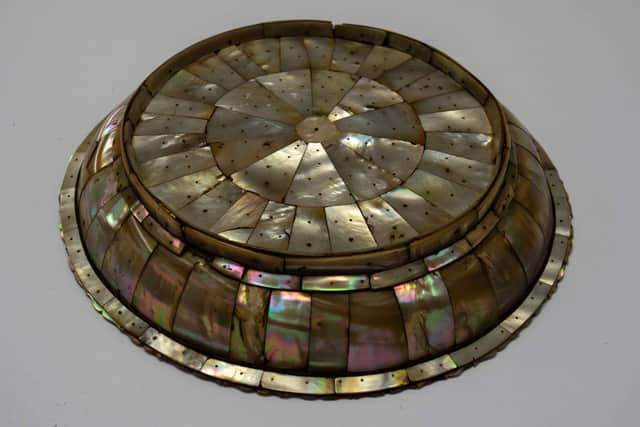
Mr Hanson believed it was brought to the UK by a British merchant for a royal or noble household around 400 years ago.
Henry VIII was among royals who liked ornate wares 'from the Indies' and similar mother-of-pearl overlayed items can be seen at London's Victoria and Albert Museum.
It is expected to be sold for £10,000 - £15,000 when it goes under the hammer in September.
The antiques expert said: "I’d been called in to inspect some French glass and jewellery but spotted the dish out of the corner of my eye sitting on a sideboard. The owner was a little dismissive.
"It was a scarce luxury object then and now. And we have the Portuguese to thank for this trend because when their country’s empire was at its height, its people commissioned mother-of-pearl wares.
“In 1498 Portuguese explorer Vasco da Gama became the first European to reach India by sea and in 1505 Portuguese India was founded. It was da Gama who may have sparked the passion for these decorative objects. Gujarat is first mentioned as the centre of mother-of- pearl work in 1502 when the King of Melinde, on the East Coast of Africa, presented da Gama with a gold and mother of pearl bedstead. Indo-Portuguese mother-of-pearl objects were brought to Europe by merchants from around 1525.
"Henry VIII was charmed by exotic goods from 'the Indies', and mother-of-pearl objects were presented as New Year gift in Tudor times.
“In 1534 Thomas Cromwell gave Henry VIII a mother-of-pearl ewer set in gold and Queen Elizabeth I was presented with a ewer and basin embellished with mother-of-pearl.
“The fragility of items like this mean few survive but a Staffordshire sideboard has proved to be a safe haven. A similar example, circa 1540, can be seen in the Green Vault, a museum in Dresden, Germany."
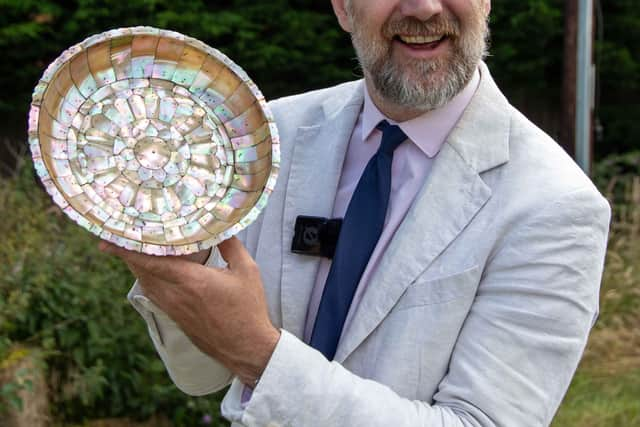
The mother-of-pearl dish, which is 26cm in diameter, will go under the hammer Hansons Auctioneers’ September 26-27 Fine Art Auction in Derbyshire. Further entries invited.