
'St George's Day should be a day for celebrating the positives - not arguing over a flag'

Our country is great, from Cornish pasties to Shakespeare, Magna Carta and Marmite - so why has the English flag become so toxic?
St George’s Day should be embraced as a chance to enjoy shared values and identity.
That is the plea from a new campaign to mark the arrival of England’s national day and reclaim the flag as a source of unity and pride.
Singer and activist Billy Bragg is among those calling on people to make today one for celebration and to "resist hateful division".
He is supporting a campaign promoting unity on the England patron saint's day.
Last summer there was community anxiety about the flying of St George's and Union flags, following an online campaign called Operation Raise The Colours, which became contentious and resulted in several local authorities removing them from public infrastructure.
The situation is currently causing tensions in Shropshire, where the council has spoken of its intention to remove the flags only for more flags to be erected.
In Walsall, the council has decided it wants to remove flags from Brownhills 'Jigger Island' and replace them with a 'managed display' that incorporates national flags along with the Black Country flag.
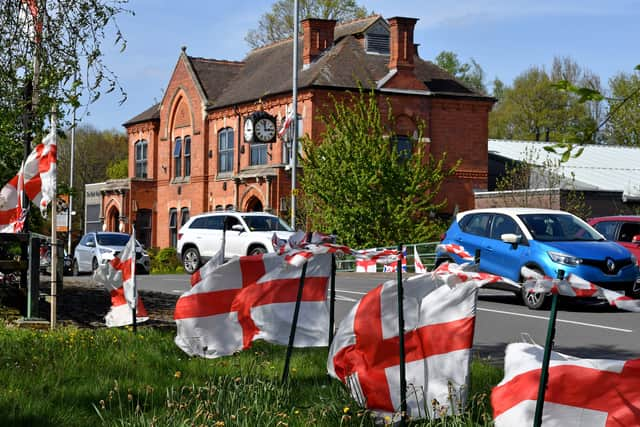

While some politicians have decried the removal of flags, others have claimed the increased number being flown was a result of xenophobia or racism.
Bragg, alongside former Conservative MP Sir Sajid Javid , is supporting a new campaign encouraging English people to celebrate what they share in common, with the launch of a "virtual pocket museum" of beloved and notable objects, people or events symbolising Englishness.
From Cornish pasties to Shakespeare, and the Magna Carta to Marmite, 3,000 ideas from members of the public were whittled down to 50 which feature in the pocket museum in the form of a deck of cards, wall posters, tea towels and T-shirts.
Giant outdoor screen projections were today being displayed at Toynbee Hall in Aldgate, in London's East End, telling "The story of England 2026 in 50 objects", as part of the campaign which is run by social enterprise Grow Social Capital with the support of the Jo Cox Foundation's More in Common and other social cohesion groups.

Bragg, who last month took part in a demonstration in London against the far right, said: "St George's Day should be a day for celebrating the positive things we have in common - a day for recognising the sense of community that comes from the identity and values that we share in this place called England .
"Through listening to each other, we can find that common ground from which to resist hateful division."
Sir Sajid said: "St George's Day is a great day to celebrate what we all have in common. When people talk about what they value, what they trust, and what they share, it becomes easier to build understanding. I'm glad my suggestions of the local bobby and war memorials made the final cut."
Separately, research for the British Future think tank suggested four in 10 people in England said they would not display an England flag for fear of appearing to support the far right.
The survey, carried out by Focaldata in February 2026 , used a nationally representative sample of 2,426 adults in England , including 684 respondents from an ethnic minority background.
The majority (81 per cent) of those surveyed agreed that they disliked it when the English flag is linked to racism or used to intimidate minorities.
Sunder Katwala, British Future director, said: "We've seen this year how national symbols can polarise opinion: some see flags on lampposts as expressing national pride while others intend or perceive a more prejudiced message.
“Those arguments can overshadow what most people agree on. We should be able to celebrate England's past, present and future - and we do that best when we express pride without prejudice, inviting everybody who calls England home to feel part of St George's Day."
St George’s Day facts
1. St George wasn’t English. He might be our national patron, but St George was likely a Greek-speaker who lived and died in the Roman Near East. A Christian, he died a martyr’s death in about AD 303.
2. He wasn’t a knight either. Whilst St George was depicted from the 11th century as a chilvaric knight or a warrior on horseback, it is more likely that he was an officer in the Roman army.
3. St George was a martyr. He died for his Christian faith in the early years of the fourth century during the persecution initiated by the Emperor Diocletian. He is still commemorated by Christians as St George the Martyr.

4. He never visited England He never came here, but he was celebrated in England from at least the early 8th century. St George’s cross become England’s national flag in the early 16th century.
5. England isn’t the only country to celebrate St George. According to English Heritage, our country shares St George with Venice, Genoa, Portugal, Ethiopia and Catalonia among many others.
Comment Guidelines
Iconic Media encourages reader discussion on our stories. User feedback, insights and back-and-forth exchanges add a rich layer of context to reporting. Please review our Community Guidelines before commenting.