
Fast food: World's quickest creature spotted eating a gull for breakfast on pylon in West Bromwich
A keen birdwatcher is thrilled by his "spot of the year" after photographing the world's fastest animal on a pylon in West Bromwich.
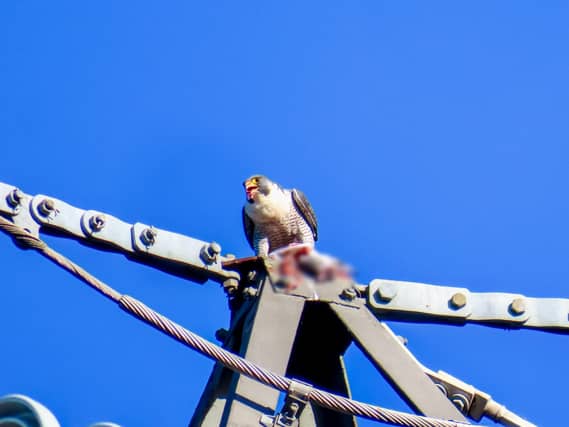

Ian Farnell spotted the peregrine falcon on the pylon at around 9am on Sunday and used his camera to zoom in and watch as the bird ate its breakfast - a gull.
When it had finished with its prey, it flew away, leaving a magpie to finish off the leftovers.
Another falcon was spotted flying away from the pylon, leading Ian to suspect the two birds were a mating pair.
Ian has seen an array of incredible birds in the area, from woodpeckers and goldcrests to buzzards and a sparrowhawk, but had never seen a peregrine falcon in West Bromwich before.
The 35-year-old said: "It was absolutely incredible. This is definitely my spot of the year. I still can't believe I saw it - on a pylon in West Bromwich, of all places.
"It's really interesting to see birds that we might typically associate with the countryside adapting to urban areas.
"We know there are falcons in Leamington, for instance, so seeing them elsewhere in the Midlands shows that they must be doing quite well in these environments.
"However, it raises questions about why these birds have to hunt in these urban areas and whether we as humans have colonised spaces that were once their hunting grounds."
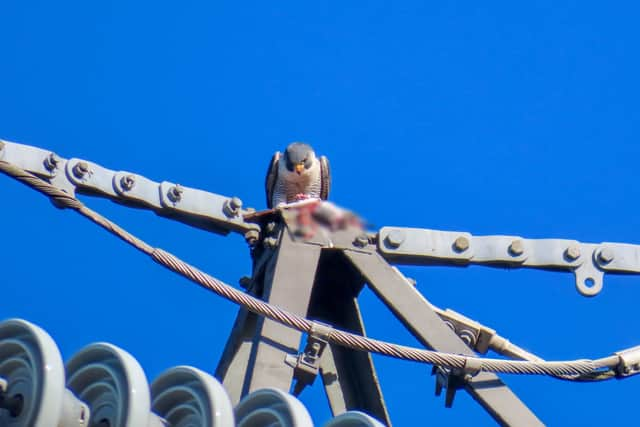
While cheetahs are widely known to be the fastest land animal on Earth, peregrine falcons are the quickest creatures on the planet and have a maximum speed three times greater than that of a cheetah.
The impressive bird of prey can cruise through the sky at 40 to 60mph, but when diving, can reach speeds of more than 240mph. Meanwhile, the top speed of a cheetah is around 69 to 75mph.
Also known as the 'duck hawk', peregrine falcons have a wingspan of 1.2m and an average life expectancy of six years.
Despite their numbers having previously plummeted drastically due to persecution, these birds of prey are now making a comeback and will often nest on tall buildings in urban areas.
In the UK they are classified as 'green' under the Birds of Conservation Concern 5: the Red List for Birds (2021).
Peregrine falcons are protected in the UK under the Wildlife and Countryside Act, 1981.
Comment Guidelines
Iconic Media encourages reader discussion on our stories. User feedback, insights and back-and-forth exchanges add a rich layer of context to reporting. Please review our Community Guidelines before commenting.